
A buyer recently walks into a sales office after finding what looks like a very attractive 3 BHK in Shela.
The advertised price is ₹72 lakh.
The buyer thinks, “My budget is ₹75 lakh. This should work.”
Then the salesperson starts adding numbers.
Parking. Floor-rise charges. Location charges. Maintenance deposit. Registration. Stamp duty. GST, where applicable. Interiors.
Suddenly, the ₹72 lakh apartment is no longer a ₹72 lakh decision.
This is the mistake I want buyers to avoid.
When people search for the 3 BHK flat price in Shela, they usually want one number. Real estate does not work that way. The advertised apartment price is only the beginning of the calculation, which is why understanding the cost of buying a 3 BHK in Shela is important before setting your actual purchase budget.
Current Shela listings demonstrate how wide the market can be. Housing.com was showing more than 1,450 listed 3 BHK flats in Shela in July 2026, with examples ranging from around ₹60 lakh to ₹1 crore-plus. Magicbricks’ Q2 2026 data showed 3 BHK asking rates of roughly ₹3,900–₹5,500 per sq ft in Shela.
That variation is not necessarily a problem.
It is a warning.
A ₹65 lakh 3 BHK and a ₹95 lakh 3 BHK may be completely different products in terms of carpet area, construction stage, location, specifications, builder, amenities, possession and resale potential.
So the real question is not:
“What is the 3 BHK flat price in Shela?”
It is:
“What will this particular 3 BHK actually cost me from booking to possession, and is that total cost justified by what I am getting?”
That is what this guide will help you calculate.

Why the Advertised Price Is Not the Real Cost
The most dangerous property price is the one that looks affordable before you have the complete cost sheet.
For example, imagine a 3 BHK advertised at:
₹72 lakh
A buyer may mentally calculate:
₹72 lakh + home loan = done.
It is not done.
The final cost can include several additional components.
Depending on the project and transaction, you may have to account for:
- Base apartment price
- GST, where applicable
- Stamp duty
- Registration charges
- Parking
- Floor-rise charges
- Preferential-location charges
- Maintenance deposit
- Clubhouse/amenity charges
- Legal/documentation charges
- Electricity and water-related charges
- Brokerage in some resale transactions
- Home-loan processing and related charges
- Interiors
- Appliances
- Moving expenses
- Initial repairs or modifications
Not every charge applies to every property.
That is exactly why you should never assume a fixed percentage for the entire market.
Ask the seller for a written, property-specific cost sheet.
What Is the 3 BHK Flat Price in Shela in 2026?
There is no single Shela price.
Current market data shows a broad range.
Magicbricks’ July 2026 locality data puts the average multistorey apartment asking level in Shela at about ₹5,125/sq ft, with a reported range of approximately ₹4,051–₹6,198/sq ft across its locality data. For 3 BHK apartments specifically, it shows roughly ₹3,900–₹5,500/sq ft. These figures are useful for understanding 3 BHK buying costs in Shela, but buyers should also account for carpet area, floor, project quality, parking, registration charges and other additional costs before comparing properties.
Magicbricks also reported an average 3 BHK asking level of about ₹4,869/sq ft for Shela in April–June 2026.
Housing.com’s July 2026 listings show the practical spread even more clearly:
- Sun Parkwest: around ₹60–68 lakh
- Rashmi Riesen: around ₹72 lakh
- Sun Skyview: around ₹68.9–95 lakh
- Vishwanath Maher Select: around ₹86–88.3 lakh
- The Planet by Venus: around ₹94.7 lakh
- Kavisha The Portrait: around ₹1.1 crore and above in listed configurations
These are asking/listing prices, not proof of final registered transaction prices.
That distinction is extremely important.
A portal can tell you what sellers are asking.
It cannot automatically tell you what a particular buyer finally paid.
My practical interpretation
| Approx. Advertised Range | What You Should Investigate |
|---|---|
| ₹60–70 lakh | Carpet area, project location, specifications, possession timeline, and total cost |
| ₹70–80 lakh | Whether the apartment offers genuinely better usable space and value |
| ₹80–95 lakh | Builder quality, location, amenities, construction quality, and resale justification |
| ₹1 crore+ | Whether the premium is actually supported by product quality and buyer demand |
These are market-observation bands, not official valuation bands.
Do not use them as a substitute for comparing the exact apartment you are considering.
The First Cost Trap: Super Built-Up vs Carpet Area
This is one of the most important calculations in the entire purchase.
Suppose two apartments are advertised as:
Apartment A
- Price: ₹72 lakh
- Super built-up: 1,750 sq ft
- Carpet: 950 sq ft
Apartment B
- Price: ₹78 lakh
- Super built-up: 1,600 sq ft
- Carpet: 1,020 sq ft
At first glance, Apartment A looks cheaper.
But Apartment B provides more usable carpet area.
That is why I would never compare two 3 BHKs solely using the advertised ₹/sq ft.
Read More:- Is Shela a Good Place to Buy a 3 BHK in 2026?
You need to compare:
Total cost ÷ carpet area
This does not solve every comparison problem, but it gives you a much more useful starting point.
One current Shela resale listing illustrates the issue: a 3 BHK advertised at ₹77 lakh had a listed built-up area of 1,760 sq ft but a carpet area of 968 sq ft.
That is exactly why buyers should ask:
“What is the carpet area?”
before getting excited about the headline size.
The Second Cost Trap: Government Charges
A property transaction also involves statutory charges. In Gujarat, the Revenue Department provides online services covering document registration, Jantri rates, property cards and land records, which can help buyers better understand 3 BHK buying costs in Shela before finalising a property purchase.
The important point is this:
Do not estimate these charges casually from a broker’s WhatsApp message.
Ask for the applicable calculation for your actual transaction.
For a resale property, the calculation can differ from an under-construction purchase.
For an under-construction property, tax treatment can also depend on the project’s status and applicable rules.
So your final budget should have a separate line called:
Government/statutory charges — verified for this transaction
not a guessed number.
The Third Cost Trap: Parking
Parking is often treated as a minor detail.
It should not be.
Ask:
- Is one parking space included?
- Is it allotted or only mentioned?
- Is it covered?
- Is it mechanically operated?
- Is visitor parking available?
- What are the society’s parking rules?
- Is the quoted amount for the apartment inclusive of parking?
A ₹72 lakh apartment with a parking-related cost that pushes the final deal substantially higher is not really a ₹72 lakh purchase.
The buyer should compare the complete acquisition cost.
The Fourth Cost Trap: Floor-Rise and Location Charges
You may be quoted a base price such as:
₹4,500/sq ft
Then discover that a higher floor attracts an additional charge.
A preferred-facing apartment may attract another charge.
A corner unit may have another premium.
A preferred stack may have another premium.
None of these are automatically unreasonable.
But you need to know them before comparing projects.
A common mistake is comparing:
Project A base price
with
Project B all-inclusive price.
That comparison is meaningless.
The Fifth Cost Trap: Maintenance and Clubhouse Charges
New projects often have attractive amenities.
Swimming pool.
Gym.
Clubhouse.
Landscape areas.
Children’s play area.
Sports facilities.
But amenities are not free to operate.
Ask about:
- Initial maintenance deposit
- Monthly maintenance
- Clubhouse charges
- Corpus fund
- Sinking fund
- Facility charges
- Security
- Water
- Common electricity
A buyer who focuses only on the purchase price can underestimate the ongoing ownership cost.
For a large 3 BHK, recurring maintenance can matter significantly over a 5–10 year holding period.
The Sixth Cost Trap: Interiors
This is where many families quietly break their original budget.
You buy the apartment for ₹75 lakh.
Then you need:
- Modular kitchen
- Wardrobes
- Electrical work
- Lights
- Fans
- Curtains/blinds
- TV units
- Bathroom accessories
- Furniture
- Appliances
- Air conditioners
- Storage
Suddenly the family has spent another substantial amount.
The amount varies enormously depending on specification and lifestyle.
Therefore, I would not recommend using one universal “interior cost per sq ft” number.
Instead, prepare an actual room-by-room budget before booking.
My rule
If you cannot afford:
Apartment + transaction costs + basic interiors + emergency reserve
you probably cannot comfortably afford the apartment.
What the Real Cost Could Look Like
Let’s use an illustrative example, not a quotation.
Suppose:
Base apartment price: ₹72 lakh
Then assume the buyer has separately budgeted for:
- Government charges: transaction-specific
- Parking: project-specific
- Maintenance/corpus: project-specific
- Other charges: project-specific
- Interiors: ₹7–10 lakh, depending on specification
- Loan-related costs: lender-specific
The final ownership budget could therefore move materially above ₹72 lakh.
That is why I would tell a buyer with a ₹75 lakh maximum total budget not to shop for ₹75 lakh apartments.
I would leave a buffer.
The exact buffer depends on the property, financing and transaction structure.
Step-by-Step Buyer Action Plan
Step 1: Choose the Location Before the Apartment
A cheap 3 BHK in the wrong part of Shela is not a bargain.
Before comparing apartments, investigate:
- Approach road
- Traffic
- Public transport
- Schools
- Hospitals
- Grocery and daily retail
- Nearby employment areas
- Street lighting
- Drainage
- Water
- Surrounding construction
- Future development
- Noise
- Road widening or planning issues where relevant
Visit at different times.
I would especially check:
Morning commute + evening return journey.
The apartment may look excellent at 11 AM on Sunday.
Your family may experience it very differently at 8:30 AM on Monday.
Step 2: Validate the Price Properly
This is where you should use the current 3 BHK flat price in Shela data — but carefully.
Use portals to create a shortlist.
Then compare:
Project A
₹72 lakh
Project B
₹78 lakh
Project C
₹86 lakh
Do not stop there.
Add:
- Carpet area
- Possession
- Age
- Builder
- Construction stage
- Amenities
- Parking
- Maintenance
- Location
- Resale demand
Then calculate the effective cost.
For example:
₹72 lakh ÷ 950 sq ft carpet = approximately ₹7,579 per carpet sq ft
That number may look very different from the project’s advertised ₹4,000–₹5,000 per sq ft based on another area definition.
That is precisely why buyers get confused.
Step 3: Verify the Builder and RERA
If the project is under construction, independently check its RERA information.
Do not rely on:
“Sir, RERA approved hai.”
Check the registered project information yourself.
Housing.com currently identifies many Shela listings as RERA projects, but a property portal’s label should still be followed by verification against the official record.
Check:
- Promoter
- Registration number
- Project name
- Development details
- Possession timeline
- Registered information
- Updates/extensions where applicable
Then investigate the builder’s completed projects.
Red flag
If the salesperson becomes uncomfortable when you ask for documentation, slow down.
You are not being difficult.
You are spending tens of lakhs.
Step 4: Inspect the Actual Apartment
Do not allow the sales presentation to become the site inspection.
Check:
Apartment
- Carpet area
- Room dimensions
- Ventilation
- Natural light
- Balcony usability
- Kitchen
- Storage
- Bathroom layout
- Windows
- AC provisions
Building
- Lift
- Fire safety provisions
- Parking
- Water
- Power backup
- Common areas
- Security
- Construction quality
Society
If occupied, speak to residents.
Ask:
“What is the biggest problem you have faced here?”
That question is more useful than:
“Are you happy with the amenities?”
Step 5: Legal and Registry Checks
For a purchase this large, I strongly recommend professional legal review.
Check:
- Title
- Ownership
- Encumbrances
- Approved plans
- RERA documents
- Agreement
- Permissions
- Property tax
- Relevant land records
- Sale deed/registration documentation
Gujarat’s Revenue Department provides online access to services including document registration, land records and property cards.
Important distinction
Jantri value is not automatically the same thing as market value.
Use government valuation information for the purposes it serves.
Do not tell readers:
“Jantri is ₹X, therefore the apartment’s market value must be ₹X.”
That is an oversimplification.
Step 6: Negotiate the Total Cost, Not the Brochure Price
Imagine the seller offers:
₹3 lakh discount.
Sounds good.
But then you discover:
- Parking is extra
- Location premium is extra
- Maintenance is extra
- Other charges are extra
The ₹3 lakh discount may not actually make the deal competitive.
I would negotiate using one sentence:
“Give me the final all-inclusive cost in writing, and I will compare it with two alternatives.”
That changes the conversation.
You are no longer negotiating emotionally.
You are comparing numbers.
A Simple Real-Cost Calculation
Total acquisition cost
Apartment price
- applicable taxes
- stamp duty
- registration
- parking
- floor/location charges
- maintenance/corpus
- other project charges
- brokerage, if applicable
- legal/documentation costs
- loan-related costs
- basic interiors
- immediate furnishing/appliances
= Real first-year ownership cost
Ongoing annual cost
- EMI interest
- Maintenance
- Property tax
- Insurance
- Repairs
- Utilities
- Society charges
This is the number you should compare with renting.
End-User Case Study: Family Buyer
The following is an illustrative scenario, not a claimed client transaction.
A family has:
Maximum comfortable housing budget: ₹85 lakh
They initially shortlist a new 3 BHK advertised at:
₹73 lakh
After calculating the transaction costs, parking, maintenance-related payments and basic interiors, their expected first-year outlay moves close to their upper comfort limit.
They then compare it with a ready/resale 3 BHK priced around:
₹76 lakh
The resale apartment has:
- Established society
- Existing residents
- Known maintenance
- Immediate possession
- More predictable surroundings
Suppose the family later values the apartment at around ₹88–90 lakh based on comparable asking prices.
The important outcome is not the ₹12–14 lakh theoretical appreciation.
The important outcome is that they avoided overextending themselves.
Lesson
The cheapest advertised 3 BHK is not necessarily the cheapest home to own.
Investor Case Study
Again, this is an illustrative calculation, not a historical client claim.
Suppose an investor buys a 3 BHK for:
₹72 lakh
Assume rent of:
₹23,000/month
Annual gross rent:
₹2.76 lakh
Gross rental yield:
₹2.76 lakh ÷ ₹72 lakh = approximately 3.8%
After vacancy, maintenance, repairs and other costs, the actual net yield would be lower.
Now assume the property appreciates to:
₹86 lakh
The gross capital appreciation is:
₹14 lakh
But the investor must still consider:
- Buying costs
- Selling costs
- Taxes
- Financing
- Maintenance
- Vacancy
- Inflation
What worked?
A reasonable entry price and actual rental demand.
What didn’t?
The property did not magically produce extraordinary annual returns.
Exit strategy
The investor should target genuine end-user demand rather than relying on another investor paying an inflated price.
What Current Market Data Tells Us
The most useful thing about current Shela data is not a single average.
It is the spread.
Housing.com showed more than 1,450 3 BHK flat listings in Shela as of July 2026. Its current examples include properties around ₹60–68 lakh, ₹72 lakh, ₹86–88 lakh, ₹94.7 lakh and ₹1.1 crore-plus.
Magicbricks reported 3 BHK asking rates of roughly ₹3,900–₹5,500/sq ft in its July 2026 Shela data.
Another Magicbricks series showed the average 3 BHK asking rate at approximately ₹4,869/sq ft in Q2 2026.
These sources differ because their datasets, listings and methodologies can differ.
That is normal.
I would therefore use portals for:
market discovery + comparison
not:
final valuation.
For a serious purchase, cross-check the asking price against comparable properties, resale evidence and available registration information.
Social Proof: What Buyers Should Learn From
The following are illustrative testimonial examples, not verified client testimonials. They should only be presented as real testimonials if you replace them with genuine buyer statements.
IT Professional
“I thought the apartment was ₹75 lakh. Once I calculated everything, my real budget was closer to ₹84 lakh. That changed which projects I considered.”
PSU Employee
“I was comparing projects by super built-up area. When I switched to carpet area, one of the expensive-looking apartments actually became better value.”
NRI Buyer
“I was more worried about paperwork than the price. I used independent legal verification before transferring a significant amount, and that gave me much more confidence.”
These stories are useful because they teach a buyer what to check, rather than simply telling them where to buy.
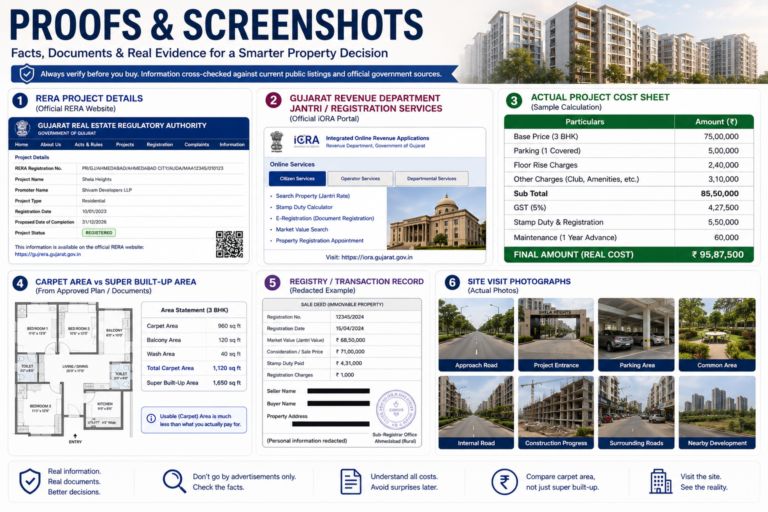
Proofs & Screenshot
Who This Guide Is NOT For
I would not use this guide as justification for buying property if you:
- Want a quick flip
- Expect guaranteed appreciation
- Are buying based on rumors
- Need to stretch your finances
- Have no emergency fund
- Are uncertain about staying in Ahmedabad
- Have not verified the documents
- Are buying because a broker says prices will rise tomorrow
You should consider waiting if:
- Your entire savings would go into the down payment.
- Your EMI would leave little room for emergencies.
- You expect to move within two or three years.
- You are still unsure whether you need a 2 BHK or 3 BHK.
- You have not compared resale options.
- You are uncomfortable with the project’s documentation.
Renting may be better if:
- Your job location is uncertain.
- You are likely to relocate.
- You want flexibility.
- You can rent a comparable home significantly more cheaply than the total ownership cost.
- Buying a house is not automatically financially superior to renting.
If I Were Buying This Property Today
If I were buying a 3 BHK in Shela today, I would not start with the cheapest listing.
I would start with a target all-in budget.
Then I would work backward.
For example, if my maximum comfortable total budget were ₹85 lakh, I would not spend ₹85 lakh on the apartment itself.
I would reserve money for:
- Transaction costs
- Interiors
- Moving
- Emergency fund
- Initial ownership expenses
Which configuration would I choose?
A practical 3 BHK with:
- Strong carpet-area efficiency
- Good natural light
- Good ventilation
- Sensible room sizes
- One usable parking space
- Reliable building infrastructure
- Good access to daily needs
I would not pay a large premium simply for a bigger brochure size.
What would I negotiate hardest?
The final all-inclusive number.
I would ask for the complete cost sheet first.
Then I would compare that figure against at least two alternatives.
Would I buy now or wait?
I would buy now if the property passed the documentation checks and the negotiated all-in price was reasonable.
I would wait if:
- The seller refused transparency
- The project was materially overpriced
- The EMI stretched my finances
- The location did not work for my daily life
- The legal documents were unclear
- I was buying purely because of FOMO
The red flag I would not ignore
A surprisingly low headline price combined with an unclear cost sheet.
If someone cannot clearly explain why the apartment costs what it costs, I would not book it.
My Final Verdict
The 3 BHK flat price in Shela is not one number.
Current 2026 asking data shows a broad market, with 3 BHK listings spanning roughly ₹60 lakh to ₹1 crore-plus and portal-level 3 BHK asking rates around ₹3,900–₹5,500 per sq ft.
But the advertised price is only the first number.
The real cost is:
Purchase price + applicable government charges + project charges + parking + financing + interiors + initial ownership costs.
And even that does not tell you whether the property is a good buy.
You also need to ask:
What am I getting for that money?
A ₹70 lakh 3 BHK can be expensive.
A ₹85 lakh 3 BHK can be good value.
A ₹95 lakh 3 BHK can be justified.
Or all three could be poor purchases.
It depends on the property.
If you are currently comparing a 3 BHK in Shela, I would recommend making a simple one-page comparison of three properties before paying any token amount.
Record:
- Carpet area
- Total price
- All additional charges
- Final all-in cost
- ₹/carpet sq ft
- Possession
- Builder
- Location
- Maintenance
- Parking
- Legal status
- Resale/rental prospects
That one sheet can reveal more than ten property brochures.
FAQ: Real Questions About the Cost of a 3 BHK in Shela
What is the current 3 BHK flat price in Shela?
Is ₹70 lakh enough to buy a 3 BHK in Shela?
Should I buy the cheapest 3 BHK I can find?
Is a higher ₹/sq ft automatically bad?
Should I wait for prices to fall?
References
About the Author