
If you search online for a 3 BHK flat for sale in Shela, you will quickly see the same pattern: attractive photographs, large amenity lists, “limited-period” offers and claims about future appreciation.
Then you visit three projects and discover something completely different.
This is where buyers get into trouble.
In my view, the question in 2026 is not simply “Is Shela good?” It is:
“Is this particular 3 BHK in Shela worth the total price, in this particular location, from this particular developer, for my particular purpose?”
That distinction matters.
Current listing data shows a large and varied 3 BHK market in Shela. Housing.com was showing more than 1,400 listed 3 BHK flats in July 2026, with examples ranging from roughly ₹60–68 lakh to above ₹1 crore. With such a wide range of prices and property options, buyers should carefully consider whether a 3 BHK is right for you based on their budget, space requirements, location preferences, and long-term plans.
At the same time, market portals do not agree on one single “Shela price.” Magicbricks reported an average multistorey-apartment asking level of about ₹5,125/sq ft in Q2 2026, while Housing.com reported a broader locality average around ₹6,268/sq ft.
That variation is exactly why buyers should stop looking for one magical “Shela rate.”
The purpose of this guide is to help you decide whether buying a 3 BHK flat for sale in Shela makes sense for you — and when it does not.

Why Most Online Shela Property Articles Don't Help Real Buyers
Most property articles answer the easiest question:
“Why should you buy in Shela?”
A serious buyer needs answers to harder questions:
- Is the quoted price actually reasonable?
- What is the carpet area?
- What will I pay after all charges?
- How much of the surrounding development is already usable?
- Is the builder’s delivery history reliable?
- Is the apartment better for living or investing?
- What happens if I need to sell after five years?
- Will the rental demand support my expected return?
- Am I buying the apartment or simply buying a brochure?
These questions become especially important because Shela has a wide range of projects and configurations.
Current listings demonstrate that clearly. Some 3 BHK offerings are advertised below ₹75 lakh, while others are around ₹85–95 lakh or ₹1 crore and above.
Therefore, “3 BHK in Shela” is not one market.
There are different micro-markets, building ages, developers, carpet areas, and levels of surrounding infrastructure, so buyers should compare each property on its actual merits rather than assuming all 3 BHK flats in Shela offer the same value or living experience.
That is where your buying decision should begin.
The Real Problems Buyers Face in Shela
Price Confusion and Hidden Costs
Suppose a salesperson tells you:
“Sir, 3 BHK only ₹72 lakh.”
Do not celebrate yet.
Ask for the complete written cost sheet.
You need to know whether the quoted amount includes or excludes items such as:
- Base apartment price
- GST, where applicable
- Stamp duty
- Registration
- Parking
- Floor-rise charges
- Preferential-location charges
- Maintenance deposit
- Clubhouse or amenity charges
- Legal/documentation charges
- Electricity/water-related charges
- Other project-specific charges
The important number is not the brochure price.
It is the all-in acquisition cost.
A ₹72 lakh apartment that becomes ₹82–84 lakh after additions may be less attractive than an ₹77 lakh apartment with a cleaner cost structure.
My rule
Never compare two projects using only the headline price.
Compare:
Total acquisition cost ÷ usable carpet area
That gives you a much more meaningful comparison.
Fake Urgency
“Only two flats left.”
“Price increases tomorrow.”
“Last unit at this rate.”
“Builder meeting today.”
“Another customer is ready to book.”
Sometimes there really is limited inventory.
But urgency is not proof of value.
I would rather lose a supposedly “discounted” apartment than spend ₹80 lakh on the wrong apartment because someone gave me two hours to decide.
A genuine buyer should be able to say:
“Give me the complete cost sheet and documents. I will verify them before paying.”
If the response is pressure instead of documentation, that itself is useful information.
Builder Trust and Delivery Risk
A good-looking project can still be a bad purchase.
For an under-construction 3 BHK, investigate:
- RERA registration
- Promoter details
- Approved plans
- Promised possession
- Construction progress
- Project extensions, if any
- Litigation or title concerns
- Previous delivery history
- Quality of completed projects
- Maintenance performance after handover
Do not treat a RERA number as a substitute for due diligence.
RERA registration is an important verification step, not a guarantee that every aspect of a purchase is risk-free.
Wrong Location Selection
Two projects can both have a Shela, Ahmedabad address and provide very different living experiences.
Drive the route yourself.
Check:
- Approach road
- Traffic at peak hours
- Street lighting
- Drainage
- Water availability
- Nearby grocery stores
- Schools
- Hospitals
- Public transport
- Daily commute
- Noise
- Construction activity
- Future development around the project
A five-minute difference on a map can become a frustrating daily commute.
End-Use vs Investment Confusion
This is one of the biggest mistakes I see buyers make.
An end-user asks:
“Will my family enjoy living here?”
An investor asks:
“Can I rent and eventually sell it profitably?”
Those are different questions.
A large 3 BHK with excellent amenities may suit a family but produce mediocre rental yield.
A smaller, efficiently planned 3 BHK near established demand may be more attractive to an investor.
Do not buy an end-user property using an investor’s logic.
And do not buy an investment property simply because you personally love the apartment.
Read More:- What Makes a 5 BHK Apartment Truly Premium?
Step-by-Step Buyer Action Plan
Step 1: Location Selection
What to do
Before selecting a project, shortlist the micro-location.
Do not simply search “3 BHK flat for sale in Shela.”
Identify:
- Exact road
- Project access
- Distance from major roads
- Existing residential density
- Nearby schools and healthcare
- Daily retail
- Traffic conditions
- Future development
- Surrounding vacant land
- Quality of neighboring development
Why it matters
Infrastructure promised for the future cannot replace infrastructure you need today.
If your family requires a school, grocery store and hospital within a reasonable daily radius, evaluate what actually exists — not what a salesperson says will arrive.
Mistake to avoid
Do not buy purely because:
“This area will develop in five years.”
That statement has cost buyers plenty of money.
Pro tip
Visit the location:
7–9 AM, 1–3 PM and 6–9 PM.
One Sunday afternoon visit is not enough.
Step 2: Budget & Price Validation
Start with your maximum comfortable all-in budget, not your maximum loan eligibility.
For example:
If you can technically buy a ₹90 lakh apartment, that does not mean you should.
Consider:
- Down payment
- EMI
- Registration and transaction costs
- Interior expenses
- Emergency savings
- Maintenance
- Property tax
- Existing loans
- Education/family expenses
- Future financial commitments
What price should you expect?
Current online asking data shows significant variation.
Magicbricks’ July 2026 data puts 3 BHK asking prices in Shela around ₹3,900–₹5,500/sq ft, while Housing.com listings show individual projects at very different effective rates depending on configuration and project.
This is why I would not tell a buyer:
“The correct Shela rate is ₹X per sq ft.”
There is no single number that accurately describes every 3 BHK.
Mistake to avoid
Do not compare:
₹/sq ft on super built-up area
with
₹/sq ft on carpet area
without understanding the difference.
Pro tip
Ask every seller for:
- Carpet area
- Built-up area
- Super built-up area
- Total price
- All additional charges
Then compare apples with apples.
Step 3: Builder & RERA Verification
Before paying a booking amount, independently verify the project.
Check the project’s RERA record and compare:
- Registered promoter
- Project name
- Registration number
- Development status
- Approved information
- Completion/possession commitments
- Any available updates or extensions
Also investigate the developer’s previous projects.
Mistake to avoid
Do not accept:
“Sir, RERA hai, tension nahi.”
That is not due diligence.
Pro tip
Ask for documentation before booking.
If a salesperson says documents can be provided after the token payment, slow down.
Step 4: Site Visit Checklist
A site visit should be an inspection, not a sightseeing trip.
Check the actual apartment for:
Inside the apartment
- Carpet area
- Room dimensions
- Natural light
- Cross ventilation
- Balcony usability
- Kitchen size
- Storage
- Bathroom ventilation
- AC outdoor-unit locations
- Window quality
- Ceiling height
- Plumbing points
Outside
- Lift quality
- Fire exits
- Parking
- Visitor parking
- Security
- Garbage management
- Water systems
- Generator backup
- Common-area maintenance
- Construction quality
- Noise
Most important question
Ask residents if the project is occupied.
Then ask them:
“What is the one thing you don’t like about living here?”
You will often learn more from that answer than from a 45-minute sales presentation.
Step 5: Legal & Registry Checks
This is where buyers should become deliberately boring.
Check:
- Title documents
- Ownership
- Development rights
- Approved plans
- RERA information
- Encumbrances
- Property tax
- Relevant permissions
- Agreement documents
- Sale deed/registration requirements
- Society/association documentation where applicable
For resale properties, investigate the seller’s ownership chain and outstanding dues.
For under-construction properties, independently verify the project documentation.
Mistake to avoid
Never think:
“The bank approved the loan, so the property must be legally perfect.”
A bank’s due diligence is not a substitute for your own legal review.
Pro tip
For a major purchase, pay a qualified property lawyer to review the documents.
Spending a relatively small amount on legal verification can prevent a much larger problem.
Step 6: Negotiation Strategy
Do not negotiate only on the base price.
Negotiate the complete deal.
Ask about:
- Price
- Parking
- Floor-rise
- PLC
- Maintenance deposit
- Other charges
- Payment schedule
- Possession-linked terms
- Included specifications
- Documentation charges
A practical negotiation method
Do not say:
“Give me your best price.”
Instead say:
“I am ready to proceed if the final all-inclusive cost comes within ₹X and the documentation checks out.”
That signals seriousness without desperation.
Biggest mistake
Do not negotiate aggressively for ₹1–2 lakh and ignore a ₹5–10 lakh difference in total ownership cost.
Realistic Buyer Case Studies
Important: The following cases are illustrative buyer scenarios based on realistic market mathematics. They should not be published as actual client transactions unless you replace them with your documented cases.
Case 1: End-User Family
A hypothetical Ahmedabad family had a total housing budget of approximately ₹85 lakh.
They initially wanted a new 3 BHK project priced around ₹72–75 lakh.
After adding transaction and project-specific costs, interiors and other expenses, their effective budget became uncomfortable.
They eventually considered a better-established resale option at approximately ₹76 lakh, where the apartment was immediately usable and the surrounding society was already occupied.
Assume that after several years, comparable properties reach approximately ₹88–92 lakh.
The family’s biggest benefit would not necessarily be the appreciation.
It would be that they bought a home they could actually use without stretching their finances excessively.
Lesson
For an end-user:
A ₹10 lakh lower purchase price can be less important than a ₹10 lakh lower financial stress level.
Case 2: Investor
Consider a hypothetical investor buying a 3 BHK for ₹72 lakh.
Suppose the apartment generates approximately ₹22,000–₹24,000 per month in rent.
At ₹23,000 monthly rent:
Annual gross rent = ₹2.76 lakh
Gross rental yield:
₹2.76 lakh ÷ ₹72 lakh ≈ 3.8%
After maintenance, vacancy, repairs and other costs, the effective yield would be lower.
Now assume the property appreciates to approximately ₹86 lakh after several years.
That is roughly ₹14 lakh of capital appreciation before transaction costs and taxes.
What worked?
- Reasonable entry price
- Rental demand
- Good apartment condition
- Location with practical connectivity
What did not?
The investor did not achieve an extraordinary rental return.
That is normal.
Residential real estate should not automatically be sold as a “high-yield” investment.
Exit strategy
The investor should ideally target a buyer who wants the apartment for end use.
That is generally a stronger exit strategy than hoping another investor will pay a much higher price simply because “Shela prices will double.”
Social Proof: What Buyers Should Actually Listen To
The following are illustrative testimonial formats, not verified client testimonials. Replace them with genuine buyer statements before publishing them as social proof.
IT Professional — Shela
“I initially focused only on the project amenities. After comparing carpet areas and actual commute time, I changed my shortlist. The cheaper flat wasn’t actually better value.”
PSU Employee — Shela
“My biggest mistake was looking at EMI instead of total cost. Once I added interiors, registration and other expenses, my original budget was too aggressive.”
NRI Buyer
“I was comfortable buying remotely, but I wasn’t comfortable relying on the broker’s documents. I hired someone locally to inspect the property and verify the paperwork. That changed the decision.”
These are the kinds of statements that help buyers because they reveal decision-making mistakes, not because they praise a project.
What the 2026 Market Data Actually Tells Us
Current listing data suggests that Shela has a large supply of 3 BHK properties and substantial price variation.
Housing.com reported more than 1,400 3 BHK flats listed in Shela in July 2026, alongside hundreds of projects and resale listings.
Its listings include 3 BHK examples around:
- ₹60–68 lakh
- ₹68–75 lakh
- ₹72 lakh
- ₹77 lakh
- ₹86–88 lakh
- ₹94 lakh
- ₹1 crore+
These are asking/listing prices, not proof of final registered transaction prices.
That distinction is critical.
A property advertised at ₹90 lakh does not automatically mean buyers are actually closing at ₹90 lakh.
Similarly, an advertised ₹70 lakh apartment may become significantly more expensive after additional costs.
Price trend signals are mixed
Magicbricks reported a Q2 2026 average multistorey apartment asking level of about ₹5,125/sq ft in Shela and described the latest quarter as roughly 1% higher.
Housing.com’s locality data, meanwhile, showed a different broader average and reported a year-on-year decline in its tracked Shela price indicator.
I would not treat either portal as the final truth.
Instead, use them as market indicators and verify the actual property through:
- RERA
- Comparable listings
- Resale enquiries
- Registered transaction information where available
- Local market checks
- Professional legal review
That is a much safer approach than believing a single portal’s average.
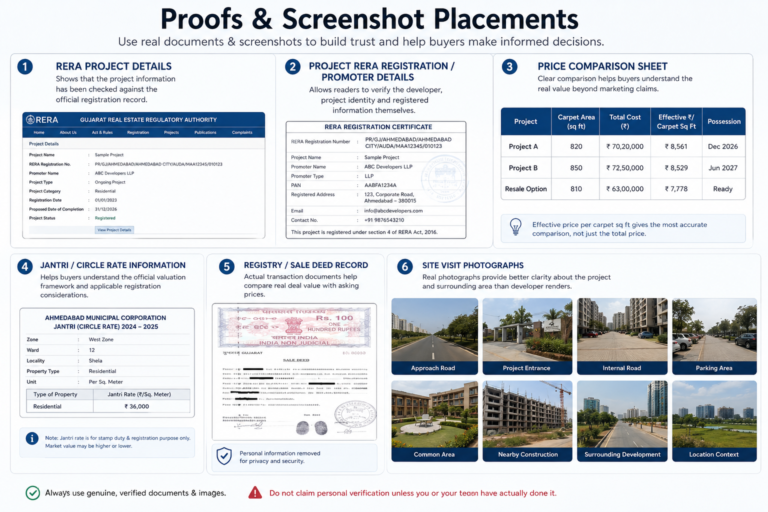
Proofs & Screenshot
Who This Guide Is NOT For
I would not recommend buying a 3 BHK in Shela simply because the market is expected to rise.
This guide is not for someone who:
- Wants a quick flip
- Expects 20–30% annual appreciation
- Is buying purely on broker predictions
- Has an unstable income
- Needs excessive leverage
- Has not calculated the total purchase cost
- Cannot tolerate a long holding period
- Is buying remotely without independent verification
- Is relying on rumors about future infrastructure
Who should wait?
I would seriously consider waiting if:
- Your down payment would exhaust your savings
- EMI would consume too much of household income
- You expect to relocate soon
- You are unsure whether you need 2 BHK or 3 BHK
- You have not compared resale properties
- You have not checked the builder
- You are buying only because of a “price increase tomorrow”
Who may be better off renting?
If your work location is uncertain or you expect to remain in Ahmedabad for only a few years, renting may be financially and practically better.
A house is not automatically a good investment simply because you own it.
If I Were Buying This Property Today
If I were personally evaluating a 3 BHK flat for sale in Shela in 2026, I would not rush to book a new launch simply because the salesperson says prices are about to increase.
I would first compare three things:
- A ready-to-move or established resale apartment
- A completed/newer project from a credible developer
- A carefully selected under-construction project with strong documentation
My preferred configuration
I would choose a well-planned 3 BHK with useful carpet area rather than the largest possible super-built-up number.
I would rather have:
- Properly sized bedrooms
- Good ventilation
- Natural light
- Practical kitchen
- Usable balconies
- Good parking
- Reliable lifts
- Reasonable maintenance
than a huge amenity list that I rarely use.
What would I negotiate hardest?
The total all-inclusive price.
Not the brochure discount.
If the seller says:
“₹5 lakh discount.”
I would ask:
“What is my final payable amount after every charge?”
That is the number that matters.
Would I buy now or wait?
I would buy now only if I found the right property at the right valuation.
I would not wait for a hypothetical crash, but I would also refuse to overpay because of FOMO.
Current market data itself shows why selectivity matters: Shela has a large inventory of 3 BHK options with substantial variation in asking prices.
The one red flag I would not ignore
A mismatch between the sales pitch and the documents.
If the salesperson says one thing but the RERA record, agreement, sanctioned plan or cost sheet says something different, I stop.
No apartment is worth ignoring that signal.
Final Verdict: Is Shela a Good Place to Buy a 3 BHK in 2026?
My answer is: Shela can be a good place to buy a 3 BHK in 2026 — but only if you buy the right property at the right price.
I would give Shela serious consideration for an end-user who:
- Wants a 3 BHK
- Plans to stay for several years
- Has a comfortable budget
- Accepts the area’s evolving character
- Finds a well-connected project
- Verifies the builder
- Checks the legal documents
- Negotiates the total cost
I would be much more cautious for a short-term investor.
The biggest mistake would be assuming:
“Shela is developing, therefore every property in Shela will appreciate.”
That is not how real estate works.
Development can improve an area while individual projects still perform poorly because of:
- Overpricing
- Weak construction
- Poor access
- Excess supply
- Low occupancy
- Bad maintenance
- Weak rental demand
- Poor resale liquidity
So if you are currently searching for a 3 BHK flat for sale in Shela, don’t start by asking:
“Which project is best?”
Start with:
“What do I need this property to accomplish, and what price would make that decision sensible?”
That one question can save you from a very expensive mistake.
FAQ — Real Buyer Doubts
Is Shela a good place to buy a 3 BHK in 2026?
What is a reasonable price for a 3 BHK in Shela?
Is Shela better for living or investment?
Is a ₹70 lakh 3 BHK automatically a better deal than a ₹90 lakh 3 BHK?
Should I wait for Shela property prices to fall?
What is the biggest red flag?
References
About the Author