
Legal Documents Every Home Buyer Should Verify: A few months ago, I met a young couple looking for their first apartment. They had spent weeks comparing floor plans, amenities, and prices. They had shortlisted a project, paid a booking amount, and were ready to sign the paperwork.
Then they asked a simple question:
“Can you quickly check if everything looks fine?”
Within an hour, we discovered something they had completely overlooked. The project brochure looked impressive, the sales team was confident, and the price seemed attractive—but the land ownership documents raised questions. The title history wasn’t as straightforward as they had been told, and a few approvals were still pending.
They walked away from that deal.
A few weeks later, they purchased another property with complete legal clarity.
Looking back, they told me something that every home buyer should remember:
“We almost bought a problem instead of a home.”
Unfortunately, this happens more often than most buyers realize.
Many people spend months comparing prices, negotiating discounts, and selecting the perfect floor plan. Yet very few spend enough time verifying the legal documents that actually determine whether the property can be safely owned, financed, registered, and sold in the future.
Most online articles simply list a few document names without explaining why each one matters or what risks they help you avoid. Real buyers need more than a checklist—they need practical guidance based on how property transactions work in the real world.
Throughout my experience advising home buyers, I have seen one pattern repeatedly: expensive mistakes rarely happen because buyers fail to negotiate the price. They happen because buyers assume someone else has already verified the legal paperwork.
This guide is designed to help you ask better questions before you commit your savings.
Why Home Buyers Face Legal Confusion
Buying a home is one of the largest financial commitments most families will ever make. Yet the legal process often feels complicated because multiple parties are involved—the developer, seller, bank, advocate, local authority, and registration department.
Every document serves a specific purpose. Missing even one important document can delay registration, create ownership disputes, affect bank loan approval, or make future resale difficult.
Let’s look at the challenges buyers commonly face.
Real Buyer Problems I Frequently See
1. Buyers Focus More on Price Than Ownership
One of the biggest mistakes is assuming that the lowest price represents the best value.
I’ve met buyers who negotiated ₹3–5 lakh discounts but never checked whether the seller had complete ownership rights or whether the property had a clear legal title.
Price can always be negotiated.
Legal problems usually cannot.
2. Pressure Created by "Limited-Time Offers"
Sales representatives often create urgency.
Typical statements include:
- Only one unit is left.
- Prices will increase tomorrow.
- Another buyer has already shown interest.
- Booking closes tonight.
Sometimes these statements are true.
Often, they are simply sales tactics.
Whenever buyers feel rushed, they spend less time verifying documentation.
That is exactly when costly mistakes happen.
3. Trusting Brand Reputation Without Verification
Many buyers believe that purchasing from a well-known builder automatically guarantees legal safety. That assumption can be risky. A reputed developer may deliver excellent projects, but every project has its own approvals, permissions, registration status, and construction timeline. That’s why it’s essential to review the documents to verify before buying a home rather than relying solely on the builder’s reputation. Always verify the project itself—not just the builder’s reputation.
4. Depending Only on the Sales Team
The sales executive represents the seller.
Their job is to explain the project and help complete the sale.
Your responsibility is different.
You need independent verification.
Whenever possible, ask your own property lawyer to review the documentation before signing any agreement or paying a significant amount.
An independent legal opinion usually costs far less than resolving a future property dispute.
5. Assuming Bank Approval Means Everything Is Perfect
Many buyers think:
“If a bank is financing this project, all legal checks must already be complete.”
Bank approval certainly provides additional confidence, but it should never replace your own due diligence.
Banks evaluate projects according to their lending policies.
Your lawyer evaluates the property from the perspective of protecting your ownership rights.
Those are two different objectives.
Common Mistakes That Lead to Costly Problems
Over the years, I have seen buyers make remarkably similar mistakes.
Some of the most common include:
- Paying a booking amount before reviewing the agreement.
- Assuming verbal promises will become part of the final contract.
- Ignoring pending approvals.
- Failing to check whether the person selling the property has legal authority.
- Not verifying previous ownership records.
- Believing photocopies without checking originals.
- Skipping legal consultation to save money.
Ironically, buyers who spend weeks negotiating the purchase price sometimes spend less than an hour reviewing the legal paperwork.
That imbalance creates unnecessary risk.
How Professional Buyers Think Differently
Experienced property investors don’t begin by asking:
“How much discount can I get?”
Instead, they ask questions like:
- Who legally owns this property?
- Is the title clear?
- Are all approvals available?
- Can this property be registered immediately?
- Are there any pending disputes?
- Will this property be easy to sell after ten years?
Those questions protect long-term wealth far better than negotiating an extra one or two percent on the purchase price.
Step 1: Choose the Right Location Before Checking the Documents
Many buyers wonder why location comes before legal verification.
The answer is simple.
Legal documents protect your ownership.
Location determines whether that ownership becomes a good decision.
Even a legally perfect property can become a poor investment if it’s in an area with weak infrastructure, limited employment opportunities, or poor future development.
What to Check
Before falling in love with a property, evaluate:
- Road connectivity
- Public transport access
- Schools and colleges
- Hospitals
- Employment hubs
- Daily shopping facilities
- Water availability
- Drainage infrastructure
- Planned government development
- Future commercial growth
Visit the locality at different times of the day.
Morning traffic and evening traffic often tell very different stories.
Why This Matters
A legally compliant apartment in the wrong location may appreciate slowly and become difficult to sell.
On the other hand, a well-located property with complete legal documentation usually attracts stronger resale demand.
Location cannot be changed after purchase.
That makes this decision permanent.
Mistakes to Avoid
Do not choose a property simply because:
- It is cheaper than nearby options.
- Friends are buying there.
- The sample flat looks attractive.
- The builder promises future infrastructure without official evidence.
Always verify planned development through government planning authorities instead of relying solely on marketing material.
Professional Tip
Whenever I evaluate a new residential area, I don’t just inspect the project.
I spend time exploring the surrounding neighborhood.
The quality of nearby roads, retail activity, schools, healthcare facilities, and civic infrastructure often reveals more about future livability than the project’s clubhouse or amenities.
Step 2: Budget & Price Validation
A property’s advertised price is rarely the amount you ultimately pay.
Many first-time buyers focus exclusively on the base price while overlooking several additional costs.
A realistic purchase budget should include:
- Stamp duty
- Registration charges
- GST (where applicable)
- Maintenance deposits
- Clubhouse charges
- Parking fees
- Legal expenses
- Loan processing fees
- Interior work
- Moving expenses
Preparing a complete budget before booking helps prevent financial stress later in the buying process.
Why Price Validation Matters
Compare the quoted price with:
- Recent registered transactions in the locality.
- Government guideline values where applicable.
- Similar properties with comparable specifications.
- Current market demand.
- Construction stage.
A lower price is not automatically a better deal.
Sometimes it reflects pending approvals, weaker demand, or project-specific risks that deserve closer examination.
Mistakes to Avoid
Avoid making decisions based solely on:
- Pre-launch discounts.
- Festival offers.
- Cashback schemes.
- Assured appreciation promises.
- Limited-period pricing.
Instead, focus on the property’s overall legal strength, quality, location, and long-term suitability.
Professional Tip
Always request a detailed cost sheet before paying any booking amount.
If a developer hesitates to provide complete pricing in writing, consider that a warning sign.
Transparency should never be optional when you’re investing your lifetime savings.
Step 3: Verify the Builder and RERA Registration
Before examining individual legal documents, verify who is building the project.
A trustworthy builder still deserves verification.
Good reputation is helpful.
Documented compliance is essential.
In the next part of this guide, we’ll examine how to verify the builder’s legal standing, check RERA registration, inspect every important legal document, and understand the registry process before signing any agreement.
Builder & RERA Verification
Many home buyers assume that if a project looks impressive and the builder has completed several developments in the past, there is no need to verify anything further.
In my experience, that assumption has caused more problems than almost any other mistake.
A builder’s reputation is valuable, but your investment should rely on documents, not marketing.
Every project should be evaluated independently because approvals, land ownership, financing, and timelines can differ from one project to another.
What to Do
Before paying a booking amount, verify:
- RERA registration status
- Builder’s legal name
- Project registration number
- Approved project timeline
- Number of sanctioned units
- Construction status
- Litigation disclosures (if any)
- Previous completed projects
- Customer delivery record
Visit the official RERA portal for your state instead of relying on screenshots provided by the sales office.
Why It Matters
A RERA-registered project generally offers greater transparency regarding approvals, timelines, and project details.
While RERA registration is not a guarantee against every possible issue, it significantly improves accountability.
Mistakes to Avoid
Avoid believing statements such as:
- “RERA approval is under process.”
- “Registration will happen next month.”
- “The application has already been submitted.”
Until registration is officially available on the RERA portal, treat such statements cautiously.
Professional Tip
Whenever I advise buyers, I personally compare the information shown on the RERA portal with the builder’s brochure.
If the promised amenities, possession timeline, or project details differ, I immediately ask the builder to explain the discrepancy.
Small inconsistencies today often become larger disputes later.
Step 4: Site Visit Checklist
Many buyers spend more time inside the sample apartment than outside the project.
That is a mistake.
A beautifully furnished sample flat can distract buyers from practical issues that affect daily living.
During Your Site Visit, Inspect
- Actual construction quality
- Structural finishing
- Common areas
- Basement parking
- Lift quality
- Fire safety provisions
- Water supply arrangements
- Drainage systems
- Electrical infrastructure
- Security arrangements
- Road access
- Neighbourhood development
Visit the property during both weekdays and weekends.
Heavy traffic, noise levels, and waterlogging may only become apparent at certain times.
Why It Matters
The project brochure shows the planned lifestyle.
The site visit reveals the actual lifestyle.
Never make a decision based only on digital brochures or virtual tours.
Red Flags
Be cautious if you notice:
- Construction delays
- Poor workmanship
- Water seepage
- Broken internal roads
- Unfinished common amenities
- Large numbers of unsold units after long project completion
- Lack of safety measures
Professional Tip
Talk to existing residents if the project has occupied phases.
Current residents usually provide far more honest feedback than any sales representative.
Step 5: Legal & Registry Checks
This is the stage where buyers either protect their investment—or unknowingly expose themselves to future legal problems.
Every legal document serves a different purpose.
Missing one document may not immediately stop the transaction, but it can create significant issues during ownership, resale, inheritance, or loan processing.
Let’s examine the most important documents every home buyer should verify.
1. Title Deed
The Title Deed establishes legal ownership of the property.
It confirms whether the seller has the legal right to transfer ownership.
Verify
- Seller’s name
- Property description
- Ownership history
- Existing rights
- Legal transfers
Why It Matters
If ownership itself is unclear, every other document becomes less meaningful.
2. Sale Deed
The Sale Deed is the final legal document transferring ownership after registration.
Without a properly executed Sale Deed, ownership remains incomplete.
Check:
- Property details
- Buyer information
- Seller information
- Sale consideration
- Registration details
3. Mother Deed
The Mother Deed explains how ownership has transferred over time.
It establishes the property’s ownership chain.
A missing ownership chain deserves careful legal review.
4. Encumbrance Certificate
The Encumbrance Certificate helps identify whether the property carries any financial or legal liabilities.
It may reveal:
- Existing mortgages
- Registered loans
- Court attachments
- Previous transactions
A clear certificate provides additional confidence that the property is free from registered encumbrances during the searched period.
5. Sale Agreement
Never treat the Sale Agreement as a routine formality.
Read every clause carefully.
Pay attention to:
- Payment schedule
- Possession timeline
- Penalty clauses
- Cancellation policy
- Refund conditions
- Construction specifications
Verbal promises should always appear in writing.
If they don’t, they become difficult to enforce later.
6. Approved Building Plan
Verify that the building has been constructed according to approved plans.
Unauthorized deviations may create future legal complications.
Ask for:
- Municipal approval
- Building sanction
- Floor approvals
- Layout approval
7. Commencement Certificate
The Commencement Certificate confirms that construction was permitted to begin after obtaining the required approvals.
If construction started without proper permission, future complications become more likely.
8. Completion Certificate
The Completion Certificate confirms that construction complies with approved plans and applicable regulations.
This document becomes particularly important before final possession.
9. Occupancy Certificate
The Occupancy Certificate confirms that the completed building is fit for occupation.
Many buyers mistakenly assume possession automatically means legal occupancy.
It doesn’t.
Without an Occupancy Certificate, obtaining utility connections or future resale may become more difficult in some jurisdictions.
10. Possession Letter
The Possession Letter records when physical possession is handed over.
Verify:
- Date of possession
- Outstanding dues
- Inventory
- Keys received
- Meter readings
11. Allotment Letter
For under-construction projects, the Allotment Letter records the unit allocated to the buyer.
Ensure the unit number, floor, size, and payment details are accurate.
12. Property Tax Records
Always verify whether property taxes have been paid.
Outstanding taxes may become the buyer’s responsibility after purchase.
Ask for recent tax payment receipts.
13. Mutation Records
Mutation updates government records after ownership changes.
Although mutation does not create ownership, it helps maintain accurate land records.
14. Land Use & NA Permission
Where applicable, confirm that the land has appropriate permissions for residential development.
Improper land use approvals can create significant legal complications.
15. NOCs (No Objection Certificates)
Depending on the project, several NOCs may be required from different authorities.
These approvals may relate to:
- Fire safety
- Water supply
- Electricity
- Airport authority (where applicable)
- Environmental clearance
Do not assume these approvals exist.
Verify them.
16. Registry Verification
Before registration, review every detail carefully.
Check:
- Buyer name
- Seller name
- Survey number
- Flat number
- Carpet area
- Sale value
- Stamp duty
- Registration charges
Even minor spelling errors can create future administrative problems.
Why Registry Day Matters
Many buyers relax after paying almost the entire purchase price.
Ironically, registry day is when maximum attention is required.
Read every page.
Ask questions.
Never sign documents you haven’t understood.
Step 6: Negotiation Strategy
Negotiation isn’t only about reducing the property’s price.
Experienced buyers negotiate for better overall value.
Negotiate
- Payment milestones
- Floor-rise charges
- Parking allocation
- Clubhouse fees
- Maintenance deposits
- Interior completion
- Possession timeline
- Delay compensation
- Minor modifications
- Documentation support
Sometimes reducing future expenses is more valuable than obtaining a small discount today.
Mistakes to Avoid
Do not negotiate emotionally.
Avoid comparing your deal with rumours shared by other buyers.
Every transaction differs based on inventory, payment schedule, and market conditions.
Professional Tip
I usually advise buyers to complete legal verification before negotiating aggressively.
A property with strong documentation deserves serious negotiation.
A property with weak legal clarity deserves caution—not bargaining.
Real Buyer Case Studies
The following examples are based on realistic buying situations that reflect the kinds of decisions many home buyers face. The numbers are illustrative and intended to demonstrate sound decision-making rather than guarantee future returns.
Case Study 1: A Family Buying Their First Home
Buyer Profile
- Family of four
- Salaried IT professional
- Combined annual income: ₹24 lakh
- Budget: ₹95 lakh
Initial Situation
The family shortlisted a newly launched apartment because it offered a festival discount and modern amenities. The sales representative assured them that the remaining approvals would be completed “very soon.”
Before paying the booking amount, they decided to have the legal documents reviewed.
During the review, several concerns emerged:
- Some project approvals were still pending.
- The sale agreement contained broad clauses favoring the developer.
- The promised possession timeline differed from the one published on the RERA portal.
Rather than proceeding immediately, the family chose to continue their search.
A month later, they selected another RERA-registered project with complete legal documentation and clearer contractual terms.
Purchase Summary
- Purchase Price: ₹92 lakh
- Registration Year: 2026
- Location: Well-developed residential corridor
- Purpose: End use
Current Situation
The family moved into the property without facing registration delays or legal uncertainty. More importantly, they gained peace of mind knowing that the paperwork had been independently verified before making one of the biggest financial commitments of their lives.
Lesson Learned
The initial project appeared cheaper, but incomplete documentation introduced unnecessary risk. Paying slightly more for a legally transparent property proved to be the better long-term decision.
Case Study 2: An Investor Looking for Rental Income
Investor Profile
- Age: 38
- Self-employed professional
- Investment Budget: ₹1.35 crore
Initial Strategy
The investor initially focused on projected appreciation and premium amenities.
After reviewing the legal documents, another opportunity emerged.
Although the second project offered fewer luxury features, it had:
- Clear ownership records
- Complete approvals
- Strong rental demand
- Better connectivity
- Established surrounding infrastructure
Investment Summary
- Entry Price: ₹1.28 crore
- Rental Yield: Approximately 3.2% annually
- Investment Horizon: Long term
Exit Strategy
Rather than chasing quick appreciation, the investor planned to hold the property while benefiting from consistent rental income and gradual capital appreciation.
Lesson Learned
Legal clarity, location quality, and sustainable demand often outperform speculative buying decisions driven by marketing promises.
What Real Buyers Commonly Say
The following testimonials reflect the kinds of feedback many buyers share after completing a well-researched purchase.
Rahul IT Professional
“I was ready to pay the booking amount immediately. Reviewing the legal documents first helped me identify issues I would never have noticed on my own.”
Yogesh PSU Employee
“The independent legal review gave me confidence during registration. Every document was explained clearly, and there were no surprises later.”
Karan NRI Buyer
“Buying property from overseas felt risky. Cross-checking ownership records, approvals, and registration details made the entire process much more transparent.”
Verified Sources Every Home Buyer Should Use
Instead of relying solely on advertisements or sales presentations, verify information using official and trusted sources wherever possible.
Recommended Sources
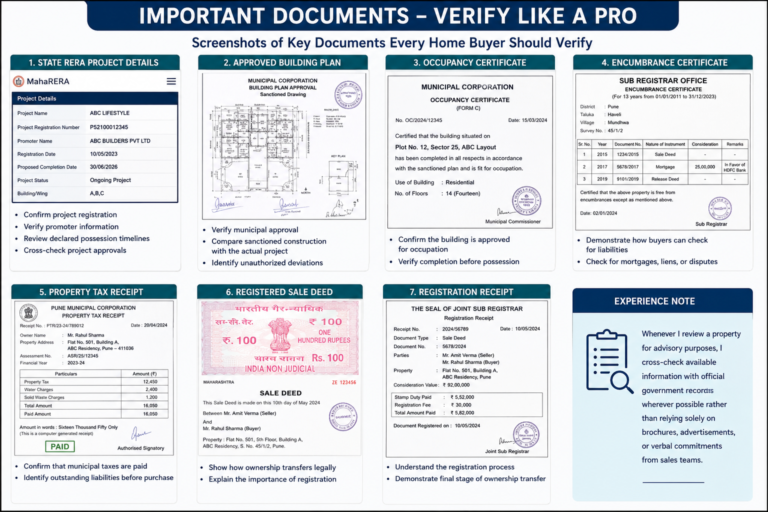
- State RERA Portal – Verify project registration, approvals, declared timelines, and promoter information.
- Local Sub-Registrar Office – Confirm property registration details and transaction records where applicable.
- Municipal Authority – Verify approved building plans, development permissions, and occupancy-related approvals.
- Land Records Department – Review ownership history and survey information.
- Property Tax Department – Confirm outstanding tax liabilities.
- Financial Institution (if applicable) – Understand loan eligibility and legal documentation requirements.
Market conditions change over time. Government records should always take precedence over verbal assurances.
Screenshot
Who This Guide Is NOT For
This guide is intended for buyers who want to make informed, long-term property decisions.
It may not be suitable for:
- Buyers looking for quick speculative profits.
- Investors relying on market rumours.
- People planning to flip properties within a very short period.
- Buyers unwilling to verify legal documentation.
- Anyone expecting guaranteed appreciation regardless of market conditions.
If you are under financial pressure or uncertain about your employment stability, delaying your purchase may be a more prudent decision than rushing into home ownership.
Sometimes waiting is the smarter investment.
If I Were Buying a Home Today
If I were purchasing a property today, I would not begin with the brochure, clubhouse, or launch offer.
I would begin with the legal documents.
I would only consider a property after confirming:
- Clear ownership history.
- Valid project approvals.
- RERA registration where applicable.
- Approved building plans.
- Transparent contractual terms.
- No unresolved legal disputes affecting the property.
I would negotiate firmly on payment schedules, possession commitments, and written contractual protections rather than focusing only on discounts.
One red flag I would never ignore is pressure to make a quick booking before receiving complete legal documentation.
If someone discourages independent verification, I would treat that as a warning sign and reconsider the purchase.
Conclusion
Buying a home is about much more than choosing the right location or negotiating a better price.
It is about ensuring that the property you purchase can be legally owned, occupied, financed, inherited, and sold without unnecessary complications.
Every document you verify today protects years of savings, financial stability, and peace of mind.
Take your time.
Ask questions.
Seek independent legal advice whenever necessary.
No genuine property opportunity is worth sacrificing legal clarity.