
Why Shela Is Becoming Ahmedabad’s Preferred Residential Destination : A few months ago, I met a family searching for a new home in Ahmedabad. Like many homebuyers, they had already visited more than ten residential projects across different locations. Every builder claimed their project was “the best investment,” every broker insisted prices would increase “next month,” and every advertisement promised luxury living.
The family was overwhelmed.
One project offered a lower price but had poor road connectivity. Another had attractive amenities but limited social infrastructure nearby. A third looked impressive in brochures but raised concerns about future development and resale potential.
Their biggest question wasn’t which apartment to buy.
It was which location would still be the right decision ten years from now.
This is where most online real estate blogs fail buyers.
They usually compare amenities, discuss carpet area, or list project features. Very few explain how to judge whether a locality is genuinely becoming a better place to live—or simply being marketed as one.
In my experience advising buyers across Ahmedabad’s residential market, location decisions influence long-term satisfaction far more than luxury specifications. A premium apartment in the wrong locality can become difficult to resell, while a well-chosen location often delivers better lifestyle value and healthier long-term appreciation.
This guide is written for buyers who want practical clarity—not marketing promises.
Whether you’re buying your first home, upgrading to a larger apartment, or evaluating a long-term property investment, this article explains why Shela Ahmedabad has increasingly become a preferred residential destination, what buyers should verify before making a decision, and where caution is still necessary.
Why Buyers Are Looking Beyond Traditional Ahmedabad Locations
A decade ago, many homebuyers automatically preferred established locations because they already had mature infrastructure and commercial activity.
Today, buyer priorities have changed.
Families are looking for:
- Better quality of life
- Less congestion
- Modern residential projects
- Better community planning
- Open spaces
- Long-term appreciation potential
Instead of buying where development has already peaked, many buyers now evaluate emerging residential corridors with stronger future potential.
This shift is one reason Shela Ahmedabad has gained significant attention in the city’s real estate market.
However, popularity alone should never become your reason for buying.
A location deserves consideration only when multiple factors support sustainable growth.
Let’s examine those factors objectively.
Understanding Shela's Transformation
Several years ago, Shela was considered a peripheral village on Ahmedabad’s western side.
Today, it is widely recognized as one of the city’s important residential growth corridors.
This transformation did not happen overnight.
It happened because multiple developments occurred simultaneously:
- Better road infrastructure
- Expansion of nearby commercial activity
- Growth of premium residential projects
- Increasing buyer demand
- Improved civic services
- Presence of reputed developers
- Better educational and healthcare access
When several positive developments happen together, buyers begin viewing an area differently—not as a future possibility but as a practical place to live.
That transition is exactly what Shela has experienced.
Strong Connectivity Is Driving Residential Demand
One factor repeatedly influences residential growth across Indian cities:
Connectivity.
No matter how attractive an apartment appears, daily commuting affects quality of life more than clubhouse facilities.
One reason many families now consider Shela is its improving access to major parts of Ahmedabad.
Important road networks such as SG Highway and SP Ring Road have significantly improved travel convenience for residents.
This means easier access to:
- Corporate offices
- Business parks
- Educational institutions
- Hospitals
- Shopping malls
- Entertainment zones
- Airport routes
- Major residential neighborhoods
For professionals commuting every day, saving even fifteen to twenty minutes can improve overall lifestyle significantly.
When evaluating any residential destination, always drive the route during actual office hours—not only on weekends.
Traffic conditions often reveal more about a location than marketing brochures ever will.
Infrastructure Development Is Supporting Long-Term Growth
Many buyers focus only on today’s condition.
Experienced buyers also evaluate tomorrow.
One question I always ask during buyer consultations is:
“What infrastructure is improving around this location?”
If roads, civic services, commercial development, and public facilities continue expanding, the surrounding neighborhood often becomes more attractive over time.
Shela has benefited from continuous infrastructure development including:
- Better internal roads
- Improved drainage
- Wider access roads
- Commercial establishments
- Retail development
- Residential township expansion
- Civic infrastructure improvements
While no developing locality is completely finished, consistent infrastructure investment generally increases buyer confidence.
That said, buyers should verify ongoing work independently instead of relying solely on builder presentations.
Modern Lifestyle Without the Congestion
Many established city locations provide excellent connectivity but struggle with traffic congestion, parking shortages, and limited open spaces.
Shela offers a different lifestyle experience.
Many newer residential projects have been planned with:
- Landscaped gardens
- Walking tracks
- Children’s play area
- Clubhouse facilities
- Sports amenities
- Better parking design
- Community open spaces
These features contribute to a more comfortable modern lifestyle, especially for families with children and senior citizens.
However, buyers should remember that amenities alone do not create good living.
The surrounding neighborhood matters equally.
Ask yourself:
- Can children safely walk?
- Is there adequate greenery?
- Is the area peaceful during evenings?
- Are roads well maintained?
Lifestyle extends beyond apartment walls.
Family-Friendly Neighborhood Matters More Than Luxury
Luxury specifications often attract attention during site visits. However, when evaluating Residential property in Shela, the surrounding neighborhood deserves just as much attention as the apartment itself.
Yet, families rarely regret buying a slightly smaller apartment. They often regret choosing the wrong neighborhood.
A genuinely family-friendly neighborhood usually offers:
- Safe internal roads
- Active community living
- Good street lighting
- Nearby schools
- Healthcare access
- Daily conveniences
- Parks
- Low industrial disturbance
Many buyers now prioritize these practical factors over imported tiles or designer entrance lobbies because, after possession, everyday convenience matters much more than brochure photography.
Educational Institutions Reduce Daily Stress
Parents consistently rank school accessibility among their top buying priorities.
Lengthy daily commutes affect both children and working parents.
One reason Shela attracts families is the presence of multiple educational institutions within convenient driving distance.
While buyers should evaluate schools based on their individual preferences, having multiple options nearby offers long-term flexibility.
When visiting a project, don’t simply ask:
“Which schools are nearby?”
Instead ask:
- How long does it take during school hours?
- Is the route safe?
- Is public transport available?
- How much traffic builds during peak timings?
These practical questions provide far more useful answers.
Healthcare Facilities Are an Overlooked Buying Factor
Many buyers think about hospitals only after moving in.
Experienced buyers think about healthcare before booking.
Reliable healthcare facilities become especially important for:
- Families with young children
- Senior citizens
- Emergency situations
- Long-term living
A location with good hospital accessibility reduces future stress and improves overall residential comfort.
This is a factor buyers often underestimate.
Daily Conveniences Shape Everyday Living
Luxury is enjoyable.
Convenience is essential.
Residents rarely want to drive several kilometers for everyday needs.
Fortunately, Shela’s growing residential population has encouraged increasing commercial activity.
Today, buyers can generally find easier access to:
- Grocery stores
- Pharmacies
- Banks
- Restaurants
- Cafés
- Fitness centers
- Shopping malls
- Service providers
These daily conveniences save time and improve overall quality of life.
Whenever I evaluate a residential area, I spend at least thirty minutes simply observing local activity.
A neighborhood that functions well throughout the day usually offers better long-term livability.
Green Surroundings Continue to Attract Buyers
One noticeable advantage many buyers appreciate is the availability of relatively more green surroundings and open spaces compared to highly congested urban pockets.
This contributes to a more peaceful environment, making the locality attractive for:
- Young families
- Working professionals
- Retired homeowners
- Buyers seeking healthier urban living
Of course, every project differs.
Some offer generous landscaping, while others maximize construction.
Always inspect the actual open space instead of relying only on master plans.
Why Shela Appeals to Different Types of Buyers
One interesting aspect of the locality is its diverse buyer profile.
Today’s demand comes from:
- First-time homebuyers
- Growing families upgrading to 3 BHK apartments
- Buyers seeking spacious 4 BHK apartments
- Investors looking for long-term property appreciation
- Professionals relocating closer to western Ahmedabad
- NRIs purchasing homes for future use
A healthy mix of buyers generally indicates balanced residential demand rather than speculative activity alone.
That balance often supports a stronger and more sustainable Ahmedabad real estate market within the locality.
What Buyers Should Remember Before Assuming Every Project Is a Good Investment
Although Shela is becoming Ahmedabad’s preferred residential destination, one important truth remains:
A good location does not automatically make every project a good purchase.
Two projects on the same road can deliver completely different outcomes depending on:
- Builder reputation
- Construction quality
- Legal approvals
- Pricing
- Layout efficiency
- Maintenance planning
- Future resale demand
Choosing the right project still requires careful research—not just confidence in the location itself.
In the next section, we’ll walk through a practical buyer action plan covering location selection, budget validation, builder verification, legal checks, site inspections, negotiation strategies, and the mistakes that cost buyers the most money.
By the time most buyers reach this stage, they’ve already shortlisted two or three projects in Shela.
Ironically, this is where many expensive mistakes happen.
A polished sample flat, a limited-time discount, or a persuasive sales executive can shift attention away from the factors that actually determine whether the purchase is a good decision.
In my experience, buyers who follow a structured evaluation process usually make more confident decisions than those who visit the most projects.
The following six-step framework is the same sequence I recommend before anyone books a home in Shela Ahmedabad.
Step 1: Choose the Right Location Within Shela—Not Just Shela
One of the biggest misconceptions is treating Shela as a single, uniform market.
It isn’t.
Like every growing locality, different pockets offer different advantages.
Some projects have better access to SG Highway, while others provide easier connectivity to SP Ring Road. Certain areas are surrounded by established residential townships, whereas others may still depend on future infrastructure.
Buying in the right micro-location can influence:
- Daily travel time
- Future resale demand
- Rental demand
- Noise levels
- Access to schools and hospitals
- Long-term property appreciation
What to Do
Visit the surrounding neighborhood—not just the project.
Spend at least one hour driving around the locality.
Observe:
- Road conditions
- Street lighting
- Commercial development
- Traffic movement
- Nearby construction activity
- Public transport availability
- Drainage after rainfall (if possible)
Why It Matters
A beautiful apartment cannot compensate for poor surroundings.
You will experience the neighborhood every day, not just your living room.
Mistakes I Frequently See
- Choosing only because a friend purchased there.
- Buying based solely on brochure images.
- Ignoring future road expansion.
- Assuming every Shela project offers identical connectivity.
Professional Tip
Always revisit the location after 7 PM.
Daytime and evening conditions can be very different.
Step 2: Validate Your Budget Beyond the Apartment Price
Many buyers believe they can afford a property because they qualify for a home loan.
That isn’t the complete picture.
The purchase price is only one part of the financial commitment.
Additional expenses often include:
- Stamp duty
- Registration charges
- GST (where applicable)
- Parking
- Maintenance deposits
- Clubhouse charges
- Legal verification
- Interior work
- Furniture
- Moving expenses
These costs can significantly affect your overall budget.
What to Do
Prepare a complete cost sheet before paying the booking amount.
Calculate:
- Total acquisition cost
- Loan EMI
- Emergency savings after purchase
- Annual maintenance
- Future furnishing costs
Why It Matters
Financial stress after possession reduces the enjoyment of homeownership.
Buying comfortably is better than stretching beyond your limits.
Common Buyer Mistake
Many buyers spend nearly all their savings on the down payment and later struggle to complete interiors.
Professional Tip
Maintain an emergency reserve equivalent to at least six months of household expenses even after purchasing your home.
Step 3: Verify the Builder Before You Trust the Brand
A premium showroom does not necessarily indicate a premium builder.
Neither does aggressive advertising.
Before evaluating floor plans or amenities, investigate the developer’s track record.
Ask yourself:
- Were previous projects delivered on time?
- How is construction quality after five years?
- What do existing residents say?
- Are maintenance standards acceptable?
- Were promised amenities actually completed?
Many reputed builders have established a positive reputation through consistent delivery rather than marketing.
However, every project deserves independent verification.
- Builder Verification Checklist
- Past completed projects
- Delivery timelines
- Construction quality
- Customer feedback
- Litigation history
- Financial stability
- Maintenance quality
Why It Matters
The builder influences everything from construction quality to resale value.
Professional Tip
Visit an older completed project—not just the new launch.
Existing residents usually provide more honest feedback than sales representatives.
Step 4: Verify RERA Registration and Legal Compliance
Every buyer should independently verify RERA-approved projects before making any financial commitment.
Never assume registration simply because it appears in marketing material.
Visit the official Gujarat RERA portal and verify:
- Registration number
- Project status
- Completion timeline
- Developer details
- Approved plans
Why This Matters
RERA improves transparency but only if buyers actually use the available information.
Additional Legal Checks
Confirm:
- Land ownership
- Approved building plans
- Development permissions
- Encumbrance status
- Occupancy Certificate (for completed projects)
- Fire safety approvals
- Environmental approvals where applicable
Red Flag
If someone discourages you from verifying documents independently, treat it as a warning sign.
Professional developers generally welcome informed buyers.
Step 5: Conduct a Meaningful Site Visit
Many buyers spend over an hour inside the sample apartment and less than ten minutes outside it.
I recommend doing the opposite.
The apartment can be modified later.
The surroundings cannot.
During Your Visit, Observe
Exterior roads
Pedestrian access
Drainage
Waterlogging signs
Nearby commercial activity
Noise levels
Construction quality
Natural ventilation
Sunlight
Security arrangements
Visitor parking
Open spaces
Actual clubhouse progress
Children’s play area
Landscaping quality
Community living atmosphere
Questions Worth Asking
How many apartments are already occupied?
What is the maintenance cost?
Is visitor parking sufficient?
How many lifts serve each tower?
What is the backup power capacity?
How is water supplied?
Mistakes Buyers Commonly Make
Focusing only on:
- Italian marble
- Modular kitchens
- Decorative lighting
- Furnished sample flats
Instead, inspect:
- Wall finishing
- Ceiling quality
- Tile alignment
- Plumbing fixtures
- Window sealing
- Balcony usability
Construction quality is far more important than decoration.
Step 6: Negotiate Before You Book
One misconception is that residential prices are fixed.
Sometimes they are.
Often, they are negotiable.
Negotiation doesn’t always mean reducing the apartment price.
Better opportunities may include:
- Additional parking
- Waiver of maintenance deposits
- Modular kitchen upgrades
- Flexible payment plans
- Club membership
- Interior assistance
- Floor preference
Why Negotiation Matters
Even modest savings today improve long-term affordability.
Professional Tip
Never negotiate during your first visit.
Visit multiple residential projects before making your final offer.
Developers usually negotiate more seriously when buyers demonstrate market awareness.
Understanding Whether You're Buying for Living or Investment
One question I ask every buyer is:
“Would you still buy this apartment if prices remained stable for the next three years?”
The answer reveals your true objective.
If You’re an End-User
Your priorities should include:
- Daily convenience
- Family-friendly neighborhood
- Educational institutions
- Healthcare facilities
- Safety
- Community living
- Open spaces
- Lifestyle amenities
Short-term price movements should not dominate your decision.
Your family’s quality of life matters more.
If You’re an Investor
Evaluate:
- Entry price
- Future growth
- Rental demand
- Vacancy risk
- Property appreciation
- Infrastructure development
- Supply pipeline
- Exit opportunities
Avoid buying simply because “everyone else is investing.”
Good investments are supported by data—not excitement.
Questions Every Buyer Should Ask Before Booking
Before signing any booking form, ask these questions:
- Why is this project priced differently from nearby developments?
- What exactly am I paying for?
- What future infrastructure is officially planned nearby?
- How many apartments remain unsold?
- What happens if possession is delayed?
- How much will annual maintenance cost?
- Are all promised amenities included in the agreement?
- Is this apartment suitable for my lifestyle five years from now?
If satisfactory answers aren’t available, continue researching.
There is usually another opportunity in the market.
Practical Advice I Give Every Homebuyer
Buying a home should never feel rushed.
A residential property is one of the largest financial decisions most families make.
Taking an additional month to verify documents, compare projects, negotiate better terms, and evaluate the surrounding neighborhood is rarely a mistake.
Rushing because of an “offer ending this weekend” often is.
In my experience, informed buyers usually negotiate better, identify hidden risks earlier, and enjoy greater confidence after possession.
The goal isn’t simply to buy a home in Shela Ahmedabad.
The goal is to buy the right home, in the right project, at the right price, for the right reasons.
Illustrative Buyer Scenario 1: Family Buying for End Use
Note: This example is illustrative and based on common buying patterns, not a real client’s personal details.
Buyer Profile
- Family of four
- Budget: ₹1.35 crore
- Requirement: Spacious 3 BHK apartment
- Employment: One family member working near SG Highway
- Goal: Long-term self-occupation
Buying Decision
The family compared projects in Shela, South Bopal, and Gota.
Instead of selecting the cheapest apartment, they evaluated:
- Commute time
- School accessibility
- Hospital availability
- Builder reputation
- Maintenance quality
- Community environment
After comparing all factors, they chose a project in Shela that offered better connectivity and social infrastructure, even though it cost slightly more.
Five Years Later (Illustrative)
- Family enjoys shorter daily commutes.
- Children have access to nearby schools and recreational facilities.
- The locality has seen additional commercial and infrastructure development.
- The apartment has appreciated in value, though the primary benefit has been improved quality of life.
Key Lesson
For end-users, choosing the right location often delivers more value than negotiating the last few lakh rupees.
Illustrative Buyer Scenario 2: Long-Term Investor
Note: This is an illustrative example based on typical investment considerations.
Investor Profile
- Budget: ₹95 lakh
- Goal: Capital appreciation over 8–10 years
- Preference: Under-construction project from an established developer
Investment Strategy
Instead of purchasing based solely on launch offers, the investor evaluated:
- Planned infrastructure
- Existing residential demand
- Rental potential
- Competing future supply
- Builder delivery history
Possible Outcome
As infrastructure matured and occupancy increased, rental demand strengthened and resale opportunities improved. Returns depended on project selection, market conditions, and holding period rather than speculation.
Key Lesson
Successful real estate investing usually rewards patience, careful due diligence, and realistic expectations—not quick-profit assumptions.
Current Market Context
Shela has evolved into one of Ahmedabad’s active residential micro-markets because of a combination of factors rather than a single trend.
These include:
- Expansion of residential developments.
- Improved road connectivity.
- Growing social infrastructure.
- Demand from working professionals and families.
- Interest from long-term investors.
Like any property market, however, conditions change over time. Interest rates, new project launches, government policies, and local infrastructure can all influence pricing and demand.
No locality appreciates indefinitely, and no project is guaranteed to outperform the market.
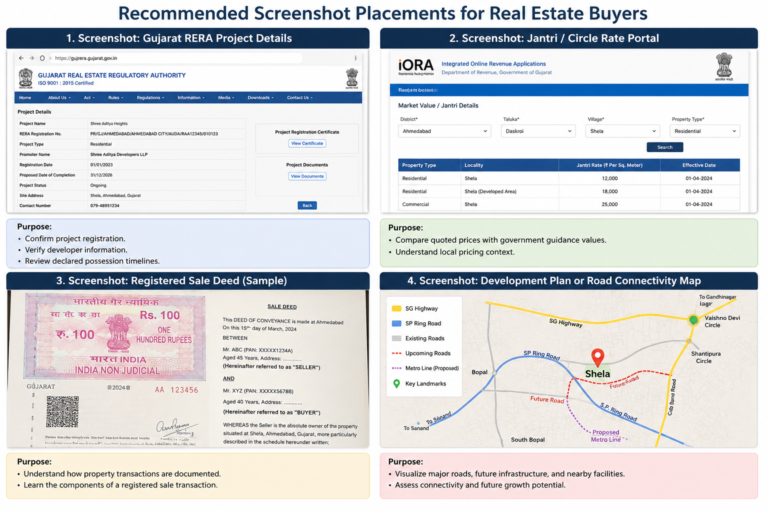
Screenshot
Who This Guide Is For
This guide is most helpful if you are:
- Buying your first home.
- Upgrading to a larger apartment.
- Planning to live in Ahmedabad for several years.
- Looking for a long-term residential investment.
- Comparing multiple residential locations objectively.
Who Should Wait Before Buying
Buying may not be the right decision today if you:
- Need to relocate within the next 2–3 years.
- Have insufficient savings beyond the down payment.
- Are relying entirely on expected short-term price appreciation.
- Have not finalized your employment or family plans.
- Are purchasing only because of pressure from sales campaigns or acquaintances.
In such situations, renting or delaying the purchase until your circumstances become clearer may be the wiser choice.
If I Were Buying in Shela Today
If I were evaluating a home in Shela today, I would focus on long-term usability rather than trying to predict short-term price movements.
I would shortlist projects that offer:
- Strong connectivity.
- A proven developer track record.
- Good construction quality.
- Functional layouts.
- Access to schools, hospitals, and everyday services.
- Transparent legal documentation.
I would negotiate firmly on the total purchase package—not just the base price—and I would avoid making a decision under time pressure.
The one red flag I would not ignore is incomplete or unclear documentation. Even an attractive price cannot compensate for legal uncertainty.
Conclusion:
Shela’s rise as a preferred residential destination is supported by improving infrastructure, expanding social amenities, and sustained residential development.
However, the best buying decision is rarely based on the location name alone.
Compare projects carefully. Verify documents independently. Consider your family’s long-term needs. Evaluate the builder’s track record. Understand the full financial commitment before signing any agreement.
A well-informed purchase today is more valuable than chasing uncertain market predictions tomorrow.
Why Shela Is Becoming Ahmedabad's Preferred Residential Destination : faqs
1. Is Shela a good place to buy a home in Ahmedabad?
2. Is Shela suitable for long-term investment?
3. Should I choose a ready-to-move apartment or an under-construction project?
4. How important is a builder's reputation?
5. What should I verify before paying a booking amount?
References
About the Author

Mitesh Vyas
Hello My Name is Mitesh Vyas i am a Real Estate content writer and Property Market Enthusiast I shares practical insights on buying, selling, investing, and understanding real estate trends. With a strong focus on residential and commercial properties, My aims to help readers make informed property decisions through clear, research-based, and easy-to-understand content.