
A family I would expect to see in Shela today usually starts with a simple requirement: “We need a good 3 BHK, preferably below ₹1 crore.”
Then the search begins.
One broker quotes ₹72 lakh. Another says a similar flat is ₹85 lakh. A new project shows a price above ₹90 lakh. Then someone says, “Sir, rates are increasing every few months. If you wait, the same flat will cost ₹10–15 lakh more.”
This is where buyers make expensive mistakes.
A price increase in Shela does not automatically mean every 3 BHK has become a better investment. It also does not mean you should rush into booking a property simply because a salesperson says prices are going up.
Current market data itself shows why buyers need to be careful. MagicBricks’ Q2 2026 data puts the average multistorey apartment price in Shela at about ₹5,125 per sq ft, with a reported range of roughly ₹4,051–₹6,198 per sq ft. For 3 BHK apartments specifically, it reports approximately ₹4,000–₹5,800 per sq ft and 6% year-on-year growth.
But another major property portal reports a different locality-wide average and a decline over the previous year. Housing.com currently reports an average Shela property rate around ₹6,268 per sq ft and a 3.85% year-on-year decline on its locality data.
That difference is important.
It tells you that “Shela property prices are increasing” is too simplistic a statement to make a buying decision.
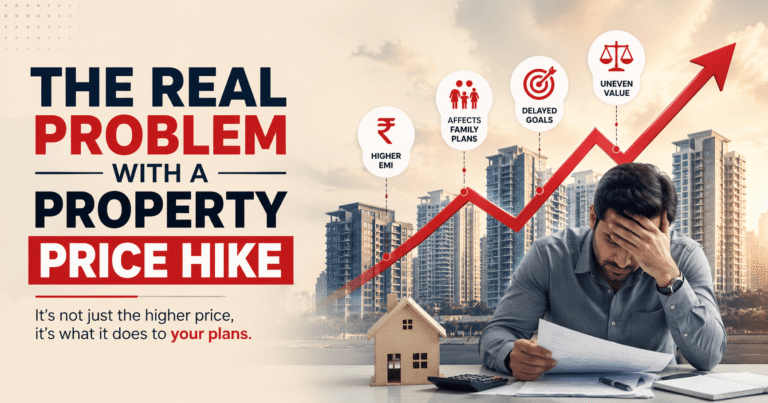
1. The Real Problem With a Property Price Hike
A rising property market creates two completely different situations.
For an existing owner, rising prices can be good news.
For a buyer, however, rising prices can create a dangerous combination:
- Higher purchase price
- Higher down payment
- Larger home loan
- Higher EMI
- Higher registration and transaction costs
- Less negotiating power
- Pressure to compromise on location or size
- Lower rental yield if rents do not rise at the same speed
This is why I would never tell a buyer:
“Prices are increasing, so buy immediately.”
I would first ask:
“Increasing from what price?”
Suppose a 3 BHK was available at ₹70 lakh and is now being quoted at ₹80 lakh.
That is a ₹10 lakh increase.
But if the same property can realistically be negotiated to ₹75 lakh, the advertised increase is not the same as the actual transaction increase.
Similarly, if a new project is launched at ₹90 lakh while comparable ready-to-move properties are selling around ₹75–80 lakh, the new launch price does not automatically establish a new market value.
This distinction can save a buyer lakhs of rupees.
2. What Is Happening to 3 BHK Prices in Shela?
The current Shela market is not one uniform price market.
Different projects can have dramatically different ticket sizes depending on:
- Builder reputation
- Project age
- Carpet area
- Super built-up area
- Amenities
- Road access
- Construction quality
- Floor
- View
- Parking
- Possession status
- RERA status
- Exact micro-location
- Resale demand
MagicBricks’ current 3 BHK data shows an asking-price range in Shela of roughly ₹61 lakh to ₹1.71 crore, illustrating just how wide the market can be.
Current listings also show examples around ₹70–95 lakh for several 3 BHK properties, while premium/newer offerings can cross ₹1 crore.
So if somebody tells you:
“A 3 BHK in Shela costs ₹90 lakh.”
My response would be:
Which 3 BHK?
A 1,500 sq ft apartment and an 850 sq ft carpet-area apartment cannot be compared simply because both are called “3 BHK”.
That is one of the biggest mistakes I see buyers make when comparing properties.
3. How a Price Hike Actually Affects a 3 BHK Buyer
Let’s make this practical.
Assume you were considering a 3 BHK at:
₹70 lakh
Later, the asking price becomes:
₹80 lakh
The apparent increase is ₹10 lakh, or approximately 14.3%.
But your actual financial impact is larger than ₹10 lakh.
You may also face:
- Higher loan requirement
- Higher EMI
- Higher registration-related costs
- Higher interest outgo
- Higher interior budget relative to your remaining cash
- Lower emergency fund after purchase
Example
Suppose your available down payment is ₹20 lakh.
At ₹70 lakh:
Property price: ₹70 lakh
Down payment: ₹20 lakh
Loan: ₹50 lakh
At ₹80 lakh:
Property price: ₹80 lakh
Down payment: ₹20 lakh
Loan: ₹60 lakh
You haven’t simply paid ₹10 lakh more.
You have potentially added ₹10 lakh to your debt.
That means the property-price increase can continue affecting your finances for years through interest payments.
This is why I would rather see a buyer negotiate ₹5 lakh off the purchase price than spend weeks trying to predict whether Shela will rise another 5% next year.
4. Why Shela's Price Increase Does Not Affect Every 3 BHK Equally
This is an important point.
A locality can become more expensive while an individual project performs poorly.
Imagine two 3 BHK apartments in Shela.
Property A
- Good internal road
- Established society
- Ready possession
- Good maintenance
- Practical carpet area
- Strong resale demand
Property B
- New project
- Higher advertised price
- Smaller usable space
- Construction still underway
- Limited resale history
- Higher maintenance expectations
- Poor access during peak traffic
If Shela prices increase 6%, should both properties automatically increase 6%?
No.
Property B may struggle to appreciate if buyers discover that its premium was already too high.
This is why I strongly recommend project-level comparison instead of locality-level comparison.
5. What Causes Property Prices to Rise in Shela?
A price increase can come from several different factors.
5.1 Infrastructure and connectivity
Better roads, improved connectivity and surrounding development can increase buyer interest.
But buyers should not pay today’s premium solely for an infrastructure promise.
Ask:
- Is the infrastructure completed?
- Is there an official plan?
- Is there a realistic completion timeline?
- Will it actually improve this project’s connectivity?
- Has the improvement already been priced into the property?
A future road is not the same thing as a functioning road today.
5.2 Construction and land costs
Developers may increase prices because construction inputs, labour, financing and land costs have increased.
That can be legitimate.
But it does not mean the buyer must accept every price increase.
The developer’s cost is one factor.
Your property’s market value is another.
5.3 Demand for larger homes
A 3 BHK can attract a different buyer segment from a 2 BHK.
Families may want:
- Children’s bedroom
- Parents’ room
- Home office
- Larger living area
- Additional storage
That can support demand.
But demand does not mean unlimited pricing power.
If a 3 BHK becomes too expensive compared with a 2 BHK or a nearby 3 BHK in a better-established society, buyers can shift.
5.4 New project launches
This is where buyers need to be particularly careful.
A new premium project can launch at a much higher price than older properties nearby.
That does not necessarily mean the whole locality has appreciated by the same amount.
A launch price is an asking price.
A registered sale transaction is much stronger evidence of actual market value.
6. Step-by-Step Buyer Action Plan
Step 1: Choose the Right Location Before Chasing the Price
Don’t begin with:
“Show me the cheapest 3 BHK in Shela.”
Begin with:
“Which part of Shela works for my daily life?”
Check:
- Daily commute
- School access
- Hospital access
- Grocery and daily shopping
- Road width
- Traffic at 8–10 AM
- Traffic at 6–9 PM
- Parking
- Public transport
- Future development around the building
Why it matters
A ₹5 lakh cheaper flat can become a bad purchase if your family spends an extra hour every day commuting.
Mistake to avoid
Don’t select the project based only on the entrance road and sales office.
Drive the actual route you will use every day.
My practical tip
Visit once on a weekday morning and once during evening peak traffic.
A Sunday site visit can give you a completely false impression of the locality.
Step 2: Validate the Budget and Actual Price
Never compare properties using only the advertised total price.
Calculate:
Property price + applicable taxes/charges + registration-related expenses + parking + maintenance deposits + interiors + loan-related costs = actual acquisition cost
Then compare the effective price per usable square foot, not just the builder’s headline rate.
For example:
Flat A
₹78 lakh
1,500 sq ft super built-up
Flat B
₹75 lakh
1,300 sq ft super built-up
At first glance, Flat B looks cheaper.
But you need to know:
- Carpet area
- Balcony area
- Loading
- Parking
- Floor
- Construction quality
The ₹/sq-ft calculation is useful only when you compare similar measurement bases.
Biggest mistake
Comparing one project’s super built-up rate with another project’s carpet-area rate.
That can completely distort your decision.
Step 3: Verify the Builder and RERA Information
Before paying a booking amount, verify the project independently.
The Gujarat RERA system exists to provide project and regulatory information to buyers. The official Gujarat RERA portal is:
GujRERA official portal
Check:
- RERA registration number
- Promoter name
- Project name
- Approved plans
- Project status
- Completion date
- Quarterly progress information
- Litigation/complaint information where available
- Changes to the project
- Phase details
Do not accept a screenshot supplied by a salesperson as your only verification.
Search the project yourself.
Gujarat’s RERA framework is intended to regulate and promote the real estate sector and protect consumers.
Red flag
If the salesperson says:
“Sir, RERA is there, don’t worry about anything.”
That is not verification.
RERA registration is only one part of due diligence.
Step 4: Conduct a Proper Site Visit
Don’t visit the site like a tourist.
Visit it like someone who is about to spend ₹70–100 lakh.
Check:
Inside the flat
- Carpet area
- Room dimensions
- Natural light
- Ventilation
- Bathroom layout
- Kitchen usability
- Storage
- Balcony size
- Window placement
- Electrical points
Outside the flat
- Lift waiting time
- Staircase
- Fire exits
- Parking
- Visitor parking
- Security
- Water supply
- Garbage management
- Society maintenance
- Construction quality
Around the project
- Road condition
- Drainage
- Street lighting
- Traffic
- Nearby construction
- Commercial activity
- Noise
- Waterlogging risk
Pro tip
Don’t allow the salesperson to control the entire visit.
Spend 15–20 minutes walking around the project yourself.
You will notice things that a guided sales tour conveniently skips.
Step 5: Complete Legal and Registry Checks
Before making a major payment, have the documents reviewed by a qualified property lawyer.
Depending on the property and transaction, due diligence can include:
- Title documents
- Chain of ownership
- Encumbrance-related checks
- Approved plans
- Development permissions
- RERA documents
- Agreement for sale
- Possession documentation for completed properties
- Society/association documents where applicable
- Property tax records
- Land records
- Relevant local authority approvals
For Gujarat land and property-related records and government services, the Revenue Department provides online services covering areas such as land records, property cards, document registration and Jantri rates.
Important
Jantri is not the same thing as market value.
Use official valuation/reference information as one part of your due diligence rather than assuming:
“Jantri = actual selling price.”
It doesn’t.
Step 6: Negotiate After You Know the Market
The strongest negotiation is not:
“Give me your best price.”
Instead say:
“I compared three similar 3 BHK properties in the same micro-market. Based on usable area, possession, floor, parking and condition, this is the price at which I am comfortable proceeding.”
That is much harder to dismiss.
What I would negotiate
Depending on the property:
- Base price
- Floor-rise charges
- Parking
- Maintenance deposit
- Clubhouse/amenity charges
- Other builder charges
- Payment schedule
- Possession-related terms
- Included fixtures
- Resale seller’s asking price
One important rule
If the seller refuses to negotiate ₹3 lakh but the property is fundamentally good, don’t automatically walk away.
A good property at a fair price can be better than a mediocre property at a cheap price.
But don’t let a broker convince you that a bad property becomes good because of a ₹5 lakh discount.
How Much Should You Pay for a 3 BHK in Shela?
There is no single correct answer.
Current online data shows substantial variation.
MagicBricks’ Q2 2026 data reports an average 3 BHK rate around ₹4,869 per sq ft, with approximately 6% year-on-year growth for the 3 BHK segment.
At the same time, individual listings show substantial variation, with current examples around ₹70 lakh, ₹75 lakh, ₹80 lakh, ₹90 lakh and above depending on size and project.
This tells you something important:
Do not use one average price to decide whether your flat is expensive.
Use the average as a starting point.
Then compare:
- Same project
- Same configuration
- Similar carpet area
- Similar age
- Similar floor
- Similar possession status
- Similar parking
- Similar condition
Only then do you get closer to the real market price.
Realistic Case Study 1: End-User Family
Illustrative example — not a claimed client transaction.
A family has a budget of ₹85 lakh.
They initially look at a new 3 BHK priced at ₹90 lakh.
The broker tells them:
“Rates are going up. If you wait six months, this could cross ₹1 crore.”
Instead of rushing, they compare:
- One new project
- Two ready-to-move projects
- One resale property
They eventually find a resale 3 BHK at approximately:
Purchase price: ₹76 lakh
They spend around ₹4–5 lakh on improvements and basic interiors.
Why this worked
They did not try to predict the market.
They bought based on:
- Location
- Usable area
- Society quality
- Immediate usability
- Negotiated price
Illustrative future outcome
If the property later appreciates to ₹90 lakh, the family has gained value.
But the bigger success is that they avoided taking a larger loan simply because a broker created urgency.
Lesson
For an end-user:
Buying the right property at a sensible price is more important than buying at the exact bottom of the market.
Realistic Case Study 2: Investor
Illustrative example — not a claimed client transaction.
An investor buys a 3 BHK in Shela for:
₹78 lakh
After furnishing, the total investment reaches approximately:
₹83 lakh
Suppose the property rents for around:
₹28,000/month
Annual gross rent:
₹3.36 lakh
Gross rental yield:
₹3.36 lakh ÷ ₹83 lakh ≈ 4.0%
But this is gross, not net.
After maintenance, vacancy, repairs and other expenses, the actual return can be lower.
Suppose five years later the property sells for:
₹1.05 crore
That represents approximately ₹22 lakh of nominal appreciation over the ₹83 lakh all-in cost, before selling costs, taxes and financing effects.
What worked?
- Reasonable entry price
- Rental demand
- Long holding period
- No dependence on a quick resale
What didn’t work?
The investor initially expected the property to appreciate 10–12% every year.
That expectation was unrealistic.
Lesson
A 3 BHK bought purely because:
“Shela is going up”
is not an investment strategy.
You need an entry price, rental logic and exit plan.
Social Proof: What Buyers Typically Say After the Purchase
The following are illustrative testimonial-style examples, not verified client testimonials.
Parth IT Professional — Shela
“I initially focused only on the newest project. After comparing carpet area and resale options, I realised the older society gave me more usable space for my budget.”
Jay PSU Employee — Shela
“The biggest thing I changed was not rushing because of the price-hike argument. I checked the documents first and negotiated after comparing similar flats.”
Vishal NRI Buyer
“I stopped looking only at appreciation. For me, documentation, builder history and property management were more important because I couldn’t visit the site regularly.”
These examples represent the type of decision-making buyers should aim for—not promotional claims about guaranteed returns.
What Current Market Data Actually Tells Us
There is a reason I recommend using multiple data points.
MagicBricks reports Shela’s Q2 2026 multistorey apartment average at approximately ₹5,125/sq ft, with a 1% quarter-on-quarter increase.
For 3 BHK apartments, MagicBricks reports approximately ₹4,869/sq ft in April–June 2026 and about 6% year-on-year growth.
However, Housing.com’s locality data currently shows a different picture, with its reported Shela average around ₹6,268/sq ft and a 3.85% year-on-year decline.
I would not choose one number and pretend it represents every transaction.
Online property portals primarily reflect listing/market datasets, which can differ in methodology, property mix and timing.
For an actual purchase, I would give more weight to:
Comparable properties + actual negotiations + project-specific evidence + legal verification
than to a single portal’s average.
Why Property Price Hikes Can Actually Hurt Investors
This is often ignored.
Suppose:
Earlier
Property price: ₹70 lakh
Annual rent: ₹3 lakh
Gross rental yield:
4.29%
Now suppose the property price increases to:
₹85 lakh
But rent increases only to:
₹3.24 lakh/year
Gross rental yield becomes:
3.81%
The property has become more expensive, but the rental return has actually fallen.
This is why investors should never confuse:
capital appreciation
with
cash-flow performance.
A rising price can make an asset more expensive without making it a better rental investment.
The Biggest Trap: Paying Tomorrow's Price Today
This is one of the most dangerous behaviours during a rising market.
A salesperson says:
“This is today’s price. Next month it will increase.”
You immediately book.
But ask yourself:
What evidence proves the future price increase?
Is there:
- A written price revision?
- An official builder circular?
- Comparable transaction evidence?
- Actual demand?
- Limited inventory?
- Or simply sales pressure?
If you cannot verify it, treat it as a sales statement—not investment evidence.
When a Higher Price Can Actually Be Justified
I am not against paying more.
Sometimes paying a premium is sensible.
For example, a 3 BHK may justify a higher price if it offers:
- Better carpet area
- Superior construction
- Stronger builder reputation
- Better road access
- Ready possession
- Better floor and ventilation
- Better society maintenance
- Better parking
- Stronger resale demand
- Lower execution risk
The mistake is paying a premium without receiving a meaningful advantage.
Proofs and Screenshots
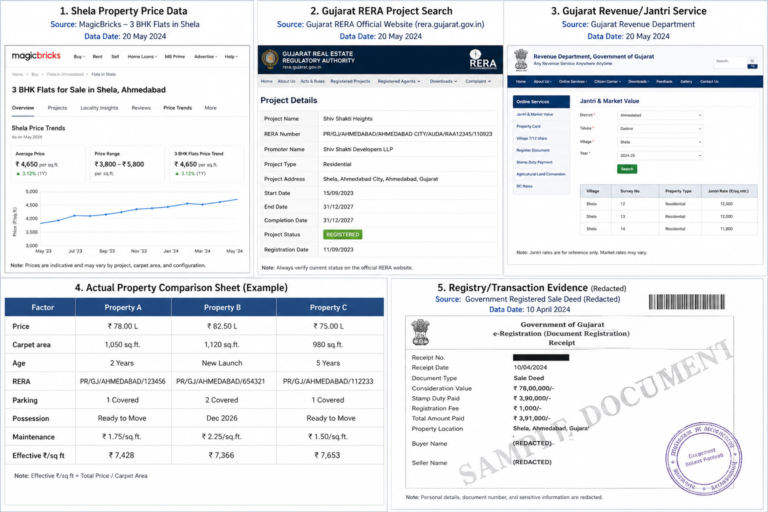
Who Should NOT Buy a 3 BHK in Shela Just Because Prices Are Rising?
This guide is not for buyers who want to make a quick profit in six months.
I would strongly discourage buying if:
- You need to stretch your EMI beyond a comfortable level
- Your down payment will consume almost all your savings
- You have unstable income
- You are buying only because a broker says prices will rise
- You have not checked the legal documents
- You are uncomfortable with the project’s possession timeline
- You have not compared resale properties
- You don’t actually need a 3 BHK
- You expect guaranteed appreciation
You should consider waiting if:
Your only reason for buying is:
“If I don’t buy today, I will miss out.”
Fear of missing out is not a financial strategy.
If your finances aren’t ready, waiting can be the smarter decision—even if property prices increase.
Who May Be Better Off Renting?
Renting can make more sense when:
- You expect to move within 2–4 years
- Your job location may change
- You are unsure about Shela
- Your down payment is insufficient
- Your EMI would severely reduce monthly savings
- You are still building an emergency fund
- You are buying primarily for speculation
Owning a home is not automatically financially superior to renting.
The correct choice depends on:
holding period + affordability + property quality + rent + expected transaction costs + personal stability.
If I Were Buying This Property Today
I would not rush to buy simply because Shela property prices have risen.
I would first shortlist three categories:
- A good resale 3 BHK
- A ready-to-move/newly completed property
- A reputable under-construction project
Then I would compare them on exactly the same basis.
My preferred configuration
For an end-use family purchase, I would prioritise:
A practical 3 BHK with strong usable/carpet area, good ventilation, sensible maintenance and reliable connectivity.
I would choose usable space over flashy amenities.
A huge clubhouse does not compensate for a badly designed apartment.
What I would negotiate hardest
I would focus on the all-in acquisition cost, not just the headline price.
If the builder says:
“₹82 lakh final.”
I would ask:
“What exactly is included in ₹82 lakh?”
Then I would calculate the actual amount required to own and occupy the apartment.
The one red flag I would not ignore
Pressure to pay quickly without giving me enough time to independently verify documents.
If someone tells me:
“Don’t worry about RERA, legal documents or comparison. Just book today.”
I would walk away.
There will always be another property.
There may not be another opportunity to recover the money you lose on a bad purchase.
Conclusion:
Shela’s property market has seen meaningful price movement, but that does not mean every 3 BHK apartment is automatically worth its asking price. Current market data shows variation between projects, configurations and property portals, so buyers should avoid making a decision based on a single average price or a broker’s claim about future appreciation.
If you are planning to buy a 3 BHK in Shela, focus on the property in front of you: its carpet area, location, construction quality, possession status, RERA details, total acquisition cost, maintenance, resale potential and the price of comparable properties nearby.
Most importantly, don’t buy simply because someone tells you that prices will increase next month. Verify the numbers, compare at least two or three alternatives, inspect the property properly and complete the necessary legal checks before paying a substantial booking amount.
The goal is not to predict whether Shela property prices will rise or fall. The goal is to avoid buying the wrong 3 BHK at the wrong price.
If a property offers the right combination of location, usable space, quality, documentation and affordability, buying can make sense even after a price increase. If it is overpriced or financially uncomfortable, waiting or negotiating may be the smarter decision.