
If you are searching for 3 BHK flats in Shela under ₹60 lakhs, the first thing I would tell you is this:
Do not start by asking which project looks best. Start by asking whether ₹60 lakh is actually enough for the home you want.
That distinction matters.
Current property listings show that 3 BHK options around ₹55–60 lakh do exist in Shela. For example, recent listings show 3 BHK units around ₹55.9 lakh in Sun Parkwest, around ₹58 lakh in Orchid Valley, and around ₹57.4 lakh in Shilp Revanta. But the same market also contains many 3 BHK properties priced well above ₹60 lakh.
So the real question is not:
“Can I find a 3 BHK in Shela for ₹60 lakh?”
You probably can.
The better question is:
“Can I buy a legally clean, practically usable 3 BHK in Shela for ₹60 lakh without stretching my finances or accepting a compromise I will regret?”
That is what this guide is about.

The Buyer Story Most Property Websites Don't Tell You
A family approaches a broker with a clear budget: ₹60 lakh maximum.
The broker immediately shows them a beautiful 3 BHK.
“Sir, this one is ₹57 lakh. Very good project. Limited units left.”
The family likes it.
Then the numbers start changing.
₹57 lakh becomes ₹58.5 lakh after one charge.
Parking is discussed separately.
Maintenance deposit appears.
Documentation charges appear.
Furniture or preferred floor costs extra.
The family asks about registration and other government costs.
The final cash requirement is suddenly much higher than the ₹57 lakh they originally heard.
This is where buyers make one of their biggest mistakes: they fall in love with the apartment before calculating the complete acquisition cost.
I would rather see a buyer reject a beautiful flat after a two-hour inspection than discover six months later that the property has poor access, drainage problems, weak resale demand or documentation complications.
That is why many online property articles are not particularly useful to buyers. They often tell you about amenities, nearby schools, attractive prices and future appreciation, but 3 BHK properties in Shela under ₹60 lakh require a closer look at the actual costs, property condition and overall value.
They rarely tell you:
- what can go wrong;
- what the advertised price excludes;
- how small the actual usable carpet area may be;
- whether ₹60 lakh means ₹60 lakh all-in;
- whether the project deadline is realistic;
- whether the location works for your daily commute;
- or when you should simply walk away.
This guide takes the opposite approach.
What the ₹60 Lakh Budget Really Means in Shela
There is a genuine market for budget-conscious 3 BHK buyers in Shela, but ₹60 lakh is now a tight budget rather than a comfortable one.
Housing listings updated in August 2026 show a large number of 3 BHK properties in Shela overall, but many are priced considerably above ₹60 lakh. At the same time, property portals continue to show selected 3 BHK inventory in the ₹50–60 lakh band.
That tells us something important.
₹60 lakh does not buy “the average 3 BHK in Shela.”
It buys a specific segment of the market.
You may have to choose between:
- ready-to-move versus under-construction;
- larger carpet area versus newer construction;
- premium location versus lower price;
- better amenities versus lower maintenance;
- resale versus new construction;
- lower floor versus preferred higher floor;
- established society versus newer project.
And this is exactly why comparing only the headline price is dangerous.
A practical budget example
Suppose the quoted apartment price is:
₹57,00,000
You should not automatically tell yourself:
“My ₹60 lakh budget is safe.”
Instead, create a purchase-cost sheet containing:
| Cost | What to Check |
|---|---|
| Apartment Consideration | Exact agreement value |
| Stamp Duty | Verify current applicable rate |
| Registration | Verify applicable fee |
| GST, if Applicable | Depends on transaction/project status |
| Parking | Included or separately charged? |
| Maintenance Deposit | One-time or recurring? |
| Society Charges | Transfer/admission/etc. |
| Legal Verification | Independent lawyer |
| Loan Processing | Bank-specific |
| Brokerage | If applicable |
| Interiors | Realistic post-possession estimate |
| Utility/Meter Charges | Check agreement |
| Moving Expenses | Keep a buffer |
For a ₹60 lakh ceiling, I would not spend the entire ₹60 lakh on the apartment itself.
If ₹60 lakh is your total financial limit, your property agreement value should be comfortably below ₹60 lakh after accounting for transaction and setup costs.
Why Shela Is Attractive — and Why I Would Still Be Careful
Shela has developed into a major residential market on the western/south-western side of Ahmedabad.
The attraction is easy to understand:
- connection toward South Bopal;
- access toward SP Ring Road;
- large residential developments;
- schools and commercial facilities nearby;
- multiple apartment configurations;
- relatively more affordable options than several established western Ahmedabad locations.
Infrastructure investment is also continuing around Ahmedabad. AUDA’s SP Ring Road upgrade plan involves widening and service-road improvements, although parts of the project face planning and land-related hurdles.
There are also proposed and planned metro connectivity developments involving Bopal and Shela. A reported proposed branch would run from Thaltej/Shilaj toward Sanathal via Bopal and Shela, but buyers should treat proposed infrastructure as future potential, not today’s guaranteed convenience.
That distinction is critical.
Never pay today’s premium for tomorrow’s infrastructure.
If a broker tells you:
“Metro is coming, so this will definitely become ₹1 crore.”
my response would be:
Show me the official project status, approved alignment, expected timeline and current price justification.
Future infrastructure can increase desirability.
It is not a guaranteed return.
The Shela Problem Buyers Should Not Ignore: Infrastructure Quality
This is one area where I would be more cautious than a typical property article.
Shela’s residential development has, in some pockets, moved faster than civic infrastructure.
A 2026 report highlighted delays in underground utility infrastructure, including storm-water drainage and water-supply networks, in Shela and surrounding areas. The report noted that more than 50 residential and commercial projects had been approved before essential underground utility networks were established and described a major drainage project involving storm-water pipelines, box drains and pumping stations.
This matters enormously to a homebuyer.
A flat can have:
- a beautiful lobby;
- clubhouse;
- swimming pool;
- gym;
- landscaped garden;
and still be a bad purchase if the approach road, drainage, water supply or surrounding infrastructure is poor.
My rule:
Visit the property after rain if possible.
Don’t only visit on a Sunday afternoon in good weather.
Ask residents:
“What happens here during heavy rain?”
Their answer may be more valuable than the brochure.
Step-by-Step Buyer Action Plan
Step 1: Select the Location Before Selecting the Flat
What to do
Take the address of the apartment and test your actual daily routes.
Check:
- workplace commute;
- school route;
- hospital access;
- grocery access;
- main road connection;
- SP Ring Road access;
- evening traffic;
- monsoon access;
- public transport;
- future construction around the society.
Do not simply search:
“Schools near Shela.”
Instead, physically travel from the actual building to the school at the time you will normally travel.
Why it matters
A ₹57 lakh apartment that creates a painful daily commute can become an expensive mistake.
Mistake to avoid
Buying because:
“South Bopal is nearby.”
Shela is not one uniform micro-market.
Two projects a few kilometres apart can have very different road access, surrounding development and day-to-day convenience.
Pro tip
Put the exact building location into your navigation app and test:
8:30 AM + 6:30 PM + Saturday evening + monsoon conditions if possible.
Step 2: Validate the Price — Not the Broker's Price
What to do
Compare at least:
- 3 similar new projects;
- 3 resale apartments;
- same approximate carpet area;
- same age;
- similar floor;
- similar parking;
- similar possession status.
Do not compare a 1,500 sq ft built-up property with a 780 sq ft carpet-area property simply because both are called “3 BHK.”
Recent listings illustrate why this matters: one current 3 BHK listing in Orchid Valley was shown at ₹58 lakh with approximately 780 sq ft carpet area, while other 3 BHK options around Shela are listed at substantially different prices and sizes.
Why it matters
The cheapest 3 BHK may simply be the smallest usable 3 BHK.
Mistake to avoid
Comparing:
₹3,800/sq ft vs ₹4,300/sq ft
without asking:
“Which area figure is being used?”
Always ask:
“Is this price based on carpet area, built-up area or super built-up area?”
Pro tip
For your own comparison, calculate:
Effective price ÷ carpet area
Then compare similar properties.
Step 3: Verify the Builder and RERA Yourself
Never rely on:
“Sir, RERA approved hai.”
Ask for the exact RERA registration number.
Then independently search the project.
GujRERA provides a public system for checking registered projects and project information. The Government of Gujarat’s RERA application is also published through the Government of Gujarat’s Department of Science & Technology.
Check:
- promoter name;
- project name;
- registration number;
- sanctioned plans;
- declared completion date;
- project progress;
- quarterly updates;
- complaints/orders where available;
- land/title documents filed;
- building permissions;
- promised amenities.
GujRERA has specifically required registered promoters to file Quarterly Progress Returns, making project-progress disclosures an important part of buyer due diligence.
Red flag
If the salesperson becomes uncomfortable when you say:
“I’ll verify the RERA record myself.”
Slow down.
A genuine project should survive independent verification.
Step 4: Conduct a Proper Site Visit
Don’t spend 20 minutes looking at the sample flat.
Spend at least a couple of hours understanding the project.
Check the apartment
- carpet area;
- bedroom size;
- natural light;
- ventilation;
- balcony usability;
- bathroom ventilation;
- kitchen platform;
- electrical points;
- AC outdoor-unit position;
- plumbing;
- water pressure;
- leakage marks;
- wall cracks;
- window quality.
Check the building
- lift waiting time;
- generator backup;
- fire exits;
- parking;
- visitor parking;
- security;
- garbage collection;
- water storage;
- common-area maintenance.
Check outside the building
This is often ignored.
Look at:
- road condition;
- drainage;
- open plots;
- construction activity;
- commercial development;
- traffic noise;
- dust;
- nearby high-tension infrastructure;
- sewage/drainage infrastructure;
- waterlogging signs.
Pro tip
Speak to three existing residents, not just the sales manager.
Ask them:
“If you were buying again today, what would you check first?”
You may get a completely different answer.
Step 5: Complete Legal and Registry Checks
This is where I would never try to save a few thousand rupees.
Hire an independent property lawyer.
Not:
- the builder’s lawyer;
- the broker’s recommended lawyer;
- a relative who “knows property.”
An independent lawyer should examine the relevant title and transaction documents.
Check where applicable
- title chain;
- sale deed;
- development agreement;
- encumbrance;
- land records;
- non-agricultural status;
- sanctioned plan;
- building permission;
- BU/occupancy-related documents where applicable;
- society/declaration documents;
- pending litigation;
- mortgage/charge;
- seller’s authority to sell;
- dues.
For Gujarat land/property verification, the Revenue Department provides online services relating to document registration, Jantri rates, land records and property cards.
One important warning
RERA registration does not replace title due diligence.
RERA is one part of your verification.
It is not a magic certificate saying:
“Everything about this property is risk-free.”
Step 6: Negotiate After Due Diligence
Do not negotiate emotionally.
If the asking price is ₹59 lakh, don’t simply say:
“Give me ₹55 lakh.”
Instead, build your negotiation around evidence.
For example:
“Comparable units are selling around X. This unit has a smaller carpet area, and I also have to account for Y and Z. At ₹55 lakh I can proceed quickly subject to legal verification.”
Negotiate hardest on:
- base price;
- floor-rise premium;
- parking;
- maintenance deposit;
- documentation charges;
- club/amenity charges;
- payment schedule;
- included fittings;
- possession-related commitments.
Mistake to avoid
Don’t accept a “discount” that is simply a discount from an inflated original price.
Ask for the complete cost sheet in writing.
What Does a ₹60 Lakh 3 BHK Actually Look Like in Shela?
Based on currently visible listings, buyers can find 3 BHK inventory around the ₹55–60 lakh range, but choices become much broader once the budget rises above ₹60 lakh. Housing.com’s current Shela data, for example, shows several 3 BHK projects above ₹60 lakh, while selected listings remain below or around that threshold.
This creates four broad possibilities.
Option A — Older/resale 3 BHK
Potential advantage: more established surroundings and immediate possession.
Risk: older construction, maintenance, society condition and renovation expenses.
Option B — Ready-to-move 3 BHK
Potential advantage: you can inspect the actual apartment.
This is a major advantage.
You don’t have to imagine what the balcony, view, light or surroundings will look like.
Option C — Under-construction 3 BHK
Potential advantage: potentially lower entry price or newer amenities.
Risk: construction delay, changing surroundings and waiting cost.
A current listing for Sun Parkwest, for example, showed a 3 BHK around ₹56.5 lakh with possession indicated for June 2027.
Option D — Smaller carpet-area new 3 BHK
This is the option buyers should inspect carefully.
“3 BHK” sounds spacious.
But a 3 BHK with compact bedrooms and a small living room may not serve a family better than a well-planned 2 BHK.
Case Study
Case Study 1 — End User Family
Important: The following is an illustrative buyer case study, constructed from realistic Shela market conditions. It is not presented as a real client’s transaction.
Family
A dual-income Ahmedabad family with one child.
Budget
Maximum property budget: ₹60 lakh.
Requirement
3 bedrooms, school access, reasonable commute and immediate/near-immediate possession.
Shortlisted property
3 BHK resale/ready apartment in the Shela corridor.
Purchase decision
Instead of choosing the newest project, they selected a slightly older ready apartment after comparing:
- carpet area;
- actual condition;
- society maintenance;
- access road;
- commute;
- resale supply.
Illustrative purchase price
₹56 lakh.
Additional setup/transaction budget
They kept approximately ₹4–6 lakh separately rather than treating ₹60 lakh as the apartment-only price.
Outcome
They sacrificed some new-project amenities but obtained a property they could inspect before purchase.
Lesson
For a ₹60 lakh budget, certainty can be more valuable than shiny amenities.
If the family plans to live there for 7–10 years, I would generally prioritize:
- location;
- usable carpet area;
- construction quality;
- water/drainage;
- commute;
- legal clarity;
before clubhouse features.
Case Study 2 — Investor
Again, this is an illustrative scenario, not a claim about a specific investor.
An investor buys a 3 BHK for approximately ₹57 lakh because the project appears inexpensive relative to nearby developments.
Assume rent eventually reaches approximately ₹20,000 per month.
Annual gross rent:
₹20,000 × 12 = ₹2.40 lakh
Gross rental yield:
₹2.40 lakh ÷ ₹57 lakh ≈ 4.2%
But that is gross, not net.
After vacancy, maintenance, repairs, taxes and other ownership costs, the actual yield can be meaningfully lower.
Appreciation scenario
Suppose the property appreciates from ₹57 lakh to ₹70 lakh over several years.
That is:
₹13 lakh gross capital appreciation
before considering:
- transaction costs;
- financing interest;
- maintenance;
- taxes;
- selling costs;
- inflation.
What worked
- reasonable entry price;
- rental demand;
- usable 3 BHK configuration.
What didn’t work
The investor initially assumed that future infrastructure would automatically create rapid appreciation.
It didn’t.
Lesson
Don’t buy a Shela 3 BHK purely because someone predicts a future price.
Buy only if the present-day property makes sense.
Buyer Feedback: What Real Testimonials Should Look Like
I will not manufacture “real customer testimonials” and present them as genuine. That would weaken the very trust this article is supposed to create.
If you have genuine buyer feedback, publish it only with the buyer’s permission.
For illustration, these are the kinds of short, natural testimonials worth collecting:
Illustrative testimonial — IT professional
“We initially focused only on the project amenities. After comparing the actual carpet area and commute, we changed our shortlist. That probably saved us from buying the wrong flat.”
Illustrative testimonial — PSU employee
“The biggest lesson for us was checking the complete cost instead of only the quoted price. We also spoke to residents before paying the booking amount.”
Illustrative testimonial — NRI buyer
“I was initially relying heavily on the builder’s documents. I eventually used an independent lawyer and verified the RERA information myself. I would recommend doing that even if everything looks fine.”
Use these only as examples, not as fabricated customer claims.
Price Validation: Don't Ignore Jantri
Gujarat’s Revenue Department provides online services covering Jantri rates and document registration.
Jantri is important because buyers should understand the government valuation framework applicable to the property and how it may affect stamp-duty calculations.
Current reporting also notes that Gujarat’s property registration revenue increased sharply in FY 2025–26, with Ahmedabad accounting for a substantial share, while the state had previously doubled Jantri rates in 2023–24.
Do not use Jantri as a simple substitute for market value.
Instead, use it as one verification point alongside:
- recent comparable transactions;
- current listings;
- property condition;
- carpet area;
- project age;
- location;
- floor;
- parking;
- legal status.
Government Charges: Calculate Them Before You Negotiate
For Gujarat residential property, commonly cited current rates are around 4.9% stamp duty and 1% registration fee, but the exact amount applicable to a transaction should be confirmed through the official registration system because rates, exemptions and valuation rules can change.
For a ₹60 lakh property, 4.9% alone would be:
₹2.94 lakh
before considering registration and other applicable costs.
That is why the sentence:
“₹60 lakh budget”
needs to be clarified.
Does it mean:
- ₹60 lakh apartment price?
or
- ₹60 lakh total acquisition budget?
These are completely different budgets.
For property purchases of ₹50 lakh or more, buyers should also understand the applicability of Section 194-IA TDS requirements. The Income Tax Department’s TDS FAQ states that a 1% deduction applies to qualifying transfers of immovable property when the consideration and stamp-duty value meet the statutory threshold.
Get your CA/lawyer to confirm the exact treatment before payment.
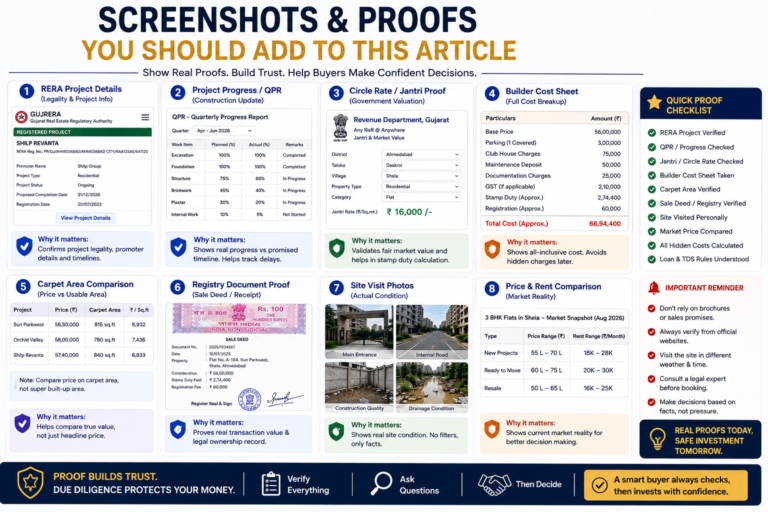
Screenshots and Proofs You Should Add to This Article
Who This Guide Is NOT For
This guide is not for someone who wants a guaranteed quick return.
It is not for:
- short-term flippers;
- speculative buyers chasing rumours;
- people buying solely because “prices will double”;
- buyers who cannot comfortably afford the EMI;
- buyers who refuse independent legal verification;
- people who need immediate resale liquidity;
- buyers who are depending entirely on an unbuilt future infrastructure project.
You should seriously consider waiting if:
Your EMI will stretch your monthly finances
A property should not consume so much of your income that you cannot handle:
- emergency expenses;
- job changes;
- education costs;
- medical expenses;
- family obligations.
You are buying only because the broker says prices will rise
That is not an investment thesis.
You haven’t visited the location at peak traffic
Don’t sign first and investigate later.
You don’t have an emergency fund
A house is a long-term commitment.
You are uncomfortable with the project’s legal documents
Then don’t rationalize the concern away.
If I Were Buying This Property Today
If I Were Buying a 3 BHK in Shela Today
My position would be fairly clear:
I would buy — but only selectively.
I would not rush into the first ₹57–60 lakh listing I saw.
I would prefer:
A ready-to-move or genuinely completed 3 BHK with clean documentation, usable carpet area and good road access over an under-construction project with a slightly lower headline price.
Why?
Because at this budget, certainty matters.
I can physically inspect a ready apartment.
I can speak to residents.
I can test the water.
I can inspect the lift.
I can inspect the approach road.
I can see the surrounding development.
I can understand the actual view.
That reduces several unknowns.
What would I negotiate hardest?
The complete acquisition cost.
Not just the apartment price.
I would negotiate:
- base price;
- parking;
- floor premium;
- maintenance deposit;
- documentation/administrative charges;
- payment schedule;
- included fittings.
One red flag I would not ignore
A seller or developer who creates urgency specifically to prevent independent verification.
“Last flat.”
“Price increases tonight.”
“Pay ₹2 lakh today.”
“Documents later.”
“RERA is there, don’t worry.”
These are not reasons to buy.
They are reasons to slow down.
My Preferred Buyer Strategy Under ₹60 Lakh
If I had exactly ₹60 lakh available for the complete purchase, my shortlist would look approximately like this:
Priority 1 — Ready-to-move 3 BHK
Preferably with:
- clear title;
- clean RERA/project documentation;
- reasonable carpet area;
- good road access;
- established society;
- no obvious waterlogging problem.
Priority 2 — Good resale
Especially if the resale gives substantially better carpet area or location.
Priority 3 — Under-construction
Only when:
- the developer has a strong delivery record;
- RERA information is satisfactory;
- the price advantage is meaningful;
- I have enough financial flexibility to wait.
What I would not do
I would not stretch to ₹70–75 lakh merely because a broker says:
“Sir, 3 BHK market is going up.”
If my finances comfortably support ₹70 lakh, that is a different conversation.
But if ₹60 lakh is my real limit, I would stay within my limit.
What Buyers Should Actually Compare
| Factor | Weight |
|---|---|
| Location/Commute | 20% |
| Carpet Area/Layout | 20% |
| Legal/RERA Clarity | 20% |
| Construction Quality | 15% |
| Total Purchase Cost | 15% |
| Resale/Rental Potential | 5% |
| Amenities | 5% |
Notice something?
Amenities get only 5%.
That’s deliberate.
A swimming pool will not compensate for:
- bad drainage;
- poor road access;
- weak construction;
- legal uncertainty;
- an unsuitable floor plan.
Final Verdict
If you are searching for 3 BHK flats in Shela under ₹60 lakhs, don’t treat ₹60 lakh as a shopping number.
Treat it as a risk-management exercise.
The right property is not necessarily:
- the newest;
- the tallest;
- the one with the biggest clubhouse;
- the one with the biggest discount;
- or the one a broker says will appreciate fastest.
The right property is the one where:
the location works, the carpet area makes sense, the complete cost fits your finances, the documents survive independent verification, the construction quality is acceptable, and you would still be comfortable owning it if prices remained flat for several years.
That last test is powerful.
If you would hate the property without appreciation, don’t buy it as a home.
If the numbers work even without a speculative price increase, the property deserves serious consideration.
And if the documents, infrastructure or total cost don’t make sense?
Walk away.
There will always be another flat.
There may not be another opportunity to recover money lost on a bad purchase.
A practical next step
Before paying any token amount, create a one-page comparison sheet for 3–5 Shela properties covering:
- total price;
- carpet area;
- ₹/carpet sq ft;
- RERA status;
- possession;
- parking;
- maintenance;
- road access;
- drainage/water;
- legal verification;
- expected EMI;
- resale potential.
If a property cannot survive that comparison, it should not survive your booking decision either.
FAQ — Real Buyer Doubts
What should I check before buying a 3 BHK under ₹60 lakh in Shela?
Are 3 BHK flats under ₹60 lakh in Shela usually ready to move?
What is the biggest hidden cost when buying a 3 BHK in Shela?
How do I compare two 3 BHK flats with similar prices?
Is carpet area more important than super built-up area?
References
About the Author