
Buying a home is one of the biggest financial decisions most families will ever make. Yet one question comes up repeatedly from buyers visiting Shela:
“Prices were lower a year ago. Why have they gone up so quickly? Should I buy now or wait?”
I’ve heard this question from first-time buyers, NRIs, investors, and families upgrading from older parts of Ahmedabad. Many walk into site offices expecting straightforward answers. Instead, they’re met with sales pitches, “limited-period offers,” and claims that prices will rise again next month.
The result is confusion.
Some buyers rush into a booking because they fear missing out. Others delay for years, hoping prices will fall, only to discover that the home they wanted has become even less affordable.
In my experience advising buyers in Ahmedabad’s western residential markets, the biggest mistake isn’t buying at the wrong time—it’s buying (or waiting) for the wrong reasons.
Most online articles about Shela simply say:
- Infrastructure is improving.
- Demand is increasing.
- Prices are rising.
While those statements may be true, they don’t answer the question every serious buyer should ask:
Why are prices rising, and are those increases actually justified?
Those are two very different questions.
Some price increases are backed by genuine improvements such as better road connectivity, stronger end-user demand, and quality residential development. Others are driven by speculation, marketing hype, or temporary supply shortages.
Understanding the difference can save you lakhs of rupees and help you avoid buying into a project that looks attractive today but struggles to hold its value over the next five to ten years.
This guide isn’t written to convince you that Shela is the perfect place to buy.
Instead, it’s designed to help you understand:
- Why property prices are rising in Shela.
- Which factors genuinely support long-term value.
- Which price increases deserve caution.
- What I’d personally verify before paying today’s prices.
- When waiting may actually be the smarter financial decision.
If, by the end of this guide, you decide not to buy immediately because the numbers don’t work for your situation, that’s a successful outcome too. Good real estate advice isn’t about encouraging every purchase—it’s about helping you make the right one.
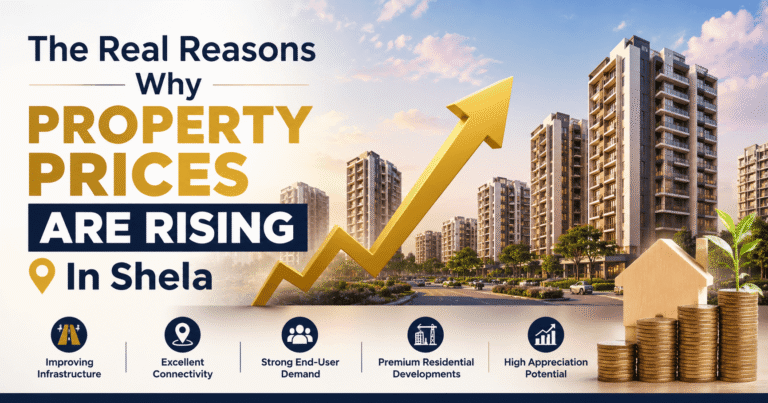
The Real Reasons Why Property Prices Are Rising In Shela
Property prices rarely increase because of a single reason. In most healthy residential markets, appreciation happens when several factors improve together—buyer demand, infrastructure, employment, connectivity, and the availability of quality housing.
Shela is a good example of this. Over the past few years, it has transitioned from being seen as an emerging suburb to becoming one of western Ahmedabad’s preferred residential destinations. However, not every increase in price is automatically justified. As a buyer, it’s important to understand which factors genuinely support long-term value and which ones may simply create short-term excitement.
Let’s look at the key reasons behind the rise in property prices.
1. Genuine End-User Demand Is Stronger Than Before
One of the healthiest signs in any residential market is consistent demand from genuine homebuyers rather than only investors.
From my observations during buyer consultations, Shela attracts several types of purchasers:
- Young IT and corporate professionals upgrading from older apartments.
- Families looking for larger 2 and 3 BHK homes.
- Business owners relocating closer to western Ahmedabad.
- NRIs planning a future move back to the city.
- Long-term investors seeking residential assets with stable appreciation.
This diversity matters because it creates a balanced market. When a locality depends on just one category of buyer, prices can become volatile if that group exits the market. In contrast, a mix of end-users and investors generally supports more stable growth over time.
Buyer Tip:
Ask the sales team how many units have been purchased by end-users versus investors. A project with a healthy proportion of owner-occupiers often develops into a stronger community, which can improve long-term livability and resale potential.
2. Infrastructure Has Improved Significantly
Property values often follow infrastructure improvements. Better roads, utilities, drainage, and public services make an area more practical for everyday living.
In Shela, improvements in internal roads and surrounding civic development have increased buyer confidence. Planned infrastructure also encourages reputable developers to launch new residential projects, further enhancing the area’s appeal.
However, buyers should distinguish between:
- Infrastructure that is already completed.
- Infrastructure currently under construction.
- Infrastructure that exists only in future plans.
A premium price is easier to justify when the supporting infrastructure is operational rather than merely proposed.
Mistake to Avoid:
Never pay today’s premium solely based on a promised future road or civic project without checking its current status and implementation timeline.
3. Better Connectivity Makes Daily Life Easier
Improved connectivity is one of the biggest reasons families consider Shela.
Residents can access several important parts of western Ahmedabad more conveniently than in the past. Reduced travel time to workplaces, educational institutions, healthcare facilities, and commercial zones has made the locality increasingly attractive for end-users.
Convenient access doesn’t just improve daily life—it also supports stronger resale demand because future buyers often prioritize commuting convenience.
Buyer Tip:
During your site visit, drive the route to your workplace during peak traffic hours instead of relying on estimated travel times provided in brochures.
4. Limited Supply of Premium Residential Projects
Many buyers assume that a higher number of projects automatically means excess supply. That’s not always the case. While Shela has seen substantial residential construction, the availability of well-planned premium projects with strong layouts, quality construction, and reputable builders remains comparatively limited. This is one of the key reasons explained in our guide on Property Prices Are Rising In Shela.
This creates a situation where:
- Good projects maintain steady booking momentum.
- Average projects compete more aggressively on pricing.
- Premium developments often command higher valuation because of buyer preference.
When quality inventory is limited, buyers are generally willing to pay more for projects that meet their expectations.
Lesson: Don’t compare prices between two projects without comparing specifications, construction quality, amenities, floor plans, location advantages, and builder reputation. A detailed comparison helps you understand the real value behind the price rather than choosing solely based on cost.
5. Rising Land Costs Affect Property Prices
Every residential project begins with land acquisition, and land prices have increased in many parts of western Ahmedabad.
Higher land acquisition costs directly influence:
- Base selling prices.
- Development expenses.
- Financing costs.
- Project feasibility.
Developers purchasing land at today’s prices often have little flexibility to sell apartments at rates similar to projects launched several years earlier.
However, expensive land alone doesn’t justify every price increase. Buyers should still assess whether the overall product delivers proportional value.
6. Urbanization Continues to Expand Westward
As Ahmedabad continues to grow, urbanization naturally extends toward newer residential corridors.
Families increasingly prefer planned neighborhoods with:
- Wider roads.
- Modern residential projects.
- Better open spaces.
- Organized infrastructure.
- Improved lifestyle amenities.
This gradual shift has made Shela more attractive than many older, densely developed localities where redevelopment opportunities are limited.
Growing urbanization often supports long-term residential demand, particularly when civic planning keeps pace with population growth.
7. Lifestyle Expectations Have Changed
Today’s buyers aren’t just purchasing square footage—they’re investing in a better lifestyle.
Many families now prioritize:
- Security.
- Children’s play areas.
- Clubhouses.
- Green spaces.
- Fitness facilities.
- Walking tracks.
- Community spaces.
- Better overall livability.
Projects that successfully combine these features with thoughtful design often attract stronger buyer interest, allowing them to maintain premium pricing.
That said, attractive amenities shouldn’t distract you from evaluating the basics:
- Construction quality.
- Water supply.
- Maintenance planning.
- Parking.
- Natural ventilation.
- Carpet area efficiency.
A beautiful clubhouse cannot compensate for poor construction or an inefficient apartment layout.
8. Employment Growth Supports Housing Demand
Residential markets become healthier when employment opportunities expand nearby.
As commercial activity grows across western Ahmedabad, more professionals seek homes that reduce commuting time and improve work-life balance.
Stable employment generates:
- Consistent home loan eligibility.
- Higher purchasing power.
- Better affordability for genuine buyers.
- Long-term housing demand.
Markets driven by employment growth are generally more resilient than those fueled only by speculation.
9. Migration Is Bringing New Buyers
Internal migration from other parts of Ahmedabad and nearby cities has contributed to increasing housing demand.
Many families relocating for work, education, or improved living standards consider Shela because it offers relatively newer residential developments compared with older established neighborhoods.
This expanding buyer base helps maintain market activity even during periods when investor demand slows.
10. Limited Ready Possession Inventory
Many buyers prefer immediate possession over waiting several years for under-construction projects.
When ready-to-move inventory is limited but demand remains healthy, prices for completed homes often increase.
Buyers are frequently willing to pay a premium for:
- Immediate occupancy.
- Lower construction risk.
- Visible project quality.
- Established community living.
However, always compare the premium you’re paying against the benefits of avoiding construction delays.
11. Financing Has Become More Accessible
Improved access to mortgage and financing options has made homeownership possible for a wider range of buyers.
Lower down-payment planning, longer loan tenures, and competitive interest rates (when available) can increase purchasing activity.
But affordability shouldn’t be judged only by monthly EMIs.
A home is affordable only if you can comfortably manage:
- EMI payments.
- Maintenance charges.
- Registration costs.
- Interior expenses.
- Emergency savings.
Stretching your budget to buy a premium apartment may create unnecessary financial stress later.
12. Long-Term Investment Confidence
Many buyers view Shela as a long-term investment rather than a short-term trading opportunity.
Historically, residential markets with improving infrastructure, healthy demand, and planned development tend to experience gradual appreciation rather than sudden price spikes.
That said, no market rises indefinitely.
Future returns depend on several variables, including:
- Economic conditions.
- Interest rates.
- New project launches.
- Supply-demand balance.
- Government policies.
- Overall market sentiment.
Buying solely because “prices always go up” is rarely a sound investment strategy.
Read More:- New Launch Luxury Apartments In Shela 2026
The Real Problems Buyers Face in Shela
Property prices may be rising in Shela, but that doesn’t mean every buying decision is a good one.
In fact, some of the biggest financial mistakes I’ve seen had nothing to do with buying in the “wrong” location. They happened because buyers trusted marketing claims, skipped due diligence, or made decisions under pressure.
A rising market can create confidence—but it can also create complacency.
This section isn’t about discouraging you from buying in Shela. It’s about helping you recognize the risks that can turn a good investment into an expensive lesson.
Problem 1: Price Confusion — Why Similar Flats Have Very Different Prices
One of the first questions buyers ask is:
“Why is this 3 BHK priced ₹20–30 lakh higher than another project just a kilometer away?”
The assumption is often that a higher price automatically means a better property.
Unfortunately, that’s not always true.
Two apartments in the same locality can have significantly different prices because of factors such as:
- Land acquisition cost
- Builder reputation
- Construction quality
- Floor plan efficiency
- Carpet area versus super built-up area
- Amenities and maintenance standards
- Floor level and view
- Project density
- Possession timeline
- Future infrastructure nearby
Many buyers compare only the total sale price and overlook these differences.
What I’ve Seen
I’ve met buyers who rejected a slightly more expensive project because it looked costly at first glance. A year later, they realized the cheaper project had:
- Smaller usable carpet area
- Higher maintenance charges
- Poor ventilation
- Lower resale demand
- Delayed possession
The initial savings disappeared over time.
Buyer Tip
Instead of asking:
“Which apartment is cheaper?”
Ask:
“Which apartment gives me better long-term value?”
That question usually leads to a much smarter decision.
Problem 2: Fake Urgency Created by Sales Teams
Almost every buyer has heard statements like:
- “Only two units are left.”
- “Prices will increase tomorrow.”
- “Today’s offer won’t be available next week.”
- “The builder has already decided the next price revision.”
Sometimes these statements are true.
Many times, they’re simply sales techniques designed to speed up your decision.
A Simple Rule I Follow
If a property is genuinely good today, it should still look good after you’ve verified:
- RERA details
- Legal documents
- Price comparison
- Builder reputation
- Loan eligibility
If taking two or three days to verify these points causes you to lose the apartment, that’s unfortunate—but buying without verification could cost you far more.
Buyer Tip
Never let artificial urgency replace proper due diligence.
Problem 3: Hidden Costs That Increase Your Budget
Many buyers calculate affordability using only the advertised apartment price.
The final amount payable is usually much higher.
Additional expenses may include:
- Stamp duty and registration
- GST (where applicable)
- Parking charges
- Clubhouse membership
- Maintenance deposit
- Legal documentation fees
- Interior work
- Utility connection charges
- Moving expenses
These costs can add several lakhs to your total budget.
Common Mistake
A buyer secures loan approval for the apartment but forgets to budget for interiors and registration costs.
The result?
Personal loans, credit card debt, or financial stress immediately after possession.
Buyer Tip
Prepare a complete cost sheet before paying the booking amount.
If the builder or salesperson hesitates to provide a detailed breakup, consider it a warning sign.
Problem 4: Choosing the Wrong Builder
A great location cannot compensate for a poor developer.
I’ve seen buyers focus entirely on location while ignoring questions like:
- Has the builder delivered previous projects on time?
- What is the construction quality after five years?
- How responsive is the builder after possession?
- Are existing residents satisfied?
Builder credibility affects much more than possession timelines.
It influences:
- Construction quality
- Maintenance standards
- Future resale value
- Rental demand
- Buyer confidence
Buyer Tip
Visit one or two completed projects by the same builder.
Talk to residents—not just the sales team.
Residents usually provide the most honest feedback.
Problem 5: Buying the Wrong Location Within Shela
Many people think of Shela as a single market.
In reality, every micro-location has different characteristics.
Some areas offer:
- Better connectivity
- Less traffic
- Better future infrastructure
- Stronger residential surroundings
Others may experience:
- Construction congestion
- Slower development
- Higher noise levels
- Limited civic amenities
What Buyers Often Miss
They compare projects instead of comparing locations.
Even an excellent apartment may underperform if the surrounding neighborhood develops slowly.
Buyer Tip
Spend time exploring the locality at different times of the day.
Visit on:
- Weekday mornings
- Evenings
- Weekends
You’ll notice traffic patterns, noise levels, and neighborhood activity that brochures never mention.
Problem 6: End-User vs Investment Confusion
One of the most expensive mistakes is buying with unclear objectives.
Ask yourself:
Are you buying to live here or to earn returns?
The answer changes everything.
If You’re an End-User
Your priorities should include:
- Daily commute
- School access
- Safety
- Community
- Livability
- Construction quality
- Long-term maintenance
If You’re an Investor
You’ll likely focus more on:
- Appreciation potential
- Rental yield
- Future demand
- Resale liquidity
- Entry valuation
Trying to satisfy both goals equally often results in compromises.
Problem 7: Overstretching Your Budget
Banks may approve a loan amount that exceeds what you’re comfortably able to repay.
That doesn’t mean you should borrow the maximum.
Homeownership involves more than monthly EMIs.
Consider ongoing expenses such as:
- Maintenance charges
- Property tax
- Insurance
- Repairs
- Furnishing
- Emergency savings
My Advice
Choose a home that allows you to sleep peacefully—not one that keeps you worried about the next EMI.
Financial stability is more valuable than owning a slightly larger apartment.
Problem 8: Ignoring Future Supply
Many buyers assume that if prices are rising today, they’ll continue rising indefinitely.
But property markets are influenced by demand-supply dynamics.
If several large residential projects are launched simultaneously, available inventory may increase faster than buyer demand.
This doesn’t necessarily reduce prices, but it can:
- Slow appreciation
- Increase negotiation opportunities
- Extend resale timelines
Buyer Tip
Before booking, ask:
- How many new projects are expected nearby?
- How much unsold inventory already exists?
- Are prices increasing because of real demand or limited supply?
Understanding market balance helps you avoid overpaying.
Problem 9: Believing Every Investment Promise
One phrase I’ve heard repeatedly is:
You’ll definitely double your money.
No responsible advisor can guarantee that.
Real estate depends on:
- Market cycles
- Economic conditions
- Infrastructure execution
- Interest rates
- Buyer demand
- Government policies
Anyone promising guaranteed appreciation is simplifying a market that is naturally uncertain.
My Rule
If projected returns sound too good to be true, verify the assumptions behind them.
Ask for:
- Recent transaction data
- Comparable sales
- Historical price trends
- Rental demand evidence
Evidence should always outweigh optimism.
Problem 10: Skipping Independent Verification
Perhaps the biggest mistake of all is relying entirely on the builder’s presentation.
Marketing materials are designed to highlight strengths.
Your job is to identify risks.
Always verify independently:
- RERA registration
- Approved plans
- Title documents
- Loan approvals from reputed banks
- Construction progress
- Possession timelines
A few hours of verification today can prevent years of regret later.
Step-by-Step Buyer Action Plan
After understanding why property prices are rising in Shela and the common mistakes buyers make, the next question is:
“What should I actually do before booking a flat?”
This is the framework I use when advising buyers. It isn’t designed to help you book a property quickly—it’s designed to help you avoid buying the wrong one.
You don’t need to complete every step in a single day. In fact, spreading the process over a week or two often leads to better decisions because it reduces emotional pressure.
Step 1: Select the Right Location Before the Right Project
Most buyers start by choosing a project.
I recommend doing the opposite.
Choose the micro-location first, then compare projects within that area.
Even in Shela, different pockets offer different advantages. Some are better connected, some are quieter, while others may benefit from future infrastructure or have stronger residential surroundings.
What I Check
Distance to workplace
Schools and colleges
Hospitals
Daily shopping needs
Public transport availability
Road width and traffic movement
Future infrastructure projects
Flood or waterlogging history
Noise levels during peak hours
Why It Matters
A good apartment in the wrong location often underperforms over time.
On the other hand, an average apartment in a strong neighborhood can deliver better long-term appreciation and resale demand.
Common Mistake
Many buyers visit only on Sunday mornings when traffic is light.
Visit the locality:
- Monday evening
- Friday evening
- Weekend afternoon
You’ll understand daily life much better.
Step 2: Validate the Property Price
One of the biggest reasons buyers overpay is that they never compare similar properties.
Instead of asking,
“Is this apartment worth ₹1.20 crore?”
Ask,
“Compared to similar projects nearby, is this price justified?”
Compare These Factors
- Carpet area
- Super built-up area
- Floor level
- Construction specifications
- Amenities
- Parking allocation
- Maintenance charges
- Builder reputation
- Possession timeline
- Future development around the project
My Personal Rule
I never compare only the total price.
I compare price per usable square foot and the overall value delivered.
Sometimes a slightly more expensive apartment is actually the better financial decision because it offers superior construction quality, better layouts, or stronger resale potential.
Buyer Tip
Compare at least three to five similar projects before making any decision.
If you compare only one project, you don’t have a market benchmark.
Step 3: Verify the Builder and RERA Registration
A builder’s reputation should never be judged solely by advertisements or sample flats.
The most reliable information usually comes from completed projects and official records.
What I Verify
RERA registration
Project approval status
Delivery history
Construction quality
Occupancy Certificate (if applicable)
Customer reviews from existing residents
Previous project delays
Legal disputes, if any
Questions I Ask Existing Residents
- Was possession delivered on time?
- Any construction quality issues?
- How responsive is the builder after possession?
- Are maintenance charges reasonable?
- Would you buy from the same builder again?
Those answers are often more valuable than an hour-long sales presentation.
Red Flags
Multiple delayed projects
Unclear legal approvals
Frequent design changes
Numerous customer complaints
Pressure to pay without documentation
If you notice several red flags together, it’s worth reconsidering the project.
Step 4: Conduct a Proper Site Visit
A beautifully designed sample apartment can hide several practical issues.
That’s why I spend more time outside the sample flat than inside it.
Exterior Checklist
- Road access
- Entry and exit points
- Visitor parking
- Drainage
- Open spaces
- Construction quality
- Safety measures
- Nearby commercial activity
Apartment Checklist
- Natural lighting
- Cross ventilation
- Ceiling height
- Layout efficiency
- Balcony usability
- Storage space
- Lift accessibility
- Privacy between apartments
Things Buyers Often Forget
- Mobile network quality
- Water pressure
- Generator backup
- Noise from nearby roads
- Future construction nearby
These affect daily living much more than expensive lobby interiors.
Step 5: Complete Legal and Registry Checks
Never assume that because a project is popular, every document is automatically in order.
Legal verification is one of the least exciting parts of buying a home—but it’s also one of the most important.
Documents to Verify
RERA registration certificate
Title documents
Approved building plans
Development permissions
Land ownership records
Bank approvals
Occupancy Certificate (Ready projects)
Completion Certificate
Sale agreement draft
Why This Matters
Legal issues can affect:
- Loan approval
- Future resale
- Property registration
- Ownership security
My Advice
Always have the documents reviewed by an independent property lawyer.
The legal fee is small compared to the value of your investment.
Step 6: Negotiate Like a Buyer, Not Like a Bargain Hunter
Many buyers believe negotiation only means asking for a lower price.
In reality, value can come in several forms.
You Can Negotiate
- Base price
- Floor rise charges
- Parking charges
- Clubhouse fees
- Interior upgrades
- Flexible payment schedules
- Waiver of certain administrative charges
- Additional fittings or specifications
Timing Matters
Builders are often more flexible:
- At the end of a financial quarter
- Near project completion
- During inventory clearance
- When sales targets need to be achieved
That doesn’t guarantee discounts, but it can improve your negotiating position.
One Important Rule
Negotiate respectfully.
A builder is far more likely to work with a buyer who is informed and realistic than someone making unreasonable demands.
Real Buyer Case Studies
Disclaimer: The following case studies are based on realistic buyer scenarios created from common market patterns and buyer advisory experience. Individual results vary depending on purchase price, project quality, market conditions, financing, and holding period. They should be used as learning examples—not as a guarantee of future returns.
One of the biggest problems with real estate blogs is that they often discuss theory without showing how actual decisions play out.
As a buyer advisor, I’ve found that people learn more from real scenarios than from generic advice. The following examples illustrate how two different buyers approached the Shela market—and why their outcomes were different.
Case Study 1 – A Family Buying Their Forever Home
Buyer Profile
- Buyer: Amit & Neha Shah (Working Couple)
- Occupation: IT Professional and Chartered Accountant
- Family: Couple with one school-going child
- Objective: End-use (Not Investment)
- Budget: ₹1.15 Crore (Including Registration & Interiors)
- Loan Requirement: 70%
Their Biggest Concern
The family had already visited six residential projects in Shela.
Every salesperson claimed:
- “Our project is appreciating the fastest.”
- “Book today before prices increase.”
- “Only premium inventory is available.”
After three weekends of site visits, they were more confused than when they started.
Their biggest question became:
“Which project actually offers the best long-term value for our family?”
What We Evaluated Together
Instead of focusing only on price, we compared:
- Carpet area efficiency
- Daily commute to workplaces
- School accessibility
- Construction quality
- Builder’s delivery history
- Future infrastructure nearby
- Maintenance costs
- Community occupancy
- Natural ventilation
- Long-term resale demand
The Decision
Rather than choosing the cheapest apartment, they selected a project priced about 6% higher than another nearby option.
Why?
Because the project offered:
- Better layout efficiency
- Larger usable living spaces
- Stronger builder reputation
- More natural light and ventilation
- Better road access
- Lower expected maintenance issues
Financial Snapshot
Particular | Value |
Purchase Price | ₹1.08 Crore |
Registration & Other Charges | ₹7.5 Lakh |
Interior Cost | ₹9 Lakh |
Total Investment | ₹1.24 Crore |
Three Years Later
Approximate Market Value:
₹1.34–₹1.40 Crore (Illustrative Example)
What mattered most wasn’t appreciation.
The family reported:
- Better quality of life
- Reduced commuting stress
- Good community environment
- Stable maintenance
- Strong satisfaction with construction quality
Biggest Lesson
Buying the better project—not necessarily the cheaper one—proved to be the right decision.
Their success came from evaluating overall value rather than chasing the lowest price.
Case Study 2 – A Long-Term Investor
Buyer Profile
- Buyer: Raj Patel
- Occupation: Business Owner
- Objective: Wealth Creation
- Holding Period: 8–10 Years
- Investment Budget: ₹90 Lakh
Initial Thinking
Raj initially wanted to purchase the project with the biggest advertised discount.
His assumption was simple:
Lower purchase price = Higher future profit.
Unfortunately, that’s rarely how residential real estate works.
What Changed
Instead of buying immediately, he spent another month researching:
- Existing inventory
- Rental demand
- Future commercial development
- Upcoming infrastructure
- Historical price movement
- Builder credibility
Final Purchase
He selected a project that was:
- Slightly more expensive
- Better located
- Developed by a builder with a strong delivery record
Financial Snapshot
Particular | Value |
Purchase Price | ₹88 Lakh |
Monthly Rent After Possession | ₹24,000–₹28,000 (Illustrative) |
Approximate Gross Rental Yield | Around 3–3.5% |
Investment Horizon | Long Term |
What Worked
Purchased below future launch pricing
Good tenant demand
Reliable builder
Healthy residential community
Stable appreciation instead of speculative spikes
What Didn’t
The investor initially expected appreciation to happen much faster.
Reality was different.
Property values increased gradually rather than dramatically.
Fortunately, rental income reduced holding costs while waiting for long-term appreciation.
Biggest Lesson
Patience created returns—not speculation.
Real estate rewards disciplined investors more often than impatient ones.
Case Study 3 – The Buyer Who Walked Away
Not every successful decision ends with a purchase.
Sometimes, walking away is the smartest move.
Buyer Profile
- Buyer: First-Time Homebuyer
- Budget: ₹95 Lakh
- Objective: End-Use
What Happened
The buyer shortlisted a newly launched project after seeing attractive pricing and luxurious amenities.
During document verification, several concerns emerged:
- Construction approvals were still incomplete.
- The builder had delayed two earlier projects.
- Sales representatives avoided providing clear written commitments.
- Future infrastructure was presented as “confirmed,” but no official notification could be verified.
Instead of paying the booking amount, the buyer decided to wait.
Eight months later, the project faced further delays.
Biggest Lesson
Sometimes the best investment decision is not investing until important questions have been answered.
Walking away from uncertainty is not missing an opportunity—it’s protecting your capital.
Comparing the Three Buyers
Factor | Family Buyer | Investor | Buyer Who Walked Away |
Primary Goal | Comfortable Living | Long-Term Wealth | Risk Avoidance |
Purchase Decision | Yes | Yes | No |
Main Success Factor | Better Location & Builder | Patience & Research | Independent Verification |
Biggest Mistake Avoided | Choosing Only by Price | Chasing Quick Profits | Ignoring Legal Risks |
Outcome | High Satisfaction | Stable Appreciation & Rental Income | Avoided Potential Losses |
What These Case Studies Teach Us
Although each buyer had different objectives, they shared several habits that contributed to better decisions:
1. They Compared Multiple Projects
None of them booked the first apartment they visited.
Comparing projects gave them realistic expectations about pricing, layouts, and builder quality.
2. They Focused on Long-Term Value
Instead of asking:
“How much can I negotiate today?”
They asked:
“Will I still be happy with this decision five years from now?”
That change in mindset often leads to better outcomes.
3. They Verified Information Independently
Rather than relying solely on brochures or verbal assurances, they checked:
- Legal approvals
- Builder history
- Project documentation
- Market pricing
- Surrounding development
Independent verification reduced the chances of making an emotional decision.
4. They Matched the Property to Their Goal
The family prioritized daily living.
The investor prioritized sustainable returns.
The third buyer prioritized risk management.
Each decision aligned with a clear objective instead of market hype.
Conclusion:
Property prices in Shela are rising because of a combination of stronger end-user demand, improving infrastructure, better connectivity, premium residential developments, and long-term urban growth. While these factors support the area’s growing popularity, they do not automatically justify the asking price of every project. The smartest buyers look beyond marketing claims and carefully evaluate the builder, location, legal approvals, construction quality, and overall value before making a decision.
Whether you’re buying a home for your family or investing for the future, focus on informed decision-making rather than market hype. Compare multiple projects, verify RERA and legal documents, visit the site personally, and stay within your financial comfort zone. A well-researched purchase is far more valuable than a rushed one, and the right property is the one that aligns with your long-term goals—not simply the one that’s generating the most buzz.
Why Property Prices Are Rising In Shela :FAQs
1. Why are property prices rising in Shela?
2. Is Shela a good location for property investment?
3. Should I buy property in Shela now or wait?
4. What factors affect property prices in Shela the most?
5. How can I verify if a property's price is justified?
Reference
About the Author

Mitesh Vyas
Hello My Name is Mitesh Vyas i am a Real Estate content writer and Property Market Enthusiast I shares practical insights on buying, selling, investing, and understanding real estate trends. With a strong focus on residential and commercial properties, My aims to help readers make informed property decisions through clear, research-based, and easy-to-understand content.