
A buyer recently starts comparing two properties.
One is in Shela.
The other is in Ghuma.
The broker says:
“Sir, Shela has already developed. Buy now before prices go up.”
Another salesperson says:
“Ghuma is cheaper today, so appreciation will be much higher.”
Then comes the familiar pressure:
“This price is only for today.”
At this point, many investors make the wrong comparison. They compare today’s price instead of comparing the entire investment.
I have seen this mistake repeatedly in developing residential markets: investors buy the cheapest property believing that a lower entry price automatically means higher returns.
It doesn’t.
A ₹4,500-per-sq-ft property in the wrong location can underperform a ₹5,500-per-sq-ft property with better rental demand, access, construction quality and resale liquidity.
That is why property investment in Shela Ahmedabad needs to be evaluated differently from simply searching for a “cheap flat.”
The question is not:
“Which area will grow fastest?”
The better question is:
“Which property can realistically produce an acceptable combination of appreciation, rent, liquidity and downside protection?”
That is what this guide will help you determine.
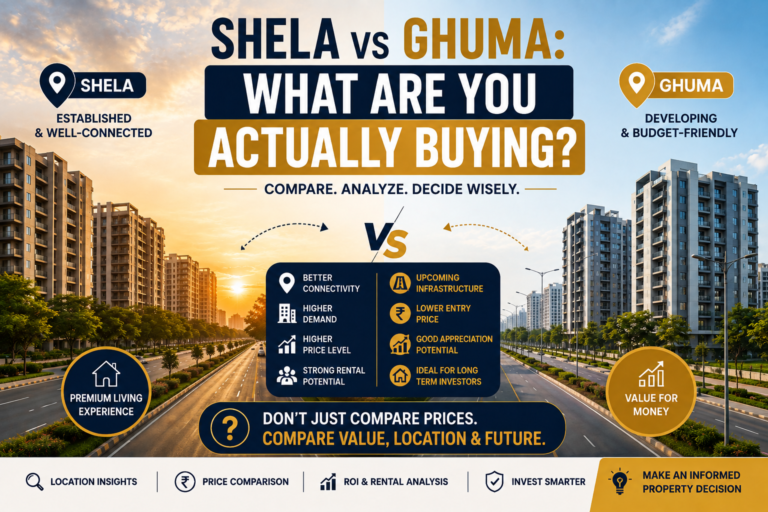
Shela vs Ghuma: What Are You Actually Buying?
Shela and Ghuma are often discussed together because they form part of Ahmedabad’s south-western residential growth belt.
But investors should not treat them as identical markets.
Current Housing.com data puts the average listed property rate in Shela at around ₹6,268/sq ft, while its Ghuma data shows an average around ₹6,057/sq ft. However, the portal’s broader listing mix includes different property types, so these figures should be treated as market indicators rather than exact valuations for an individual apartment.
Magicbricks’ Q2 2026 apartment data gives Shela an average asking rate of approximately ₹5,125/sq ft, with a reported 3 BHK range of roughly ₹4,000–₹5,800/sq ft.
That difference between portals is actually useful.
It proves one important point:
There is no single “Shela property rate.”
Rates vary according to:
- project
- carpet area
- construction age
- location
- floor
- amenities
- builder
- possession status
- apartment orientation
- parking
- exact micro-market
The Biggest Mistakes Investors Make in Shela and Ghuma
Mistake 1: Buying only because the price is low
A low entry price can be attractive.
But if there are:
- few tenants
- weak resale demand
- poor approach roads
- excessive competing inventory
- weak project maintenance
- limited surrounding development
your “cheap” property can remain cheap for a long time.
My rule
Never confuse low price with undervaluation.
Mistake 2: Believing every infrastructure promise
Developing areas naturally attract infrastructure stories.
But there is a major difference between:
- announced infrastructure
- approved infrastructure
- funded infrastructure
- construction underway
- completed infrastructure
An investor should assign different values to each.
For example, the Ahmedabad Peri-urban Livability Improvement Project includes a sewerage network and sewage treatment plant package covering Ghuma, Shela, Manipur-Godhavi and Sanathal-Telav areas. That is meaningful infrastructure context, but investors should still distinguish between a project being planned/implemented and infrastructure already benefiting a specific property’s daily living conditions.
Mistake 3: Assuming appreciation will continue at the same rate
Property doesn’t rise in a straight line.
A locality can experience:
- rapid appreciation
- price consolidation
- oversupply
- slower growth
- renewed demand
Current data itself shows why investors need to remain cautious. Housing.com’s Shela page currently reports a year-on-year decline of roughly 3.85% in its tracked average, while its Ghuma page reports a 5.87% decline. Other property portals show different movements because their datasets and property mixes differ.
The correct conclusion is not:
“Prices are falling, so don’t buy.”
Nor is it:
“Prices always rise, so buy immediately.”
The correct conclusion is:
Market-cycle timing matters, and individual property selection matters even more.
Step-by-Step Property Investment Action Plan
Step 1: Location Selection
Before comparing builders, compare micro-locations.
For an investment property, I would investigate:
- road connectivity
- proximity to established residential areas
- schools
- hospitals
- grocery and daily retail
- employment corridors
- public transport
- upcoming infrastructure
- surrounding construction
- water and drainage
- tenant profile
Why it matters
An investment property ultimately needs a future buyer or tenant.
If the location is inconvenient, appreciation may not compensate for weak rental demand.
Mistake to avoid
Don’t buy because someone says:
“This is only 5 minutes from Shela.”
Measure the journey yourself during peak hours.
Step 2: Budget & Price Validation
Start with the all-in cost, not the advertised price.
Suppose:
Property price: ₹70 lakh
You still need to investigate:
- stamp duty
- registration
- parking
- maintenance deposit
- floor-rise charges
- infrastructure/club charges
- applicable taxes
- legal/documentation expenses
- brokerage where applicable
- furnishing cost
- loan processing costs
Your actual investment may be materially higher than ₹70 lakh.
Why it matters
Suppose your final investment becomes ₹76 lakh.
If you calculate ROI using ₹70 lakh, your return looks better than it actually is.
Pro tip
Maintain two numbers:
Acquisition cost
and
Net investment cost
The second should include reasonable transaction and initial setup costs.
Shela Property Prices: What Current Data Tells Investors
Magicbricks’ Q2 2026 data shows Shela’s average multistorey apartment asking rate at approximately ₹5,125/sq ft, with the reported locality range from roughly ₹4,051 to ₹6,198/sq ft. Its 3 BHK segment is shown around ₹4,000–₹5,800/sq ft.
Current Housing.com listings show how wide the actual market can be. Its Shela page includes examples such as:
- Elenza Castle: approximately ₹64.3–66.3 lakh
- Rashmi Riesen: approximately ₹72 lakh
- Armonia Sky: approximately ₹76 lakh
- Blessings: approximately ₹80.7–92.2 lakh
- The Planet by Venus: approximately ₹94.7 lakh
These are asking/listing prices, not proof of completed transaction values.
Investment implication
Don’t ask:
“Is Shela ₹5,000 or ₹6,000 per sq ft?”
Ask:
“What should this particular apartment be worth compared with similar units?”
That is a much stronger valuation question.
Ghuma Property Prices: Why the Lower Entry Price Can Be Attractive
Ghuma can attract investors because some residential inventory is available at lower ticket sizes.
For example, current Housing.com listings include 3 BHK options around:
- ₹61.8–63 lakh
- ₹70.99 lakh
- ₹75 lakh
depending on project and specifications.
Housing.com’s broader Ghuma property-rate page currently reports an average tracked rate around ₹6,057/sq ft, but also shows a very wide range, reinforcing the importance of property-level comparison.
What this means for an investor
Ghuma can make sense if your strategy is:
lower entry cost + improving infrastructure + longer holding period.
But that strategy carries more dependence on future development.
If you need immediate rental income or easy resale, a more established micro-location may be preferable.
Step 3: Builder & RERA Verification
For an investment property, builder quality matters because you are buying an asset that must retain value after you leave the sales office.
Check:
- Gujarat RERA registration
- promoter details
- project land details
- declared completion date
- construction status
- approvals
- project disclosures
- previous delivery record
- maintenance arrangements
Do not rely only on the builder’s website.
Use the official regulatory record.
A RERA registration certificate identifies the project and promoter and provides a regulatory reference that can be independently checked before investing in Premium 4 and 5 BHK flats in Shela.
Red flag
If the investment case depends heavily on:
“The builder will definitely complete this next year.”
then you are accepting construction-timeline risk.
Step 4: Site Visit Checklist for Investors
Investors often make a different mistake from end-users.
They visit the property once.
That’s not enough.
Visit during:
- weekday morning
- weekday evening
- weekend
- after rainfall if possible
Check:
- access road
- traffic
- parking
- water
- drainage
- lift operation
- electricity backup
- construction activity
- noise
- surrounding vacant land
- nearby commercial development
- occupancy level
One particularly useful test
Ask residents:
“How easy is it to find tenants here?”
Don’t ask the sales office.
Ask residents.
Their answer may be far more useful.
Step 5: Legal & Registry Checks
An investment property is only valuable if your ownership is secure.
Have a qualified property lawyer verify relevant documents such as:
- title
- chain of ownership
- approved plans
- RERA records
- encumbrance-related information
- tax records
- possession documentation
- society/association records for resale property
- outstanding dues
- loan/mortgage status
For resale properties, ask:
Why is the owner selling?
The answer matters.
“Moving abroad” is very different from:
“Everyone is selling because the society has serious problems.”
Never assume the seller’s explanation is automatically true.
Step 6: Negotiation Strategy
The best time to negotiate is after you know the property’s weaknesses.
Don’t negotiate emotionally.
Build your argument around:
- comparable asking prices
- property age
- carpet area
- floor
- condition
- parking
- rental income
- maintenance
- project inventory
- possession status
- seller urgency
- actual transaction costs
Example
Instead of:
“Please reduce ₹5 lakh.”
Say:
“Comparable units are being offered around this range, and after accounting for maintenance, furnishing and transaction costs, my net investment would be ₹X. I can proceed at ₹Y subject to document verification.”
That is a serious investor conversation.
ROI: What Should an Investor Actually Calculate?
Do not calculate ROI only from appreciation.
Use at least four measures.
1. Capital appreciation
Selling price − total acquisition cost
2. Gross rental yield
Formula:
Annual rent ÷ property purchase price × 100
Example:
Purchase price = ₹70 lakh
Monthly rent = ₹20,000
Annual rent = ₹2.4 lakh
Gross yield:
₹2.4 lakh ÷ ₹70 lakh × 100
= approximately 3.43%
That’s reasonable as an illustrative residential yield, but it is not extraordinary.
3. Net rental yield
Subtract:
- maintenance
- vacancy
- repairs
- property management
- other recurring costs
Then calculate again.
Your real return will be lower than the headline gross yield.
4. Total return
A serious investor should eventually consider:
Rental income + capital appreciation − transaction costs − holding costs
That gives a more realistic picture.
Realistic Case Study
Case Study 1: End-User Family
The following is an illustrative scenario, not a claimed real client transaction.
A family wants a home in the Shela-Ghuma corridor.
Budget
₹80 lakh all-in
Location
Shela, with preference for established surrounding development
Purchase price
₹70 lakh
Additional acquisition/setup costs
Approximately ₹7–8 lakh, depending on applicable charges and furnishing requirements
Effective initial outlay
Approximately ₹77–78 lakh
Holding period
5 years
Illustrative current value
₹92 lakh
Approximate capital increase
₹92 lakh − ₹78 lakh = ₹14 lakh
The family also received the benefit of living in the property.
Lesson
For an end-user, this may be a successful purchase even if the investment return isn’t spectacular.
Why?
Because the property delivered:
- housing utility
- lifestyle benefit
- some capital appreciation
End-use value and investment value should not be judged identically.
Case Study 2: Investor
Again, this is an illustrative investment scenario rather than a verified client transaction.
Entry price
₹68 lakh
Acquisition and initial setup
₹74 lakh total
Monthly rent
₹20,000
Gross annual rent
₹2.4 lakh
Gross yield on purchase price
Approximately 3.5%
After vacancy, maintenance and other costs, the effective yield could be closer to 2.5–3%.
Illustrative exit price
₹84 lakh after several years
Capital gain against total initial investment
₹84 lakh − ₹74 lakh = ₹10 lakh
The investment is not spectacular.
But it may still be acceptable if:
- vacancy remained low
- maintenance stayed manageable
- resale demand remained healthy
- the investor had a sufficiently long holding period
What worked
Reasonable entry price.
What didn’t
The investor initially assumed appreciation would be much faster.
Exit strategy
Sell only when the net sale proceeds justify the holding period and transaction costs.
Lesson
A realistic 3% rental yield plus moderate appreciation can be a better investment than a property promising “20% annual growth” without evidence.
Social Proof: What Realistic Buyer Feedback Looks Like
The following examples are illustrative and should not be published as genuine customer testimonials unless they are replaced with verified reviews from actual buyers.
IT Professional
“I originally wanted Ghuma because the entry price was lower. After checking my office commute and rental demand, I decided the slightly higher Shela price made more sense for my strategy.”
PSU Employee
“I stopped comparing only the per-square-foot rate. The total purchase cost changed the ranking of the projects completely.”
NRI Investor
“My biggest mistake would have been buying remotely based on a broker’s recommendation. I now insist on independent document verification and a physical inspection before committing.”
These are useful because genuine investor feedback usually talks about problems solved, not just clubhouse facilities.
Shela vs Ghuma: Which Is Better for Investment?
There is no universal winner.
But I would use this framework.
| Factor | Shela | Ghuma |
|---|---|---|
| Entry-price opportunity | Moderate | Often stronger |
| Existing residential ecosystem | Generally stronger | Developing |
| Rental prospects | Project-dependent | More location-dependent |
| Future infrastructure dependence | Moderate | Higher in some pockets |
| Long-term potential | Good | Potentially good |
| Immediate end-use confidence | Generally stronger in established pockets | Depends heavily on micro-location |
| Investor risk | Moderate | Moderate to higher depending on project |
| Best suited to | End-users + long-term investors | Long-term value-focused investors |
My judgment
If I were buying for my own family, I would generally lean toward a better-established Shela micro-location rather than buying purely for a lower price in Ghuma.
If I were investing with a 7–10 year horizon, I would investigate Ghuma more seriously—but only where the infrastructure and project fundamentals are strong.
Future Growth: What Could Actually Drive Shela and Ghuma?
Future growth should come from fundamentals, not slogans.
Important drivers include:
1. Infrastructure
Roads, drainage, sewerage and connectivity can improve the usability of the area.
The ADB-backed Ahmedabad peri-urban project specifically includes sewerage infrastructure covering Ghuma, Shela and nearby areas.
2. Population growth
More families moving into the corridor can support:
- retail
- schools
- healthcare
- rental demand
- local employment
3. Commercial development
Residential appreciation becomes more sustainable when people can access daily needs without travelling long distances.
4. Connectivity
Improved road connections can reduce perceived distance between developing suburbs and established employment zones.
5. Supply
This is often ignored.
Too many new apartments can suppress:
- rent
- resale prices
- occupancy
- investor returns
Therefore:
Future supply is just as important as future demand.
What Could Go Wrong?
A responsible investment article should discuss downside risk.
Risk 1: Oversupply
If several projects deliver simultaneously, landlords may compete for tenants.
That can reduce rent.
Risk 2: Infrastructure delays
A promised road or drainage improvement may take longer than expected.
Don’t calculate your ROI assuming the best-case completion date.
Risk 3: High purchase price
Buying a good project at an excessive valuation can still produce a poor investment.
Risk 4: Poor liquidity
A property is not truly liquid just because there are many listings online.
You need actual buyer demand.
Risk 5: Rental yield disappointment
If your property generates ₹18,000–₹20,000 rent against a ₹75–80 lakh investment, don’t call it a high-yield property.
Calculate the percentage.
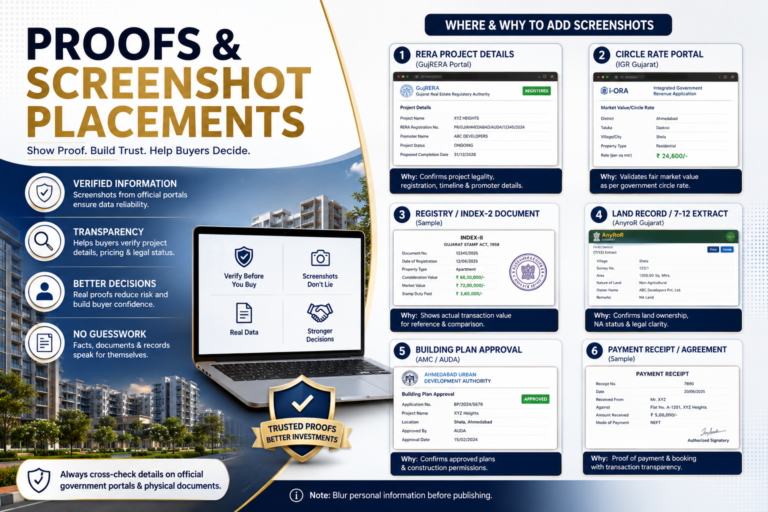
Proofs & Screenshot Placements
Who This Investment Guide Is NOT For
This guide is not for someone looking for:
- three-month flipping
- guaranteed appreciation
- insider information
- broker rumours
- pre-launch speculation
- “double your money” opportunities
It is also not suitable for someone whose purchase would consume nearly all their savings.
You should consider waiting if:
- you have unstable income
- your emergency fund is inadequate
- your expected holding period is under 3–5 years
- you are depending entirely on appreciation
- you cannot tolerate vacancy
- you haven’t verified the property documents
- you are buying only because someone says prices will rise
In such cases, renting or waiting can be financially smarter.
Not buying is also an investment decision.
If I Were Buying This Property Today
I would not chase the cheapest property in Ghuma simply because it has more apparent upside.
For my own money, I would lean toward a well-located property in Shela with stronger existing residential demand, especially if my objective included eventual self-use or easier resale.
My preferred investment would have:
- reasonable entry price
- practical apartment layout
- strong approach road
- good water/drainage situation
- established surrounding development
- reliable builder
- RERA documentation
- reasonable maintenance
- realistic rental potential
- enough comparable properties to establish a valuation
Would I buy now or wait?
I would buy only if I could negotiate a price that was supported by comparable properties.
I would not buy simply because a broker tells me that prices are about to increase.
If the property is clearly overpriced, I would wait.
If the property is fairly valued and legally clean, I would rather buy a good asset than spend a year trying to predict the perfect market bottom.
Which configuration would I choose?
For a residential investment, I would generally favour a well-planned 2 or 3 BHK with broad tenant and resale demand over an unusually large apartment with a narrow buyer pool.
If choosing a 3 BHK, I would prioritise usable carpet area over excessive common-area loading.
What would I negotiate hardest?
The total acquisition cost.
Not just the advertised rate.
One red flag I would never ignore
If the property’s expected appreciation depends on three or four future infrastructure promises, I would walk away unless those projects were independently verifiable and the current valuation already made sense.
Conclusion:
Property investment in Shela Ahmedabad can make sense, but only when the investor separates facts from sales narratives.
Shela currently has a substantial residential market, while Ghuma offers its own lower-entry and future-development opportunities. Current market data shows meaningful variation in asking prices and price trends, which is exactly why investors should avoid one-number valuations.
The strongest investment isn’t necessarily:
- the cheapest flat
- the newest project
- the biggest clubhouse
- the highest promised appreciation
- the project closest to a future road
It is the property where:
Entry price + location + rental demand + construction quality + legal safety + liquidity + future development
come together at a sensible valuation.
If you are evaluating a Shela or Ghuma property, create a simple comparison sheet covering purchase price, all-in cost, rent, rental yield, comparable properties, project risks and realistic exit value.
If the numbers still make sense after removing the broker’s promises, you may have a property worth considering.
If they don’t, walk away.
That decision can save you more money than a successful negotiation.
FAQ: Shela and Ghuma Property Investment
1. Is Shela good for property investment in Ahmedabad?
2. Is Ghuma cheaper than Shela?
3. Should I buy land or a flat in Shela?
4. What rental yield can I expect from property in Shela or Ghuma?
5. Should I wait for Shela or Ghuma property prices to fall?
References
About the Author