
If you are searching for Shela real estate investment 2026, you will probably find two very different opinions.
One person will tell you, “Buy immediately. Prices will go up.”
Another will say, “Shela has already become expensive. Wait for a correction.”
And then there is the broker who has a particular project available today and somehow believes today is always the best day to book.
This is exactly where buyers get into trouble.
In my experience researching residential property markets, the biggest mistake is not necessarily buying in the wrong city. It is buying the right locality at the wrong price, in the wrong project, or for the wrong reason.
Shela has genuine investment potential in 2026. But that does not mean every property in Shela is a good investment.
That distinction matters.
Current market data shows that Shela’s apartment market is still moving upward, but only modestly. Magicbricks’ Q2 2026 data puts the average listed apartment rate around ₹5,125/sq ft, with a roughly 1% quarter-on-quarter increase. Its historical table shows the average moving from ₹4,198/sq ft in 2022 to ₹4,875 in 2025 and ₹5,124 in Q2 2026.
Housing.com reports a higher locality-wide average, around ₹6,268/sq ft, while also reporting a year-on-year decline on its current price-trend page. The difference itself is useful: online portals are measuring different inventories and methodologies, so you should never treat one portal’s average as the exact value of your property.
So, is Shela good for real estate investment in 2026?
My answer: Yes—but selectively, and mainly for buyers with a medium-to-long investment horizon.
If your plan is to buy today and sell six months later for a quick profit, I would not recommend Shela.
If you can hold for 5–7+ years, choose the micro-location carefully, verify the project legally and financially, and buy at a sensible all-in price, the case becomes much stronger.

Why Buyers Get Confused About Shela Real Estate Investment
Imagine a family with ₹90 lakh available for a property.
They visit Shela on Saturday.
The first salesperson shows them a new project and says:
“This is the last few units at this price.”
The second says:
“Prices are increasing every month.”
The third shows a large 3 BHK farther inside Shela at a seemingly attractive price.
The family now has three questions:
- Is Shela actually a good investment?
- Is the quoted price reasonable?
- Should they buy now or wait?
Most property articles don’t answer those questions properly.
They talk about connectivity, amenities, schools and future development—but rarely tell you when the investment case breaks down.
That is what this guide focuses on.
The Reality of Shela Real Estate Investment in 2026
Shela is no longer simply an inexpensive peripheral location where buyers purchase because the entry price is low.
It has developed into a significant residential market in Ahmedabad’s western/south-western growth belt, with apartments, villas, resale homes and new developments competing for buyers. For those evaluating Shela property investment prospects, this mix of housing options also provides different opportunities depending on budget, end-use needs and long-term investment goals.
Current listing data also shows substantial inventory. Magicbricks reports more than 1,100 flats for sale on its current Shela page, with a mixture of resale, ready-to-move and under-construction properties.
That creates both an opportunity and a problem.
The opportunity
You have more properties to compare.
The problem
You have more properties to compare.
That sounds contradictory, but it isn’t.
When inventory is high, buyers don’t need to rush into the first project they see.
They can compare:
- carpet area
- usable layout
- total acquisition cost
- construction quality
- possession status
- maintenance
- location
- resale competition
- rental demand
- developer track record
This is one reason I would be cautious about anyone telling you to “book today because only one unit is left.”
A genuine shortage of one particular unit does not mean there is a shortage of property in Shela.
What Do Property Prices in Shela Look Like in 2026?
There is no single “Shela price.”
The rate varies substantially depending on:
- exact micro-location
- project
- construction age
- developer
- apartment size
- floor
- view
- amenities
- possession status
- road access
- resale versus primary sale
- carpet-to-saleable-area efficiency
Magicbricks’ Q2 2026 data places the average apartment asking rate at about ₹5,125/sq ft, with a reported range of approximately ₹4,051–₹6,198/sq ft on its locality trend page.
Its BHK-wise data shows approximately:
| Configuration | Indicative Listed Range |
|---|---|
| 2 BHK | ₹4,000–₹5,500/sq ft |
| 3 BHK | ₹4,000–₹5,800/sq ft |
| 4 BHK | ₹4,500–₹6,900/sq ft |
These are market/listing indicators, not guaranteed transaction prices.
This distinction is extremely important.
If a developer quotes ₹6,200/sq ft, that does not automatically mean the apartment is worth ₹6,200/sq ft.
And if a resale owner asks ₹5,800/sq ft, that does not mean you should immediately conclude that it is overpriced.
You need to compare the same measurement basis and calculate the total acquisition cost.
Why Shela Can Make Sense as an Investment in 2026
There are several reasons I would keep Shela on an investor’s shortlist.
A relatively established residential ecosystem
Shela is no longer an isolated development zone.
There are already numerous residential projects, resale properties and supporting services.
Housing.com currently lists more than 1,000 flats for sale in Shela and reports hundreds of ready-to-move properties, although portal inventories naturally change over time.
For an investor, an existing residential ecosystem is generally more useful than buying purely on a future-development story.
Why?
Because you can observe actual occupancy and demand.
Look at a project at 8 p.m.
Are balconies occupied?
Are shops functioning?
Are families living there?
Are residents renting?
Are maintenance facilities operating?
Those observations can tell you more than a glossy brochure.
The Biggest Investment Advantage: You Have Choices
One of the strongest arguments for Shela property investment is the range of available configurations.
Current listings include:
- 2 BHK
- 3 BHK
- 4 BHK
- villas
- resale apartments
- ready-to-move homes
- under-construction projects
That creates different investment strategies.
For rental-focused investors
A practical 2 or 3 BHK can potentially offer a broader tenant pool.
For end-users
A larger 3 or 4 BHK may make more sense if the family intends to stay for several years.
For appreciation-focused investors
The best opportunity may not necessarily be the newest luxury project.
A well-located resale property purchased below comparable replacement cost can sometimes provide a better entry point.
This is why I don’t recommend choosing the property first and then trying to justify the investment.
Choose the investment objective first.
But Shela Has Real Risks Too
This is where many “Is Shela a good investment?” articles become too promotional.
Shela is not risk-free.
Risk 1: Paying a premium for the project name
Two properties may be only a few hundred metres apart but have very different pricing.
A premium is justified only when the property provides something buyers will continue to value:
- better location
- better construction
- stronger maintenance
- superior layout
- better access
- established community
- stronger resale liquidity
Don’t pay ₹10–15 lakh extra simply because the brochure looks better.
Risk 2: Infrastructure assumptions
“Future infrastructure” is one of the most abused phrases in property sales.
A proposed road, commercial development or infrastructure improvement can support long-term growth.
But proposed is not completed.
If your investment depends entirely on something that may happen three or five years from now, your investment thesis is fragile.
Verify the planning information from the relevant authority rather than relying on WhatsApp messages or broker presentations.
Risk 3: Rental yield may disappoint you
This is a major issue for investors.
Suppose you purchase an apartment for ₹90 lakh.
If the property generates ₹30,000 monthly rent:
Annual gross rent = ₹3.60 lakh
Gross rental yield:
₹3.60 lakh ÷ ₹90 lakh × 100 = 4%
That is before considering:
- maintenance
- vacancy
- property tax
- repairs
- brokerage
- furnishing
- society charges
- financing costs
Therefore, don’t buy a property simply because someone tells you:
“Rent will easily cover the EMI.”
It may not.
Step-by-Step Buyer Action Plan
Step 1: Select the Location Before Selecting the Project
Don’t start with:
“Which project is best in Shela?”
Start with:
“Which part of Shela makes sense for my purpose?”
What to check
Visit the property:
- weekday morning
- weekday evening
- weekend
- after rainfall if possible
Check:
- approach roads
- traffic
- drainage
- waterlogging
- street lighting
- public transport
- nearby construction
- commercial activity
- distance from daily necessities
Why it matters
A beautiful apartment becomes less attractive if residents struggle every day with access, flooding, traffic or poor last-mile connectivity.
Mistake to avoid
Never judge a locality during a 30-minute builder-arranged site visit.
My tip
Drive the last 1–2 km yourself.
Don’t let the salesperson’s car take you directly from the main road into the project’s entrance.
Step 2: Validate the Budget and Actual Price
Your budget should include more than the advertised apartment price.
Calculate:
Property price + stamp duty + registration + applicable taxes/charges + parking + maintenance deposits + interiors + brokerage + loan costs + other documented charges
Then compare the all-in price.
| Item | Amount |
|---|---|
| Apartment price | ₹85 lakh |
| Registration/stamp-related costs | ₹5.95 lakh |
| Parking/other documented charges | ₹1.50 lakh |
| Initial interiors | ₹5.00 lakh |
| Other acquisition costs | ₹1.00 lakh |
| Actual investment | ₹98.45 lakh |
Don’t compare one project’s headline price with another project’s all-inclusive price.
That is how buyers think they are getting a ₹5 lakh bargain and later discover that the difference disappeared into additional costs.
Step 3: Verify the Builder and RERA Details
Never rely on:
“Sir, RERA approved hai.”
Ask for the actual project details.
Verify:
- RERA registration
- promoter details
- approved plans where applicable
- project timeline
- phase details
- declared completion date
- unit details
- litigation/complaint information where available
- project progress
The Gujarat Revenue Department also provides official online services relating to document registration, Jantri rates and property records.
Step 4: Conduct a Proper Site Visit
During the visit, don’t spend 90% of your time looking at the clubhouse.
Look at the things you will have to live with.
Check the apartment
- carpet area
- room dimensions
- natural light
- ventilation
- balcony usability
- bathroom ventilation
- kitchen utility area
- column locations
- electrical points
- storage
- water pressure
Check the building
- lift condition
- fire safety arrangements
- common-area maintenance
- parking
- basement condition
- security
- generator backup
- water source
- garbage management
Check the surroundings
Talk to at least two existing residents.
Ask:
“What is the one thing you don’t like about living here?”
You will usually learn more from that question than:
“Are you happy with the project?”
Step 5: Complete Legal and Registry Checks
This is where investors should slow down.
Depending on the property type and transaction, your lawyer should review relevant documents such as:
- title documents
- previous sale deeds
- encumbrance-related records
- sanctioned plans
- development permissions
- property tax records
- society/association documents
- land records
- applicable NOCs
- possession/occupancy documentation
- RERA information
Gujarat’s revenue system provides online access to services including land records, property cards, document registration and Jantri-related services.
The state’s documented registration process also shows the role of Jantri valuation and registration processes in property transactions.
Step 6: Negotiate Like a Buyer, Not Like a Tourist
Most buyers negotiate the wrong thing.
They ask:
“How much discount will you give?”
Instead ask:
“What is your best all-in price?”
Then negotiate components separately where applicable:
- base price
- floor-rise charges
- parking
- maintenance deposit
- amenities/other documented charges
- payment schedule
- possession-linked payments
- furnishings
- registration-related costs where negotiable
For resale properties, investigate why the seller is selling.
A seller needing a quick exit can be more negotiable than someone simply testing the market.
Realistic Investment Case Studies
Case Study 1: End-User Family
Illustrative scenario—not a claimed client transaction
A family has a budget of approximately ₹90 lakh.
They compare three 3 BHK options:
- New under-construction project: ₹88 lakh headline price
- Ready property: ₹94 lakh
- Older resale property: ₹82 lakh
They initially prefer the ₹88 lakh project because it looks newer.
After adding the relevant acquisition and interior costs, however, the difference between the ready property and new project becomes much smaller.
They eventually choose the ready property because:
- they can inspect the actual apartment
- they can verify society conditions
- they can see existing residents
- there is no waiting period
- rental/resale evidence is easier to assess
Lesson
The cheapest headline price isn’t necessarily the cheapest property to own.
Case Study 2: Investor
Illustrative scenario
An investor purchases an apartment for ₹80 lakh.
The property generates approximately ₹27,000/month rent.
Annual gross rent:
₹3.24 lakh
Gross rental yield:
4.05%
If the property’s market value later reaches ₹96 lakh, the capital appreciation is:
₹16 lakh
That is a much more believable investment story than someone claiming that the property doubled in two years.
But even this investor needs to account for:
- vacancy
- maintenance
- transaction costs
- taxation
- financing
- inflation
What worked?
- reasonable entry price
- tenant-friendly configuration
- established residential environment
- long holding period
What didn’t?
The investor initially expected rent to cover almost the entire EMI.
It didn’t.
Lesson
Capital appreciation and rental yield are two different investment engines. Don’t confuse them.
What About Property Appreciation in Shela?
This is where investors need discipline.
Magicbricks’ historical data shows average apartment asking prices increasing from approximately ₹3,832/sq ft in 2021 to ₹5,124/sq ft in Q2 2026.
That is meaningful long-term movement.
But notice what has happened recently.
The Q2 2026 quarterly movement reported by Magicbricks is only around 1%.
This tells me something important:
You should not build a 2026 investment decision around the assumption that Shela will continue delivering rapid double-digit annual appreciation.
The market can continue rising without rising quickly.
That is a much healthier assumption for a buyer.
Don't Confuse Asking Price With Market Value
This is perhaps the most important lesson in the entire article.
If five sellers ask:
- ₹90 lakh
- ₹92 lakh
- ₹95 lakh
- ₹98 lakh
- ₹1 crore
that doesn’t prove the property is worth ₹95 lakh.
You need evidence from comparable properties and, where accessible, actual registered transactions.
Similarly, portal averages should be treated as market indicators, not valuation certificates.
Housing.com’s current data itself differs significantly from Magicbricks’ average, reinforcing why buyers should compare methodology and property characteristics rather than blindly using one number.
Realistic Buyer Experiences
The following are illustrative composite testimonials, not presented as verified customer reviews.
IT Professional
“I was initially focused only on the newest project. After comparing resale properties, I realised I could get a better location for almost the same budget.”
Lesson: New construction isn’t automatically better investment value.
PSU Employee
“The broker kept talking about future appreciation. I started asking about current rent and resale demand instead. That changed my decision.”
Lesson: Ask what the property does today—not only what someone predicts it will do tomorrow.
NRI Buyer
“My biggest mistake would have been buying based only on video calls. I arranged an independent legal and physical verification before paying.”
Lesson: Distance increases the importance of independent verification.
What Sources Should a Serious Investor Trust?
Tier 1: Government / Official Records
Use these for:
- RERA information
- land records
- property cards
- Jantri
- registration-related information
- planning information
The Gujarat Revenue Department specifically provides online services covering document registration, Jantri rates, land records and property cards.
Tier 2: Market Data
Use established property portals and market reports to understand:
- asking-price trends
- inventory
- configuration demand
- broad locality movement
But remember: portal prices are not necessarily registered transaction prices.
Tier 3: Ground Verification
This is where buyers often fail.
Talk to:
- residents
- security staff
- local shopkeepers
- property managers
- multiple brokers
- independent lawyers
- valuers where appropriate
If everyone gives you the same story, confidence increases.
If everyone gives you a different story, slow down.
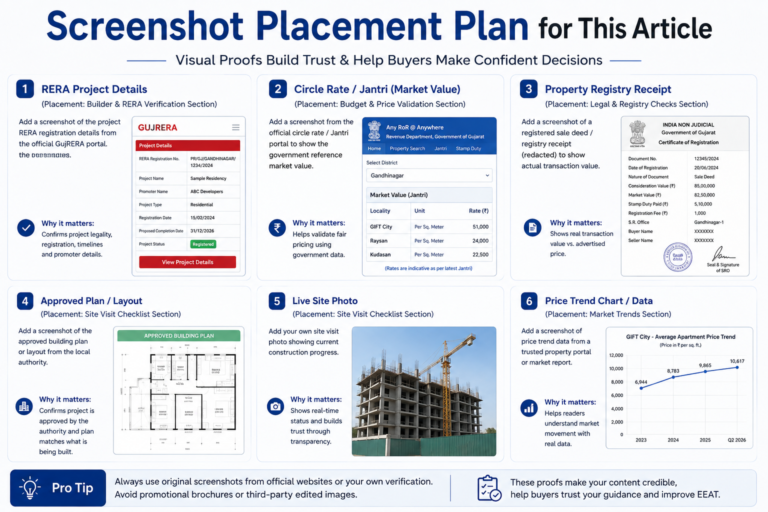
Screenshot Placement Plan for This Article
Who Should NOT Invest in Shela in 2026?
This guide is not for someone who wants:
- a 3–6 month flip
- guaranteed appreciation
- insider information
- a “sure-shot” project
- broker rumours
- pre-launch speculation without proper verification
- a property that requires stretching the budget beyond comfort
I would also ask you to reconsider buying if:
You may need the money within 2–3 years
Real estate isn’t sufficiently liquid for this strategy.
Your EMI is already uncomfortable
Don’t turn an investment into a financial burden.
You haven’t visited the property
Especially for an investment purchase.
You’re buying only because of “future development”
Future growth should support the investment thesis, not be the entire thesis.
You have no emergency fund
Property should not consume every rupee you have.
In some situations, renting and waiting is the smarter financial decision.
That’s not failure.
It’s discipline.
Is Shela Better for End-Use or Investment?
This depends on the property.
For an end-user, Shela can make sense when:
- the commute works
- the family likes the locality
- schools and daily needs are practical
- the apartment meets actual lifestyle requirements
- the family can hold for several years
For an investor, the bar should be higher.
You need to ask:
Who will buy this property from me later?
That question is often more important than:
How beautiful is the property today?
If your future buyer is obvious—family, salaried professional, investor, tenant—you have a stronger exit story.
What About Ready-to-Move vs Under-Construction?
For investment purposes, I would not automatically choose under-construction.
Ready-to-move advantage
You can verify:
- actual construction
- society maintenance
- occupancy
- parking
- surrounding development
- rental demand
Under-construction advantage
You may receive:
- newer specifications
- staged payments
- potentially lower initial capital requirement
- future possession upside
But the risk
Your money remains exposed to:
- construction delays
- market changes
- developer execution
- possession uncertainty
If the price difference between a ready property and under-construction property is small, I would generally prefer the property whose risks I can physically inspect.
The One Mistake I Would Avoid Above Everything Else
Do not buy an average property at a premium price simply because you believe Shela’s overall property prices will rise.
A rising locality does not make every property a good investment.
Suppose Shela appreciates 20% over several years.
A well-located, liquid property may benefit strongly.
An overpriced apartment with poor access and weak resale demand may underperform.
Locality appreciation and property appreciation are not the same thing.
If I Were Buying This Property Today
I would buy—but selectively.
If I were making a Shela real estate investment in 2026, I would not chase the newest launch simply because someone told me prices will rise.
I would look for:
A ready-to-move or well-established resale apartment in a proven residential pocket, with practical connectivity, strong occupancy, a sensible layout and a price that can be justified through comparable properties.
For an investment, I’d generally favour a liquid 2 or 3 BHK configuration over an unusually large apartment unless there was a compelling price advantage.
What would I negotiate hardest?
The all-in acquisition price.
Not the brochure price.
Not the “special offer.”
Not the free modular kitchen.
The number that actually leaves my bank account.
One red flag I would not ignore
A seller or developer who becomes uncomfortable when I ask for independent legal verification or comparable pricing evidence.
That is when I would walk away.
There are enough properties in the market to avoid forcing a bad transaction.
Final Verdict: Is Shela Good for Real Estate Investment in 2026?
Yes—but don’t buy Shela. Buy the right property in Shela.
That sounds like a small difference.
It isn’t.
Shela has several characteristics that make it worth considering in 2026:
- established residential activity
- significant property inventory
- multiple housing configurations
- ongoing demand
- historical price appreciation
- availability of both new and resale properties
Current market data also suggests that prices are not moving at an explosive pace, which is actually useful for disciplined buyers because it reduces the need to panic-buy.
But there are equally important reasons to be cautious:
- price differences between projects
- infrastructure variability
- high inventory
- rental-yield limitations
- developer/project risk
- asking-price versus transaction-price differences
- potential overpricing
So my practical verdict is:
For a 5–7+ year horizon: BUY selectively.
For rental income: BUY only after calculating actual yield.
For end-use: BUY if the location works for your family.
For a 6–12 month flip: I would avoid it.
For a purchase based only on future-development rumours: WAIT.
The goal isn’t to predict exactly where Shela’s property prices will be in 2030.
The goal is to make sure that even if appreciation is slower than expected, you haven’t made a bad purchase today.
That is what makes an investment decision resilient.
Conclusion
The best answer to “Is Shela good for real estate investment in 2026?” is not simply yes or no.
It is:
Shela can be a good investment location, but property selection and purchase price matter more than the locality label.
Don’t let a broker’s urgency replace your due diligence.
Don’t confuse asking prices with actual value.
Don’t assume future infrastructure is guaranteed.
Don’t calculate returns without including acquisition and holding costs.
And don’t buy an apartment simply because everyone around you says property prices will rise.
Compare several properties.
Visit the location at different times.
Verify the RERA and legal documents.
Check government records.
Calculate rental yield.
Study resale competition.
Negotiate the all-in price.
Then make the decision.
If you do those things correctly, you don’t need to predict the market perfectly.
You only need to avoid making an expensive mistake.
FAQ: Real Buyer Questions About Shela Investment
What type of property is best for investment in Shela?
Is Shela better for long-term investment or short-term gains?
What should I check before buying an investment property in Shela?
How much rental income can I expect from a property in Shela?
Are under-construction projects in Shela good for investment?
References
About the Author