
A buyer once walked into a Shela project convinced that he had found a bargain.
The broker had shown him a well-finished sample flat, explained that “prices would increase after the next launch phase,” and offered a limited-period discount. The quoted apartment price looked affordable on paper.
Then we started looking at the number that actually mattered: the total acquisition cost.
Parking, maintenance-related charges, registration and government costs, floor-rise charges, other additions and the difference between the advertised rate and the actual usable space changed the picture considerably.
The problem was not that the apartment was necessarily bad.
The problem was that the buyer was about to make a ₹70–80 lakh decision based on a ₹70–80 lakh headline number without understanding what he was actually buying.
That is exactly why I believe most online articles about Shela property investment are not particularly useful to serious buyers.
They usually tell you that Shela is developing, connectivity is improving, prices may rise and several residential projects are available.
All of that may be true.
But it does not answer the questions that matter:
- Is this particular property fairly priced?
- Is the location actually convenient for my daily life?
- Is the builder reliable?
- Can I rent the property easily?
- What happens if I need to sell in three years?
- Is the promised appreciation already priced into today’s asking price?
- Am I buying a home or simply buying a story about future growth?
This guide takes a different approach.
The objective is not to convince you to buy in Shela. It is to help you decide whether you should buy, what you should buy, what you should avoid and when walking away is the smarter financial decision.
What Is Really Happening in Shela's Property Market?
Shela has become an important residential market on the western side of Ahmedabad. It benefits from its relationship with South Bopal, Ghuma, Ambli and the wider western Ahmedabad corridor, while road connectivity includes the Sardar Patel Ring Road and Sanand-Sarkhej Road.
But there is an important distinction between a growing locality and a good investment at today’s price.
They are not the same thing.
A locality can have good long-term potential while an individual apartment is still overpriced.
That is one of the biggest mistakes I see buyers make when evaluating Shela real estate.
They research the locality but fail to research the specific project, building, road, configuration, floor, view, possession status, developer and resale market.
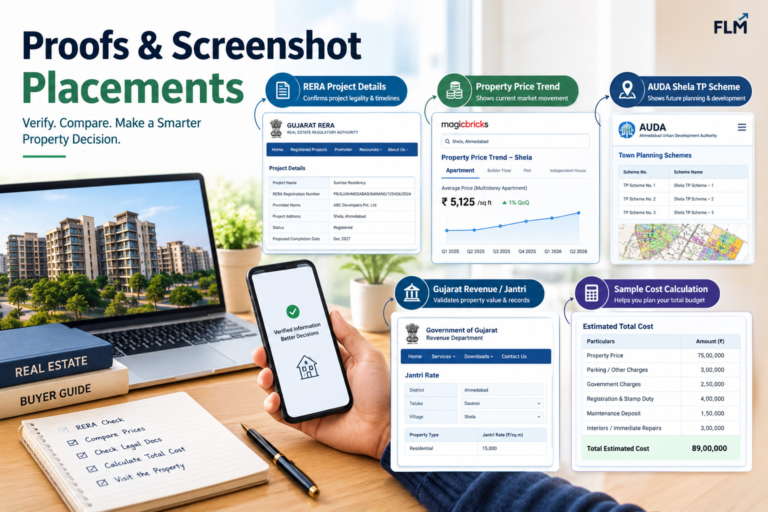
As of 2026, market portals show that Shela apartment pricing is broadly in the ₹4,000–₹6,100 per sq ft range, with Magicbricks reporting an average multistorey apartment rate of about ₹5,125 per sq ft in Q2 2026. Its 3 BHK data shows an average around ₹4,869 per sq ft.
Another major property portal currently reports different averages for Shela, which is itself a useful warning: online property-price numbers are indicators, not transaction truth. Housing.com currently reports a Shela average around ₹6,070 per sq ft on its locality page, while its Ahmedabad locality comparison shows Shela around ₹5,442 per sq ft.
Why the difference?
Because portals can use different inventories, property types, listing samples and calculation methodologies.
So I would never tell a buyer:
“Shela is ₹X per sq ft, therefore your flat should cost exactly ₹X.”
Instead, use portal data to establish a rough market band, then compare genuinely comparable properties.
The Five Problems Shela Buyers Need to Understand
Problem 1: The advertised price is rarely the complete price
A ₹75 lakh apartment does not automatically mean your cheque requirement is ₹75 lakh.
You need to calculate:
Apartment price + parking/other applicable charges + government charges + registration + taxes where applicable + maintenance/deposits + interiors + immediate repairs + loan-related costs.
Two apartments advertised at ₹75 lakh can therefore have very different effective costs.
My rule
Never compare two properties using only their brochure prices.
Compare:
Total acquisition cost ÷ usable/livable area
That number gives you a much better basis for comparison.
Problem 2: “Shela is growing” is not an investment thesis
This phrase is used constantly.
But growth has already been reflected in many asking prices.
If everybody knows an area is developing, you are not discovering the opportunity. You are buying into an opportunity that the market already knows about.
The better question is:
What future improvement is not already fully reflected in the property’s current price?
That is much harder to answer.
Problem 3: Not every part of Shela behaves the same way
A buyer should not treat Shela as one uniform property market.
Road access, surrounding development, internal roads, traffic, drainage, nearby commercial activity, school access, public transport and distance from employment hubs can change the attractiveness of a project.
Even two projects a few minutes apart can have very different resale demand.
This is why I strongly recommend visiting the property:
- During the morning peak
- Around evening peak
- On a weekend
- After rain if possible
A Sunday afternoon site visit can hide problems that become obvious on a Monday morning.
Problem 4: A new project can look cheaper than an established property
This is a common trap.
A new launch may offer:
- Lower introductory pricing
- Attractive payment plans
- Modern amenities
- New construction
- Builder incentives
But an older ready or nearly-ready property may provide something equally valuable:
evidence.
You can inspect the actual building.
You can see the approach road.
You can speak with existing residents.
You can check maintenance.
You can observe parking.
You can understand actual usable space.
For an end-user, that certainty can sometimes be worth more than a glossy new launch.
Problem 5: End-use and investment are different decisions
A family may happily pay more for:
- Better school access
- Larger usable rooms
- Quiet surroundings
- Better ventilation
- A practical kitchen
- More storage
- A better floor
An investor may care more about:
- Rental demand
- Tenant profile
- Entry price
- Liquidity
- Resale demand
- Maintenance costs
- Future competing supply
The “best” Shela property for a family is therefore not automatically the best Shela real estate investment.
Step-by-Step Shela Property Investment Action Plan
Step 1: Select the Location Before Selecting the Project
Do not begin your search with:
“Which project has the best amenities?”
Begin with:
“Which part of Shela actually works for my life or investment strategy?”
What to check
Look at:
- Main-road accessibility
- Internal road condition
- Distance from your workplace
- School access
- Daily grocery and healthcare
- Public transport
- Traffic during peak hours
- Future development around the project
- Flooding/waterlogging history where relevant
- Surrounding vacant land
- Existing residential occupancy
AUDA’s planning material shows that Shela has multiple town-planning schemes, including Shela TP Scheme Nos. 1, 2 and 3.
That matters because buyers should not simply assume that every surrounding parcel will remain exactly as it appears today.
Mistake to avoid
Buying because the broker says:
“This road will become very big.”
Ask:
Which authority document supports that statement?
If there is no document, treat it as a sales claim rather than an investment fact.
Step 2: Validate Your Budget and the Actual Price
Start with a maximum all-in budget.
For example:
₹80 lakh maximum acquisition budget.
Do not tell yourself:
“I can stretch another ₹5 lakh.”
That sentence is how budgets become ₹90 lakh.
Compare comparable properties
If you are considering a 3 BHK:
Compare:
- Similar carpet/usable area
- Similar building age
- Similar location
- Similar floor
- Similar parking
- Similar possession status
- Similar construction quality
Do not compare a premium high-rise 3 BHK with a smaller older building simply because both are labelled “3 BHK.”
Current portal data gives a useful market reference, but it should not be treated as a valuation certificate. Magicbricks currently reports Shela 3 BHK pricing around ₹4,869/sq ft on average, with quarterly movement of about 1% in Apr–Jun 2026.
Pro tip
If the seller says:
“₹5,800 per sq ft is market rate.”
Ask:
“Show me three comparable transactions or currently competing resale properties that support ₹5,800.”
That question often changes the negotiation.
Step 3: Verify the Builder and RERA Details
For an under-construction project, do not rely on:
- Brochure
- WhatsApp screenshot
- Salesperson’s promise
- “RERA approved” written on an advertisement
Go to the official RERA records and verify the project information yourself.
Check:
- RERA registration
- Promoter/developer details
- Registered project address
- Proposed completion date
- Extensions, if any
- Building/tower information
- Project disclosures
- Litigation or complaints where publicly available
- Quarterly/project updates where applicable
Red flag
If the salesperson becomes uncomfortable when you ask to independently verify the RERA details, slow down.
A serious buyer should never be made to feel guilty for doing due diligence.
Step 4: Conduct a Proper Site Visit
Do not spend 20 minutes in the sample flat and leave.
Spend time outside the sample flat.
Check the actual building
Look at:
- Entrance
- Lift condition
- Parking
- Basement
- Fire-safety arrangements
- Water supply
- Drainage
- Common areas
- Construction quality
- Ventilation
- Natural light
- Noise
- Mobile network
- Approach road
Then ask an existing resident:
“If you were buying again, would you buy this property?”
That answer can be more useful than ten sales presentations.
My strongest site-visit tip
Visit after 7 PM.
A property can look excellent at 11 AM and feel completely different when residents return from work.
Step 5: Complete Legal and Registry Checks
Before paying a serious token amount, have the property documentation reviewed appropriately.
Depending on the transaction, relevant checks may include:
- Title documents
- Previous sale deeds
- Encumbrance-related checks
- Property card/revenue records where applicable
- Approved plans
- Development permissions
- Building completion/occupancy documentation where applicable
- RERA records
- Society documentation for resale properties
- Outstanding dues
- Property tax status
- Loan/mortgage status
Gujarat’s Revenue Department provides online services relating to document registration, Jantri rates, land records and property cards.
Important
Jantri is not the same thing as market value.
It is a government reference/base value used in relevant registration and revenue processes. Do not use Jantri alone to decide whether a property is a good deal.
For a substantial purchase, involve a qualified property lawyer rather than relying entirely on a broker’s documentation explanation.
Step 6: Negotiate With Evidence, Not Emotion
The strongest negotiation is not:
“Give me ₹5 lakh discount.”
It is:
“Comparable properties are available at X, the usable area is Y, this property has Z disadvantage, and my total acquisition cost is already above the competing option.”
That gives the seller something concrete to respond to.
Negotiate hardest on:
- Base price
- Parking
- Floor-rise charges
- Other project charges
- Maintenance/deposit
- Furnishing/interiors where applicable
- Possession-related terms
- Payment schedule
- Resale seller’s asking price
One negotiation mistake I would avoid
Do not reveal your maximum budget early.
If your maximum is ₹85 lakh, don’t start by telling the broker:
“I can go up to ₹85 lakh.”
You have just removed your strongest negotiating information.
Read More:- Best Property Investment Projects In Shela
Two Realistic Shela Property Investment Case Studies
Case Study 1: Family Buying for End Use
Budget
₹80 lakh all-in target.
Requirement
3 BHK for self-use.
Shortlisted property
Shela residential project.
Negotiated purchase price
₹72 lakh.
Additional acquisition and immediate setup costs
Approximately ₹5–7 lakh depending on applicable government charges, project charges, interiors and other requirements.
Effective entry cost
Approximately ₹78–79 lakh.
Hypothetical current value after several years
₹92–96 lakh.
The family did not achieve spectacular investment returns.
But that was not the objective.
They achieved something more important:
They bought a property they could actually live in without stretching the household budget excessively.
Lesson
For an end-user, a moderate appreciation combined with good housing utility can be a successful purchase.
Do not judge your home like a stock.
Case Study 2: Investor Buying for Rental + Appreciation
Buyer profile
Investor with approximately ₹75 lakh capital allocation.
Entry price
₹68 lakh.
Property
2 BHK in a location with reasonable rental demand.
Initial rent
Approximately ₹18,000–₹20,000 per month.
At ₹19,000 monthly rent:
Annual gross rent = ₹2.28 lakh.
Gross rental yield on ₹68 lakh:
Approximately 3.35%.
That is not a spectacular yield.
And that is exactly the point.
The investor did not buy it because someone promised a 10% rental return.
The strategy was:
moderate rental income + long-term capital appreciation + eventual resale.
Hypothetical appreciation
If the property reaches ₹82 lakh after several years, the investor has approximately ₹14 lakh of capital appreciation before transaction costs, taxes and other ownership expenses.
Exit strategy
The investor would review the property after 5–7 years rather than assuming it must be held forever.
What worked
- Controlled entry price
- Reasonable rental demand
- Manageable EMI/carrying cost
- Long investment horizon
What did not work
The rental yield was lower than initially imagined.
This is a common reality in residential property.
Do not buy an apartment assuming rent will pay your entire EMI.
What About Rental Yield in Shela?
This is where many property-investment articles become misleading.
A property may appreciate while still producing mediocre rental returns.
Before buying for investment, calculate:
Gross rental yield = Annual rent ÷ Total acquisition cost × 100
Then calculate a more realistic net position after considering:
- Maintenance
- Vacancy
- Repairs
- Brokerage
- Property management
- Taxes
- Loan interest
- Interior replacement
A property giving ₹20,000 monthly rent on a ₹75 lakh total acquisition cost produces only about:
₹2.4 lakh ÷ ₹75 lakh = 3.2% gross yield.
That may still be acceptable depending on your capital-appreciation thesis.
But it is not a high-yield property.
Shela Property Investment: What Could Actually Drive Appreciation?
A sensible investment thesis should have identifiable drivers.
Potential drivers include:
1. Infrastructure
Better roads and connectivity can improve accessibility.
2. Employment access
Properties become more useful when they remain reasonably accessible to employment centres.
3. Population growth
More genuine end-users can support resale and rental demand.
4. Social infrastructure
Schools, healthcare, retail and everyday services improve livability.
5. Limited desirable inventory
If a particular micro-location has strong demand but limited good-quality stock, better properties may command a premium.
But there is an important counterargument.
Too much new supply can limit appreciation.
If several similar projects are launched around you, buyers may have many alternatives.
That is why I would rather buy:
a good property at a reasonable price
than:
an average property in a supposedly “future growth corridor” at an aggressive price.
Common Red Flags I Would Take Seriously
Red Flag 1: “Prices will increase next month”
Maybe.
Maybe not.
Ask for evidence.
Red Flag 2: Unclear carpet area
If the salesperson keeps switching between super built-up, built-up and carpet area, stop comparing the property using their quoted per-square-foot rate.
Red Flag 3: Very aggressive pre-launch pricing
A discount is only useful if the underlying property is worth buying.
₹10 lakh discount on an overpriced property is still an overpriced property.
Red Flag 4: Poor approach road
Never underestimate the approach road.
People live in the surrounding environment, not inside the brochure.
Red Flag 5: High vacancy around the project
If many buildings are completed but occupancy remains weak, investigate why.
It could indicate:
- weak rental demand
- poor connectivity
- affordability issues
- investor-heavy ownership
- delayed infrastructure
- excessive supply
Illustrative Buyer Testimonials
IT Professional — 3 BHK Buyer
“I initially focused only on the apartment price. After comparing the total cost and usable space, I changed my shortlist. The second property was slightly more expensive but made more sense for our family.”
PSU Employee — End User
“The biggest help was checking the area at different times of the day. The Sunday visit gave me a completely different impression from the weekday evening visit.”
NRI Investor
“I was looking for appreciation, but the rental numbers were weaker than I expected. I eventually focused more on entry price and resale liquidity instead of chasing a promised return.”
Verified Data and Market Context
Current property portals show that Shela’s market is not moving at one uniform rate.
Magicbricks reports an average multistorey apartment price of approximately ₹5,125/sq ft in Q2 2026, with a roughly 1% quarter-on-quarter movement. Its 3 BHK data reports approximately ₹4,869/sq ft, also with around 1% quarterly movement.
Housing.com reports a different Shela average and currently indicates a negative year-on-year movement on its locality page.
That difference is important.
It tells a serious buyer not to build an investment decision around one website’s “average price.”
My interpretation
The available data does not support the idea that every Shela property is currently experiencing runaway price appreciation.
The market looks more suitable for selective buying than blind buying.
In other words:
You may be able to buy well in Shela, but you still need to negotiate and select carefully.
That is a much healthier investment environment than assuming everything will automatically rise.
Shela's Planning Context
Planning matters because property value is influenced by what is built around your building.
AUDA’s official TP Scheme page lists multiple Shela schemes, including Shela TP Scheme Nos. 1, 2 and 3.
AUDA also explains that town-planning schemes can involve planning for roads and social infrastructure and that land can be used for infrastructure provisions under the planning process. This is particularly relevant when evaluating Shela real estate investment, because future planning can influence accessibility, surrounding development and the long-term practicality of a property.
For an investor, this means one thing:
Do not evaluate only today’s map.
Understand the planning context around the property.
But do not turn proposed infrastructure into guaranteed appreciation.
A planned road is not the same as a completed road.
A proposed development is not the same as operational infrastructure.
Proofs & Screenshot Placements
Who This Shela Property Investment Guide Is NOT For
This guide is not for someone looking for a guaranteed short-term profit.
I would especially tell you to rethink buying if:
- You need to sell within 1–2 years
- Your EMI would consume too much of your income
- You are depending on guaranteed appreciation
- You have no emergency fund
- You are buying solely because a broker says “last unit”
- You have not checked the legal documents
- You are uncomfortable with construction/possession risk
- You are buying an under-construction property without understanding the timeline risk
You may be better off renting if:
You are unsure where you will work for the next few years.
Renting can be financially sensible when:
- Your job location may change
- You are testing a locality
- You do not have enough down payment
- You expect major family changes
- You are unsure whether Shela actually suits your lifestyle
There is nothing financially sophisticated about buying a property you cannot comfortably afford.
What This Guide Will NOT Help You Do
This guide is not designed for:
Short-term flipping
Residential apartments are generally poor candidates for casual flipping when acquisition and selling costs are considered.
Rumour-based investing
“Big project coming.”
“Road is definitely coming.”
“Prices will double.”
Treat these as claims until independently verified.
Insider-style speculation
Nobody should make a major property purchase because someone claims to have inside information about future infrastructure or government decisions.
The correct response is:
Show me the document.
If I Were Buying This Property Today
This is where I would be more opinionated.
If I were buying a residential property in Shela today, I would not buy simply because I believed Shela was the next big growth area.
I would buy only if I could satisfy four conditions:
1. The property is fairly priced
I would compare at least three genuinely comparable properties.
Not three random listings.
Comparable properties.
2. The micro-location works
I would personally check:
- Morning traffic
- Evening traffic
- Approach road
- Surrounding development
- Noise
- Drainage
- Daily convenience
- Access to major roads
3. The documentation is clean
For an under-construction project, I would independently verify the RERA information.
For resale, I would have the title and transaction documentation professionally checked.
4. I have a long enough holding period
I would not enter expecting a quick 15–20% return.
I would be comfortable holding for several years.
Which configuration would I choose?
For end use, I would choose the configuration that gives the family enough usable space, not simply the largest advertised number.
For investment, I would favour the configuration with the broadest genuine tenant and resale demand rather than automatically choosing the most expensive apartment.
What would I negotiate hardest?
The effective total acquisition cost.
Not merely the headline discount.
I would negotiate the complete financial package.
The one red flag I would not ignore
A major mismatch between what the salesperson promises and what the official documents say.
If the brochure, salesperson and official records tell three different stories, I would walk away until the discrepancy is explained.
And if it cannot be explained clearly?
I would not buy.
There will always be another property.
There is no shortage of apartments.
There is, however, a shortage of buyers who properly investigate them.
My Bottom Line on Shela Property Investment
I like Shela as a residential market more than I like the idea of blindly buying “Shela property” as an investment category.
That distinction is important.
The locality has genuine residential development, western Ahmedabad connectivity and ongoing planning context. Current market data also shows that apartment prices are substantial and that price movement is relatively measured rather than something a buyer should treat as guaranteed rapid appreciation.
So my approach would be:
Buy the property, not the story.
If the property has:
- A sensible entry price
- Good usable space
- Strong location fundamentals
- Clean documentation
- Reliable construction
- Realistic rental expectations
- Good resale potential
then Shela can make sense.
But if the only reason you want to buy is:
“Everyone says Shela will become expensive,”
I would wait.
Not necessarily because Shela is bad.
Because that is not enough reason to invest ₹70–90 lakh or more.
A Simple Shela Buyer Decision Test
Before paying a token amount, ask yourself these ten questions:
- Do I know the actual total acquisition cost?
- Have I compared at least three comparable properties?
- Have I checked the property at peak traffic times?
- Have I independently checked the RERA information?
- Have I reviewed the relevant legal documents?
- Do I know the realistic rent?
- Do I know who will buy this property from me later?
- Can I comfortably hold it for several years?
- Am I relying on documented facts rather than broker promises?
- Would I still buy it if the price increased only modestly over the next few years?
If you cannot answer several of these questions, you are not ready to pay the token amount.
Conclusion:
Real estate rewards patience, but it punishes careless buying.
The biggest advantage a buyer can have in Shela is not access to a secret project.
It is the ability to say:
“The numbers do not work, so I will walk away.”
That single decision can save far more money than a small negotiation discount.
If you are evaluating a property in Shela, use this guide as a checklist, verify the official records, compare the total acquisition cost and inspect the actual location before making a commitment.
If you want a practical next step, create a one-page comparison sheet for every property you visit:
Price → usable area → total cost → location → builder → RERA → rent → resale potential → risks.
Once the properties are compared on the same sheet, emotional decisions become much harder.
And that is exactly what a good property-buying process should do.
Free Buyer Checklist
Before purchasing a property in Shela, save or print this article and use the checklist above during your site visits.
If you are unsure about a particular property, the better question is not:
“Will the price increase?”
Ask:
“If the price does not increase as quickly as I expect, would I still be happy owning this property?”
If the answer is yes, you may have a property worth considering.
If the answer is no, you may be buying speculation rather than a sound property decision.
FAQ: Genuine Shela Property Investment Questions
What factors affect property prices in Shela?
Is Shela suitable for first-time property investors?
What should I check before investing in Shela property?
Is buying an under-construction property in Shela risky?
How can I estimate the resale value of a Shela property?
References
About the Author

Mitesh Vyas
Hello My Name is Mitesh Vyas i am a Real Estate content writer and Property Market Enthusiast I shares practical insights on buying, selling, investing, and understanding real estate trends. With a strong focus on residential and commercial properties, My aims to help readers make informed property decisions through clear, research-based, and easy-to-understand content.