
Two buyers can look at the same Ahmedabad map, have almost the same budget, and still make completely different property decisions.
One may be better off buying in South Bopal because the family needs established daily infrastructure, schools, healthcare and easier access to existing residential areas.
Another may be better off buying in Shela because they want a newer apartment, a larger home within their budget, or are comfortable waiting for a developing locality to mature.
The problem is that property advice online often reduces this decision to phrases such as “fast-growing area,” “excellent investment potential,” “premium location,” or “future growth.” Those words sound useful but rarely tell a buyer what can actually go wrong.
In my experience advising buyers in developing residential markets, the most expensive mistakes usually do not happen because someone bought ₹100–₹200 per sq. ft. too high. They happen because the buyer chose the wrong location for their lifestyle, underestimated total ownership costs, trusted an unverified possession promise, or bought a property that looked attractive on paper but was inconvenient every day.
So, if you are asking “Shela vs South Bopal which is better for property buyers?”, the honest answer is:
Neither is automatically better. South Bopal is generally the safer end-use choice when established surroundings matter most. Shela can be the more attractive choice for buyers prioritising newer developments, larger configurations and longer-term growth potential.
The right decision depends on why you are buying.
Shela vs South Bopal: The Short Answer
Before going into the detailed comparison, here is the practical version.
| Buyer Priority | Better Starting Point | Why |
|---|---|---|
| Immediate family living | South Bopal | More established residential ecosystem |
| Newer apartment options | Shela | Large supply of newer developments |
| Budget-conscious buyer | Shela, depending on project | More choice across developing pockets |
| Established daily conveniences | South Bopal | Stronger existing ecosystem in many pockets |
| Larger configuration for budget | Shela | Often worth comparing newer projects |
| Buyer wanting lower development risk | South Bopal | More mature surroundings |
| Long-term development bet | Shela | Greater development-led upside, but also greater uncertainty |
| Ready-to-move requirement | Either, project dependent | Verify actual possession, not advertisements |
| Short-term speculation | Neither by default | Transaction costs and liquidity make quick flipping risky |
| First-time homebuyer | South Bopal or established Shela pocket | Reduce location and execution risk |
This is only a starting point. The specific road, project, builder, building age and purchase price can completely change the answer.

Why Buyers Get Confused Between Shela and South Bopal
Imagine a family with a budget of around ₹85 lakh.
They visit three projects.
The first salesperson says:
“South Bopal is already developed. Buy now because prices will increase.”
The second says:
“Shela is the future. South Bopal is already expensive.”
The third offers a “limited-period” discount and tells them that the same unit will cost ₹5–10 lakh more next week.
The family is now under pressure.
But none of those statements answers the questions that actually matter:
- How long will the daily commute be?
- What is the actual all-inclusive purchase cost?
- Is the quoted price based on carpet area or saleable area?
- Is the project legally clear?
- Is the promised possession realistic?
- What happens if the builder delays?
- How easy will the property be to resell?
- What rental demand actually exists?
- Is the road access convenient today or only planned for the future?
- Are there drainage, traffic or access problems during monsoon?
- Are you buying for your family or betting on appreciation?
This is why many online comparisons fail buyers.
They compare locality names.
A serious buyer should compare specific micro-locations and specific properties.
Shela vs South Bopal: What Is Actually Different?
The biggest mistake is treating both localities as homogeneous markets.
They are not.
A property close to an established road, school, commercial area or major connection can behave very differently from another property only a few kilometres away.
Shela
Shela has developed rapidly as a residential market with a substantial supply of apartments, villas, resale homes and newer developments.
The attraction is obvious: buyers can find modern housing, multiple configurations and projects targeting different budgets.
But there is another side.
Parts of Shela are still dependent on continued infrastructure and surrounding development. For buyers trying to understand the key differences between these two nearby residential markets, a detailed Shela vs South Bopal for property buyers comparison can help put the location, convenience, development risks, and long-term considerations into perspective. This means a buyer may receive a newer home in Shela but still accept greater uncertainty around how quickly the surrounding environment matures.
That distinction is important.
You should not pay today’s premium solely for tomorrow’s infrastructure.
If the road, drainage, access, social infrastructure or surrounding development is not satisfactory today, ask yourself whether you are genuinely comfortable waiting.
South Bopal
South Bopal has a more established residential identity.
For many families, the attraction is not merely appreciation potential. It is convenience.
Existing residential communities, schools, healthcare, retail and everyday services can make the locality easier to live in immediately.
But established does not mean automatically better value.
A buyer can still overpay for:
- an old building,
- a poorly maintained society,
- a premium-facing unit,
- an overpriced resale property,
- or a project where the seller is pricing the property based on emotional attachment rather than actual market evidence.
So the question is not:
“Which locality is more developed?”
The better question is:
“Which locality gives me the right combination of price, usability, property quality and future risk for my specific purpose?”
Price Comparison: Do Not Compare ₹/Sq. Ft. Blindly
Current published market data gives a useful starting point, but it should not be treated as the final transaction price.
Magicbricks’ Q2 2026 data reports average multistorey apartment prices of approximately ₹5,125/sq ft in Shela and ₹5,166/sq ft in South Bopal.
Housing.com currently reports different averages, illustrating how property portals can produce different numbers depending on their listing datasets and methodology. Its Shela page reports roughly ₹6,268/sq ft, while its South Bopal pages show figures around ₹5,677–₹7,559/sq ft depending on the dataset/location page.
This is exactly why I would never advise a buyer to decide solely from an online average.
The actual price depends on:
- carpet area,
- super built-up area,
- floor,
- facing,
- construction age,
- project quality,
- parking,
- amenities,
- possession status,
- road access,
- builder reputation,
- maintenance,
- resale demand,
- and the seller’s urgency.
Example
Suppose two 3 BHK properties are both advertised at ₹5,500/sq ft.
Property A has a more efficient carpet-area ratio and better usable space.
Property B has a larger saleable area but substantially less usable carpet area.
The second property may look cheaper or larger in the advertisement while actually providing worse value.
Always compare usable space and total acquisition cost—not just the advertised rate.
The Hidden Cost Trap Buyers Frequently Miss
A ₹75 lakh property is rarely a ₹75 lakh decision.
Your actual acquisition cost can include:
- base property price,
- GST where applicable,
- stamp duty,
- registration,
- maintenance deposit,
- parking charges,
- club or amenity charges,
- legal verification,
- brokerage,
- loan processing,
- interiors,
- moving costs,
- and potentially future repair or renovation costs.
For an under-construction property, the payment schedule and tax treatment also need to be checked carefully.
My rule:
Never negotiate the property price before calculating the complete acquisition cost.
A ₹3 lakh discount means very little if the property has ₹8–10 lakh of additional costs that you failed to budget.
Shela vs South Bopal for End-Use Buyers
If you are buying a home for your family, I would give more weight to today’s usability than speculative appreciation.
Ask:
How long is the commute?
Do the actual drive at:
- 8:30 AM,
- 1 PM,
- 6–8 PM.
A location that takes 20 minutes on Sunday can become a very different proposition during weekday traffic.
What schools are realistically accessible?
Do not simply search “schools near Shela” or “schools near South Bopal.”
Check the actual door-to-school travel time.
What happens during monsoon?
Inspect:
- approach roads,
- low-lying stretches,
- drainage,
- basement access,
- parking areas,
- internal roads.
Do not rely only on the builder’s answer.
What is available within 10–15 minutes?
Check:
- grocery stores,
- pharmacy,
- hospital,
- school,
- bank,
- public transport,
- restaurants,
- daily services.
For a family, these can matter more than a clubhouse.
Shela vs South Bopal for Investors
Investment is a different decision.
An investor should not ask:
“Which locality will grow?”
That question is too vague.
Ask:
“At what price can I buy, what rent can I realistically achieve, who will rent it, and who will buy it from me later?”
That is the real investment equation.
Shela may appeal to investors because of new development and future growth expectations.
But future growth is not guaranteed appreciation.
South Bopal’s established residential ecosystem can potentially support more immediate end-user and rental demand in suitable pockets.
However, higher entry prices can reduce rental yield.
Calculate gross rental yield
For example:
Property purchase price = ₹80 lakh
Monthly rent = ₹25,000
Annual rent:
₹25,000 × 12 = ₹3 lakh
Gross rental yield:
₹3 lakh ÷ ₹80 lakh × 100 = 3.75%
That is before:
- maintenance,
- vacancy,
- property tax,
- repairs,
- brokerage,
- and other ownership costs.
So an investor should not hear “rental property” and automatically assume strong returns.
Step-by-Step Buyer Action Plan
Step 1: Location Selection
What to do
Select the exact micro-location before selecting the project.
Visit at different times of the day.
Drive from the property to:
- workplace,
- school,
- major road,
- hospital,
- railway/transport connection where relevant,
- daily shopping.
Why it matters
Two projects within the same locality can have completely different accessibility.
Mistake to avoid
Do not buy because the broker says:
“This road will become excellent.”
Ask:
“What is usable today, and what is only proposed?”
Pro tip
If your family will live there for 8–10 years, today’s inconvenience should be treated as a real cost.
Step 2: Budget & Price Validation
What to do
Create an all-inclusive purchase sheet.
Compare at least three similar properties.
Record:
- carpet area,
- total price,
- effective price per carpet sq. ft.,
- age,
- possession,
- parking,
- maintenance,
- floor,
- facing,
- project condition.
Why it matters
The cheapest advertised rate may not be the cheapest property.
Mistake to avoid
Do not compare:
₹/sq ft of one project’s saleable area
with
₹/sq ft of another project’s carpet area.
Pro tip
For resale properties, negotiate based on recent comparable transactions and actual property condition, not just portal asking prices.
Step 3: Builder & RERA Verification
For an under-construction project, verify the project’s registration and details on the official Gujarat RERA system before making a substantial payment.
Check:
- RERA registration,
- promoter details,
- approved project information,
- proposed completion date,
- project phases,
- complaints/litigation information where available,
- sanctioned plans and disclosures,
- development status.
Do not accept:
“RERA is applied for.”
as equivalent to:
“The project is properly registered and verified.”
Mistake to avoid
Never rely only on a brochure or salesperson’s WhatsApp PDF.
Pro tip
Take the RERA number yourself and independently verify it.
Step 4: Site Visit Checklist
Visit at least twice.
Ideally:
weekday evening + weekend daytime
Check:
- actual approach road,
- construction quality,
- seepage,
- cracks,
- ventilation,
- natural light,
- lift condition,
- fire-safety provisions,
- parking,
- water supply,
- power backup,
- security,
- drainage,
- common-area maintenance,
- neighbouring construction.
For resale properties, speak to at least one resident.
Ask:
“If you had to buy again, would you choose this society?”
That answer can be more valuable than a brochure.
Step 5: Legal & Registry Checks
Before paying a large non-refundable amount, get independent legal verification.
Depending on the property, check:
- title documents,
- ownership chain,
- encumbrances,
- sanctioned plan,
- development permissions,
- building approvals,
- occupancy/completion documentation where applicable,
- society documents,
- property tax,
- dues,
- agreement terms,
- land-use and applicable planning records.
For resale property, verify that the seller actually has the legal authority to sell.
Red flag
If the seller or intermediary becomes uncomfortable when you request independent legal verification, slow down—not speed up.
Step 6: Negotiation Strategy
Do not negotiate emotionally.
Before making an offer, know:
Your maximum price.
Then identify why your offer is justified.
Useful negotiation points can include:
- delayed possession,
- repairs required,
- older construction,
- higher maintenance,
- unfavourable floor,
- lack of parking,
- comparable cheaper inventory,
- seller urgency,
- unsold builder inventory,
- inferior access.
What not to do
Do not say:
“I love this house. I will somehow arrange the money.”
That tells the seller you are emotionally committed.
Better approach
Say:
“I like the property, but at this total acquisition cost it does not work for me. If the final price reaches ₹X including the relevant charges, I can proceed subject to legal verification.”
Calm buyers negotiate better.
Realistic Case Study
Case Study 1: Family Buyer
The situation
A family with two working parents was looking for a 3 BHK.
Budget: ₹80–90 lakh
They initially preferred Shela because they could find newer projects with larger configurations.
They compared three properties.
Property A — Shela
Purchase price: ₹78 lakh
All-in acquisition: approximately ₹84 lakh
Configuration: 3 BHK
Possession: ready/near-ready depending on property
Property B — South Bopal
Purchase price: ₹87 lakh
All-in acquisition: approximately ₹94 lakh
Configuration: 3 BHK
More established surroundings
The family initially preferred the cheaper Shela option.
But after repeatedly driving from work to both locations during peak hours, they realised their daily commute from the chosen Shela project would be less convenient.
They eventually purchased the South Bopal property.
Suppose its market value later reaches around ₹1.05 crore after several years.
That is not an extraordinary investment return—and that is precisely the point.
Lesson
They did not buy the property with the highest theoretical appreciation.
They bought the property that reduced daily friction for their family.
For an end-user, that can be the smarter return.
Case Study 2: Investor
An investor purchased a 2/3 BHK property in a developing residential pocket at approximately ₹70 lakh.
Rent after possession:
₹22,000/month
Annual gross rent:
₹2.64 lakh
Gross rental yield:
approximately 3.8%
After maintenance and vacancy, the effective yield was lower.
Over several years, assume the property appreciated to approximately ₹86–90 lakh.
That is reasonable rather than spectacular.
What worked?
- Entry price was controlled.
- The property appealed to tenants.
- Configuration had a broad end-user market.
- Holding period was long enough to absorb transaction costs.
What did not work?
The investor initially expected rent to rise much faster.
It did not.
The lesson is important:
A property can appreciate reasonably and still be a mediocre rental investment.
Always calculate both capital appreciation and rental yield.
What Buyers Commonly Get Wrong in Shela and South Bopal
Mistake 1: Buying because “prices will definitely rise”
Nothing is guaranteed.
Real estate cycles change.
Interest rates, supply, infrastructure, employment patterns, buyer affordability and inventory can all influence demand.
Mistake 2: Treating every project in a locality equally
They are not equal.
Mistake 3: Believing launch discounts are automatically genuine
A ₹5 lakh “discount” means nothing if the original price was inflated.
Compare the final effective price with comparable properties.
Mistake 4: Ignoring resale liquidity
You may be able to buy easily.
Selling later is a different question.
Ask:
Who will buy this property from me in five years?
Mistake 5: Buying too much house
If a ₹1 crore home makes your monthly finances uncomfortable, the fact that the house is “better” does not make it a better purchase.
Shela vs South Bopal: Which Is Better for Different Buyers?
If you are a first-time buyer
I would lean toward the more established, convenient property, even if it means a slightly smaller home.
Your first property should not expose you to unnecessary execution risk.
If you are upgrading from an existing home
Compare lifestyle carefully.
If Shela gives you substantially more usable space without creating unacceptable commute problems, it deserves serious consideration.
If you are an investor
Do not automatically choose Shela because it is described as a growth corridor.
Calculate:
purchase price + rent + vacancy + maintenance + exit liquidity + expected holding period.
If you need possession immediately
Prioritise actual possession and legal occupancy documentation, not marketing timelines.
If you are buying for parents
Established services and healthcare access may be more important than future appreciation.
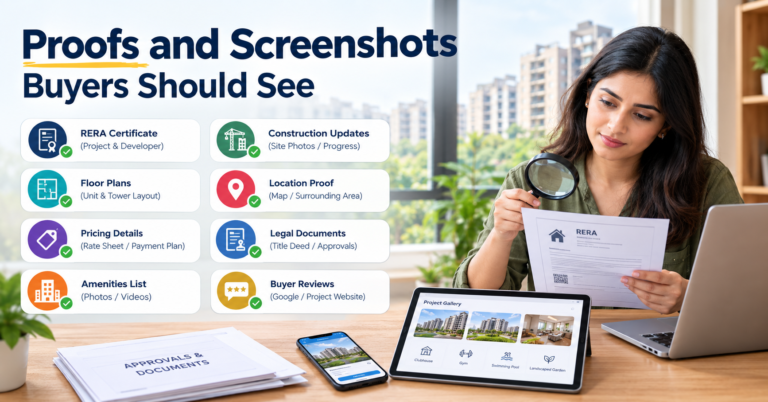
Proofs and Screenshots Buyers Should See
Who Should NOT Use This Guide to Make a Purchase Decision
This guide is not designed for someone who wants a guaranteed short-term profit.
You should rethink buying if:
- your emergency fund would disappear after the purchase,
- EMI would put your household under financial stress,
- you expect to sell within 1–2 years,
- you are depending entirely on future appreciation,
- you have not verified the property documents,
- you are buying because a broker says “last unit,”
- or you are uncomfortable with the property’s current infrastructure.
You may be better off renting if:
You are likely to relocate within a few years.
For example, if your job location is uncertain, locking ₹80–₹100 lakh into a property may create unnecessary financial and lifestyle rigidity.
This guide will NOT help with:
- short-term flipping,
- speculative booking-and-selling,
- insider information,
- rumour-based infrastructure bets,
- “buy today, double money quickly” strategies.
Those are fundamentally different strategies and carry substantially different risks.
If I Were Buying This Property Today
This is where I would take a clear position.
If I were buying today for my own family, I would generally favour a well-established South Bopal property over a speculative Shela purchase—provided the South Bopal property is not materially overpriced.
Why?
Because for an end-user, I value certainty of daily life more than a theoretical future-growth story.
I would rather buy a slightly smaller but legally clean, well-maintained property with good access than a larger apartment whose investment case depends heavily on infrastructure that has not yet arrived.
However, I would seriously consider Shela if I found:
- a strong builder,
- clean RERA documentation,
- efficient carpet area,
- good construction quality,
- sensible all-inclusive pricing,
- reliable access,
- acceptable drainage/monsoon conditions,
- and a long holding period.
Configuration I would choose
For a family, I would generally prefer a well-designed 3 BHK over an oversized 4 BHK that stretches the budget.
A practical 3 BHK with good room sizes, ventilation, parking and efficient carpet area is easier to live in and usually has a broader resale audience.
What I would negotiate hardest
The final all-inclusive price.
Not the headline discount.
I would compare the property’s effective cost against several comparable units and use genuine disadvantages—maintenance, floor, age, parking, possession, repairs or seller urgency—to negotiate.
One red flag I would not ignore
A seller or builder who discourages independent legal verification.
If someone tells you:
“Everyone buys without checking this.”
That is not reassurance.
That is a reason to check more carefully.
Final Verdict: Shela or South Bopal?
If you want the simplest answer:
Choose South Bopal if:
- you are buying primarily for end use,
- immediate convenience matters,
- your family needs established surroundings,
- you want to reduce location-development uncertainty,
- and you find a property at a fair price.
Choose Shela if:
- you want newer housing options,
- you are comfortable with a developing market,
- you are buying for a longer holding period,
- you find a genuinely well-priced property,
- and the specific micro-location works for your daily routine.
My overall buyer-first view
South Bopal wins on present-day certainty.
Shela can win on value and longer-term development potential—but only if you are willing to accept more uncertainty.
Neither locality deserves your money simply because someone calls it a “high-growth area.”
The correct property is the one where the price, legal status, construction quality, location, daily usability and future resale prospects all make sense together.
FAQ: Real Buyer Questions
Is Shela cheaper than South Bopal for buying a property?
Is South Bopal better than Shela for families?
Should I buy a 3 BHK in Shela or South Bopal?
Is Shela a good place for property investment?
Is South Bopal a good investment for rental income?
References
About the Author