
Just a few months ago, I met a family looking for a home in Ahmedabad. They had already visited six projects across different parts of the city. Every builder’s sales team told them the same thing:
“Book today, or the price will increase next week.”
One broker insisted that Shela had already become “too expensive” and suggested buying in a newer locality instead. Another claimed that every apartment in Shela would deliver exceptional returns within two years.
The family was confused.
One person said prices would double.
Another warned that the market had peaked.
Neither could explain why.
After reviewing their budget, understanding their long-term goals, checking project approvals, comparing nearby locations, and studying actual transaction trends, the answer became much clearer than the marketing brochures suggested.
The reality was this:
Shela remains one of Ahmedabad’s strongest residential markets in 2026—but it is not automatically the right investment for every buyer.
That distinction matters because buying the wrong property in the right location can still become an expensive mistake.
In my experience advising buyers, I have seen people lose money not because they chose the wrong city, but because they ignored factors like builder credibility, resale demand, pricing, and future infrastructure. Conversely, I have seen ordinary buyers build meaningful long-term wealth simply by making patient, informed decisions.
This guide is written for those buyers.
It is not another article that declares every project “the best investment.” Instead, it focuses on helping you answer one practical question:
If you were investing your own savings today, would Shela still deserve serious consideration in 2026?

Why Most Online Articles Don't Help Real Buyers
Search online for information about investing in Shela and you’ll find dozens of blogs saying almost identical things:
- Excellent location
- Great infrastructure
- High appreciation
- Premium lifestyle
- Future growth
Most of those statements are not entirely wrong.
The problem is that they rarely answer the questions buyers actually ask before investing.
Questions like:
- Has most of the price growth already happened?
- Are new launches becoming overpriced?
- Which projects have stronger resale demand?
- Does every builder deserve equal trust?
- Is buying for rental income realistic?
- Should a family buy now or wait?
- Would another locality offer better value?
Without those answers, buyers often confuse marketing with market reality.
Real estate is too expensive for guesswork.
Understanding Shela's Position in Ahmedabad in 2026
Over the last decade, Shela has transformed from a relatively quiet suburban pocket into one of Ahmedabad’s most recognized residential destinations.
Several factors contributed to this transformation:
- Better road connectivity
- Rapid development of residential communities
- Expansion of supporting commercial spaces
- Improved lifestyle amenities
- Growing demand from families seeking larger homes
- Better access to schools, hospitals, and workplaces
These improvements increased buyer confidence, which naturally supported long-term appreciation in many residential projects.
However, no locality grows forever at the same speed.
By 2026, the discussion has shifted from:
“Will Shela grow?”
to
“How much more can it realistically grow compared to other locations?”
That is a much smarter question.
Read More:- Legal Documents Every Home Buyer Should Verify
What Has Actually Changed in 2026?
The Shela market today is different from what it was five years ago.
Earlier, buyers entered mainly because prices were comparatively lower than several established areas.
Today, buyers are evaluating Shela differently.
Instead of simply chasing low prices, they are considering:
- Overall livability
- Long-term investment value
- School access
- Daily convenience
- Traffic patterns
- Builder reputation
- Construction quality
- Future resale opportunities
This indicates a more mature residential market.
Markets driven by informed end-users generally behave more predictably than markets driven only by speculative investors.
The Biggest Mistake I See Buyers Make
Many buyers believe location alone guarantees profits.
It doesn’t.
Imagine two families buying apartments in the same neighborhood.
Family A purchases from a financially strong developer with excellent construction quality, proper legal documentation, and realistic pricing.
Family B purchases from a project offering unusually large discounts but with uncertain delivery timelines and weaker market reputation.
Five years later, both properties may be in Shela.
Yet their outcomes can be completely different.
Location creates opportunity.
The builder, pricing, documentation, and project quality determine whether that opportunity becomes profitable.
Is Demand Still Strong?
One of the healthiest signs in any residential market is consistent demand from genuine homebuyers. If you’re looking for a comprehensive Shela real estate investment guide, understanding who is buying in the area is just as important as tracking property prices or future infrastructure plans.
Shela continues attracting several buyer categories:
-
Young professionals upgrading from apartments in older localities
-
Families seeking larger homes
-
Business owners relocating closer to western Ahmedabad
-
NRIs planning future relocation
-
Investors with long-term holding periods
This diversity reduces dependence on a single buyer segment, making the local property market more resilient during changing economic conditions.
Markets supported only by investors often experience greater price volatility. In contrast, markets supported by families tend to maintain stronger long-term stability because homes are purchased for living rather than quick resale. This healthy balance between end-users and investors is one of the reasons Shela continues to attract attention from buyers seeking long-term value.
Supply Has Increased—Is That Good or Bad?
Another common misconception is that more projects automatically reduce investment potential.
The truth is more nuanced.
Growing supply simply means buyers have more options.
The important question becomes:
Can demand absorb the new inventory?
If developers continuously launch projects without sufficient buyer interest, prices may remain flat for longer periods.
If genuine residential demand keeps pace, healthy market growth can continue without creating an unhealthy property bubble.
This is why buyers should always evaluate both inventory levels and actual buyer activity rather than relying on promotional advertisements.
Infrastructure Continues to Influence Property Values
Real estate appreciation rarely happens in isolation.
It usually follows improvements in public infrastructure.
In Shela, several developments have strengthened buyer confidence over the years:
- Better road networks
- Improved access to major employment corridors
- Educational institutions
- Healthcare facilities
- Retail expansion
- Daily lifestyle services
These improvements increase everyday convenience, making the locality more attractive for end-users.
Families generally stay longer in neighborhoods that provide good schools, safer roads, shopping options, and easier commuting.
That long-term occupancy creates healthier residential ecosystems.
Residential Growth Is Replacing Speculation
One encouraging trend I have observed is that Shela increasingly attracts genuine homeowners instead of short-term speculators.
That matters because speculative markets often experience dramatic swings.
End-user-driven markets usually experience:
- More consistent occupancy
- Better community development
- Stronger maintenance standards
- Healthier resale activity
- More reliable rental demand
These characteristics contribute to a stronger long-term investment environment.
What About Rental Income?
Many first-time investors assume rental income alone will generate excellent returns.
That expectation often leads to disappointment.
Rental yield in residential real estate is generally modest compared to commercial assets.
In Shela, investors should view rental income as:
- A way to offset holding costs
- Additional cash flow
- Support for long-term ownership
The larger financial opportunity often comes from gradual capital appreciation rather than high monthly rental income.
Buying solely because someone promises “excellent rental returns” deserves careful scrutiny.
Is Affordability Still a Competitive Advantage?
Five or six years ago, affordability was one of Shela’s strongest selling points.
In 2026, pricing has naturally increased.
That doesn’t necessarily make the area overpriced.
Instead, buyers should compare value rather than price alone.
Ask questions such as:
- Does this project justify its premium?
- What amenities are included?
- How does construction quality compare?
- Is the builder reliable?
- What are the maintenance costs?
- How strong is future resale demand?
Paying more for a well-planned project can be a better financial decision than buying a cheaper apartment with weaker long-term prospects.
The Role of Builder Reputation
One lesson repeats itself in almost every market cycle.
Good builders usually protect buyers better during uncertain economic periods.
Reliable developers are generally more likely to:
- Deliver projects on time
- Maintain construction quality
- Resolve customer concerns
- Preserve project reputation
- Support stronger resale values
That doesn’t mean every large developer is perfect.
It simply means reputation should be investigated with the same seriousness as price.
Always verify approvals, financial stability, completed projects, and customer feedback before making a booking decision.
Are Premium Projects Still Worth Considering?
Premium developments often attract attention because of luxury amenities, larger floor plans, and modern architecture.
However, premium pricing only makes sense when supported by genuine value.
Before paying a premium, evaluate:
- Location within Shela
- Construction quality
- Layout efficiency
- Maintenance planning
- Future resale demand
- Overall community planning
Luxury features lose their value quickly if the fundamentals are weak.
How to Invest in Shela Without Making an Expensive Mistake
Finding a good property is rarely about discovering a “hidden gem.” More often, it’s about following a disciplined process that eliminates bad options before you commit your savings.
Over the years, I’ve noticed that buyers who regret their purchase usually skipped one or more of these steps. They trusted a sales presentation, rushed into a booking because of a “limited-time offer,” or assumed that every project in a popular locality would perform equally well.
A systematic approach doesn’t guarantee the highest ROI, but it significantly reduces the chances of making a costly decision.
Step 1: Select the Right Micro-Location, Not Just Shela
One of the biggest misconceptions in real estate is that every project within the same locality offers the same investment potential.
It doesn’t.
Shela has grown rapidly, but growth isn’t uniform across every street or residential pocket. Some areas benefit from better connectivity, easier access to schools, and stronger surrounding commercial activity. Others may still depend on future development that could take years to materialize.
When evaluating a project, don’t stop at the address. Ask:
- How long does it take to reach your workplace during peak traffic?
- Are reputed schools and hospitals within a practical distance?
- Is daily shopping convenient?
- Is the surrounding neighborhood already developed or still under construction?
- Are there vacant plots likely to become industrial or high-density commercial projects?
Why It Matters
A well-connected micro-location generally attracts stronger end-user demand, supports healthier resale prospects, and creates better long-term appreciation than an isolated project.
Common Mistake
Many buyers assume that buying the cheapest apartment in Shela automatically means getting the best deal.
Lower prices sometimes reflect genuine opportunity—but they can also indicate weaker infrastructure, slower neighborhood growth, or reduced buyer interest.
Practical Tip
Visit the project twice:
- Once on a weekday during office hours.
- Once on a weekend evening.
Traffic, parking, noise levels, and overall community activity often look very different.
Step 2: Validate the Budget Before Looking at Properties
Many buyers decide what they can afford based on what banks are willing to lend.
That approach often creates unnecessary financial pressure.
Instead, calculate your comfortable ownership cost.
Include:
- Property price
- Registration charges
- Stamp duty
- GST (if applicable)
- Maintenance deposits
- Parking charges
- Clubhouse fees
- Interior work
- Furniture
- Emergency savings
Why It Matters
Owning a property should improve financial stability, not create constant cash-flow stress.
I’ve seen buyers stretch beyond their comfort zone because they expected rapid appreciation. When market growth slowed, they struggled with loan repayments and delayed other life goals.
Common Mistake
Ignoring post-possession expenses.
Many families budget only for the apartment cost and underestimate finishing work, appliances, and moving expenses.
Practical Tip
Keep a financial buffer instead of using every available rupee for the booking amount.
Unexpected expenses are common in property purchases.
Step 3: Compare Price With Market Reality
Price alone doesn’t determine value.
Two apartments with similar carpet areas may have very different long-term prospects.
When comparing projects, examine:
- Price per square foot
- Construction quality
- Builder reputation
- Floor plan efficiency
- Open space
- Community planning
- Future maintenance costs
Don’t rely solely on launch offers or “special pricing.”
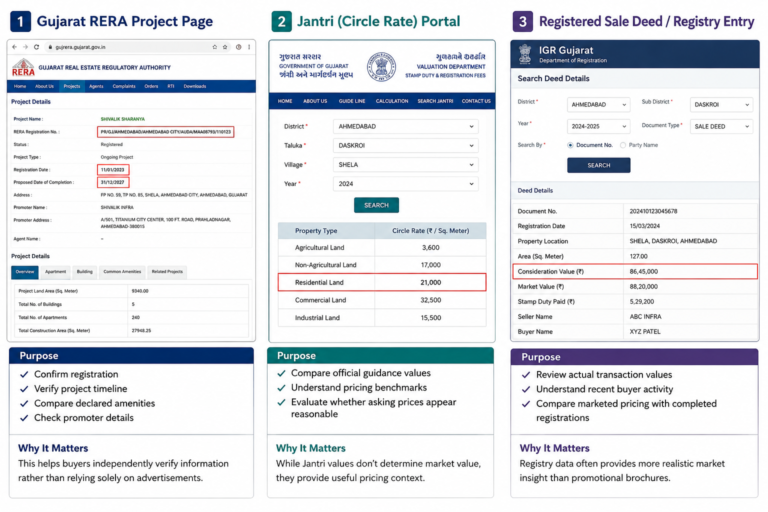
Instead, compare recently registered transactions in nearby projects where possible.
Why It Matters
Understanding local valuation helps buyers avoid paying inflated launch prices.
Common Mistake
Believing that a discount automatically means better value.
Sometimes discounts simply reduce an initially inflated asking price.
Practical Tip
Compare at least five similar projects before making a decision.
The differences become much clearer after multiple comparisons.
Step 4: Verify the Builder Before Trusting the Project
A strong location cannot compensate for poor execution.
Builder reputation should influence your decision as much as pricing.
Research:
- Completed projects
- Delivery timelines
- Construction quality
- Customer reviews
- Maintenance standards
- Financial stability
- Litigation history
Visit completed projects instead of relying only on sample flats.
Residents usually provide more balanced insights than sales teams.
Why It Matters
Reliable developers often maintain stronger buyer confidence, which supports future resale value.
Common Mistake
Assuming every well-known developer delivers identical quality across all projects.
Each project deserves independent evaluation.
Practical Tip
Speak with at least three existing homeowners before booking.
Ask about:
- Construction defects
- Water supply
- Maintenance quality
- Builder responsiveness
- Society management
Their experiences often reveal details marketing brochures never mention.
Step 5: Verify RERA Registration
Never assume a project is fully compliant simply because advertisements mention approvals.
Personally verify important information.
Check:
- RERA registration number
- Approved project timeline
- Completion schedule
- Developer details
- Project status
- Declared amenities
Why It Matters
RERA verification increases transparency and helps buyers identify discrepancies before committing.
Common Mistake
Accepting screenshots provided by sales representatives instead of checking official records independently.
Practical Tip
Always compare the promises made during sales discussions with the officially registered project information.
If important details don’t match, ask questions before proceeding.
Step 6: Conduct a Proper Site Visit
A sample apartment shows lifestyle.
The surrounding neighborhood shows reality.
During your visit, observe:
- Road conditions
- Water drainage
- Construction quality
- Ventilation
- Natural light
- Noise levels
- Parking design
- Security arrangements
- Community activity
Spend time walking around instead of remaining inside the sales office.
Why It Matters
Daily living experience depends on factors that brochures rarely emphasize.
Common Mistake
Booking based entirely on digital presentations or virtual tours.
Practical Tip
Visit nearby grocery stores, schools, pharmacies, and public spaces.
Imagine living there—not just investing there.
Step 7: Check Legal Documents Carefully
Legal verification isn’t optional.
Even attractive projects deserve independent scrutiny.
Important documents include:
- Title documents
- Land ownership records
- Approved building plans
- Commencement certificate
- Completion certificate (if applicable)
- Occupancy certificate (ready projects)
- Sale agreement
- Encumbrance details
Why It Matters
Clear documentation protects ownership rights and reduces future legal disputes.
Common Mistake
Signing booking forms before reviewing important legal paperwork.
Practical Tip
Have an independent property lawyer review documents before making substantial payments.
Step 8: Understand Future Infrastructure
Future infrastructure often influences long-term property performance.
However, buyers should distinguish between confirmed public projects and speculative promises.
Research:
- Government-approved road projects
- Public transport improvements
- Utility upgrades
- Nearby educational institutions
- Healthcare expansion
- Planned commercial developments
Why It Matters
Confirmed infrastructure generally strengthens long-term potential, while rumors often create unrealistic expectations.
Common Mistake
Buying solely because someone says “a metro station will come here.”
Always verify official announcements.
Step 9: Evaluate Rental Prospects Honestly
If you’re buying for investment, estimate rental income conservatively.
Consider:
- Nearby employment centers
- Tenant profile
- Society maintenance quality
- Competing rental inventory
- Occupancy trends
Why It Matters
Consistent rental demand can improve cash flow while waiting for long-term capital growth.
Common Mistake
Calculating investment returns using unrealistic rent estimates.
Use actual market data instead of optimistic projections.
Step 10: Negotiate Before You Book
Many buyers negotiate only the apartment price.
Experienced buyers negotiate the entire package.
Possible negotiation points include:
- Base price
- Floor-rise charges
- Parking
- Clubhouse fees
- Maintenance deposits
- Payment schedule
- Interior upgrade credits
- Waiver of administrative charges
- Flexible possession-linked plans
Why It Matters
Small negotiated savings across multiple components can significantly reduce total acquisition cost.
Common Mistake
Accepting the first “final offer.”
In many projects, builders have limited but meaningful flexibility—especially during slower sales periods or toward the end of a financial quarter.
Practical Tip
Don’t reveal your maximum budget at the beginning of negotiations.
Maintain flexibility and compare competing offers before making a final commitment.
Real Buyer Outcomes
Buying property is ultimately about outcomes, not promises. The best way to judge an investment is to examine realistic scenarios rather than marketing claims.
Below are two examples based on situations similar to those I’ve encountered while advising buyers. The numbers are illustrative—not guarantees—and are intended to show how different strategies can produce different results.
Case Study 1: End-User Family
Buyer Profile
- Family of four
- Both spouses employed
- Looking for long-term residence
- Budget: ₹1.15 crore
Their Situation
Initially, they wanted to purchase a larger apartment in a newly launched project because the sales team promised significant future appreciation.
After comparing several options, we noticed:
- Construction was only in its early phase.
- Builder delivery history was inconsistent.
- The quoted price was already close to premium market levels.
Instead, they selected a ready-to-move apartment from a developer with a strong delivery record.
Purchase Details
- Purchase Price: ₹1.08 crore
- Possession: Immediate
- Registration completed without delays
- Family shifted within two months
Estimated Position in 2026
- Approximate Market Value: ₹1.28–1.34 crore
- Significant savings on temporary rent
- Stable residential community
- Good resale interest
Biggest Lesson
Waiting for a slightly better project often delivers better value than rushing into the first attractive launch.
Case Study 2: Long-Term Investor
Investor Profile
- Age: 38
- Business owner
- Investment horizon: 8–10 years
Strategy
Rather than buying the most expensive luxury apartment, the investor focused on:
- Builder reputation
- Strong connectivity
- Consistent end-user demand
- Reasonable pricing
Purchase Details
- Purchase Price: ₹92 lakh
- Down Payment: 30%
- Loan for remaining amount
Rental Performance
Average rental income remained steady throughout the holding period, helping offset loan costs.
Although the rental yield itself was moderate, the combination of rental income and gradual capital growth improved the overall ROI.
Exit Strategy
Instead of selling during a temporary price spike, the investor continued holding because surrounding infrastructure continued improving.
Biggest Lesson
Long-term patience generally creates better investment outcomes than chasing quick profits.
What These Two Examples Have in Common
Neither buyer selected the “cheapest” project.
Neither purchased because someone promised extraordinary returns.
Instead, both evaluated:
- Builder credibility
- Price valuation
- Future development
- Residential demand
- Long-term potential
That disciplined approach reduced risk more effectively than trying to predict market timing.
What Existing Buyers Often Say
Testimonial 1 – Rahul Shah (IT Professional)
“We almost booked another project because of an attractive launch offer. After comparing documents and completed developments, we realized construction quality mattered much more than early discounts. Taking a few extra weeks to verify everything gave us much more confidence in our decision.”
Testimonial 2 – Neha Patel (PSU Employee)
“Our priority wasn’t investment returns. We wanted a peaceful neighborhood with good schools nearby for our children. Looking back, choosing a completed community instead of an under-construction project was the right decision for our family.”
Testimonial 3 – Amit Desai (NRI Buyer, USA)
“I visited multiple projects during one trip to India. Independent verification of approvals and speaking with existing residents gave me much more confidence than glossy marketing presentations. That extra effort helped me avoid making a rushed decision.”
Current Market Context
The residential market continues evolving.
Compared to earlier years:
- Buyer expectations have become more practical.
- End-users now represent a larger share of purchases.
- Developers compete more on quality than aggressive pricing.
- Buyers conduct more independent research before booking.
These trends generally contribute to healthier market stability.
However, real estate remains cyclical.
Interest rates, economic conditions, employment trends, and new supply can all influence future price movement.
No locality—including Shela—is guaranteed to outperform every year.
If I Were Buying in Shela Today
If I were investing my own money today, here’s exactly how I would approach it.
Would I Buy?
Yes—but only after comparing multiple completed and under-construction projects.
I would not purchase simply because someone claimed prices were about to rise.
What Would I Choose?
I would prioritize:
- Strong developer reputation
- Good internal planning
- Practical layouts
- Excellent road access
- Established residential surroundings
- Sustainable long-term demand
What Would I Negotiate Hardest?
I would negotiate:
- Overall purchase price
- Payment schedule
- Parking charges
- Clubhouse fees
- Maintenance deposits
- Interior upgrade packages
Small savings across multiple items can significantly improve total acquisition cost.
One Red Flag I Would Never Ignore
If a builder hesitates to provide complete legal documentation or avoids answering direct questions about approvals, I would immediately pause the buying process.
Transparency is non-negotiable.
Conclusion
Is Shela still one of Ahmedabad’s best investment locations in 2026?
In my assessment, it remains one of the city’s stronger long-term residential markets—but only for buyers who approach the decision carefully.
The locality continues benefiting from established infrastructure, growing residential communities, improving lifestyle amenities, and sustained end-user interest.
However, successful investing today is no longer about buying anywhere in Shela.
It’s about buying the right project at the right price from the right developer, with realistic expectations.
A thoughtful purchase made after proper verification is far more likely to create lasting value than a rushed decision driven by marketing pressure.