
If you are comparing a 2 BHK vs 3 BHK flat in Shela, the obvious question is usually: “Can I afford the 3 BHK?”
I think that is the wrong first question.
The better question is: “Which home will still make sense for my family, finances and resale plans five to ten years from now?”
I have seen buyers start with a comfortable budget and then get pushed toward a larger apartment because a broker says, “Sir, 3 BHK le lo, future mein kaam aayega.” Another buyer gets attracted by a low-priced 2 BHK because the headline price looks affordable, only to discover that the carpet area is much smaller than expected, parking and other charges increase the actual cost, and the second bedroom is barely useful for a growing family.
Shela makes this decision more complicated because there is a wide range of apartments, project specifications, locations, possession timelines and price points. Current listings show everything from relatively affordable 2 BHK homes to premium 3 BHK apartments, so simply comparing brochure prices can produce the wrong conclusion.
This guide is not about convincing you to buy a 3 BHK.
In some situations, I would choose a 2 BHK. In others, I would rent rather than buy either one.
The purpose here is to help you identify which decision fits your actual life.

2 BHK or 3 BHK for a Family in Shela: What Should You Really Buy?
For a small family with one child, a well-planned 2 BHK can be perfectly adequate.
For a family with two children, parents living with you, regular work-from-home requirements or a strong expectation that you will stay in the same home for 8–10 years, the extra room in a 3 BHK can become much more valuable than it initially appears.
But there is an important catch.
A badly planned 3 BHK is not automatically better than a well-planned 2 BHK.
A 3 BHK with poor carpet efficiency, small bedrooms, weak ventilation and an inconvenient location can be a worse purchase than a spacious 2 BHK in a better project. This is why a Comparison of 2 BHK and 3 BHK flats in Shela, should consider the actual layout, usability, location and long-term suitability—not just the number of bedrooms.
That is why I would compare usable space, location, total cost and future flexibility, not just the number of bedrooms.
The Real Buyer Problem: Why Choosing Between 2 BHK and 3 BHK Is Difficult
Imagine a family looking for a home in Shela with a budget of around ₹60–75 lakh.
They visit a project advertising a 2 BHK at around ₹55 lakh.
Then they see a 3 BHK available for ₹70 lakh.
The salesperson says:
“Only ₹15 lakh difference. You are already spending ₹55 lakh, so why compromise?”
That sounds reasonable.
But the buyer has to ask what that additional ₹15 lakh actually buys.
Does it provide a genuinely usable third bedroom?
Does the family need it?
Is the 3 BHK’s carpet area substantially larger?
Are the maintenance charges higher?
Is the property farther from the family’s preferred route?
Is the additional loan EMI comfortable?
Are there parking, floor-rise, clubhouse, GST, legal, registration or other acquisition costs?
And perhaps most importantly:
Would the family actually use the third bedroom, or are they buying it because somebody created urgency?
This is where many property decisions go wrong.
What Current Shela Market Data Tells Us
There is no single “Shela property price.”
Prices vary considerably by project, age, construction quality, exact location, size, amenities, possession status and whether you are looking at a primary sale or resale.
MagicBricks’ Q2 2026 data puts the average asking rate for multistorey apartments in Shela at about ₹5,125 per sq ft, with a reported range of roughly ₹4,051–₹6,198 per sq ft. Its BHK-wise data shows approximately ₹4,000–₹5,500 per sq ft for 2 BHK homes and ₹4,000–₹5,700 per sq ft for 3 BHK homes.
Housing.com shows a different overall average because property portals use different listing samples and methodologies. Its current Shela price page reports an average around ₹6,070 per sq ft and indicates a year-on-year decline in its tracked market data.
That difference is itself a lesson:
Do not treat one portal’s average price as the true value of your apartment.
A quoted ₹5,500 per sq ft may look expensive or cheap depending on whether the calculation uses carpet area, built-up area or saleable/super built-up area.
Your job is to compare like with like.
2 BHK vs 3 BHK in Shela: The Practical Difference
A 2 BHK may be the better choice when:
- You are a couple or small family.
- You have one child.
- You want to keep your EMI manageable.
- You prefer a better location over additional space.
- You expect to move again within 5–7 years.
- You want lower maintenance and furnishing costs.
- You are buying primarily for rental income.
- The available 3 BHK options stretch your finances.
The biggest advantage of a 2 BHK is not simply the lower purchase price.
It is financial flexibility.
A lower EMI can give you room for:
- emergency savings,
- children’s education,
- retirement investments,
- home furnishing,
- annual maintenance,
- insurance,
- or a future upgrade.
A family should not become house-rich and cash-poor.
When a 3 BHK Is Worth Paying More For
A 3 BHK becomes more attractive when the additional room solves an actual problem.
For example:
Family with two children
The third bedroom can prevent the family from needing to upgrade after five years.
Parents living with you
The third bedroom can provide privacy for parents without forcing everyone into the same sleeping arrangement.
Work-from-home requirement
If one or both spouses work from home, the third bedroom can function as a proper office rather than converting the dining table into a workstation every morning.
Long-term ownership
If you expect to stay in Shela for 10 years or more, paying for additional usable space can make more sense.
Future family flexibility
You may not need the third bedroom today.
But if you know your household will grow, buying enough space now can sometimes be cheaper than buying a 2 BHK and paying transaction costs again later.
The important word is sometimes.
Do not buy a 3 BHK simply because you might need it someday.
The Carpet Area Trap: A 3 BHK Can Look Bigger Than It Feels
This is one of the first things I would check.
Two apartments can both be advertised as 3 BHK while feeling completely different when you walk inside them.
One may have:
- larger bedrooms,
- better passage planning,
- useful balconies,
- less wasted corridor space,
- proper wardrobes,
- larger living space.
Another may have:
- narrow bedrooms,
- oversized passages,
- awkward columns,
- small balconies,
- limited furniture placement.
The second apartment may technically be a 3 BHK.
But it may not function like one.
Always compare carpet area and actual room dimensions.
Do not make the final decision based only on the “super built-up area” printed in a brochure.
Step-by-Step Buyer Action Plan
Step 1: Select the Right Part of Shela
What to do
Do not search for “Shela” as though it were one uniform property market.
Compare the actual location of each project.
Check:
- road approach,
- traffic during peak hours,
- distance to schools,
- grocery and daily shopping,
- healthcare,
- public transport,
- workplace commute,
- access to major roads,
- surrounding development,
- drainage and road conditions,
- future construction nearby.
Why it matters
A ₹65 lakh apartment in a convenient location can be more useful than a ₹60 lakh apartment that saves money but adds 20–30 minutes to your daily commute.
Over several years, that difference becomes significant.
Mistake to avoid
Do not assume that every project marketed as “Shela” offers the same connectivity.
Pro tip
Visit the property twice.
Visit once during the day and once during the evening peak period.
If possible, visit after rain as well.
A project can look excellent on a sunny Sunday afternoon and feel very different during weekday traffic.
Step 2: Validate the Budget and Actual Property Price
Suppose a 2 BHK is advertised at ₹55 lakh.
Do not write ₹55 lakh on your budget sheet and stop there.
Calculate:
Base property price
- parking
- floor-rise charges
- maintenance/deposit
- applicable taxes
- registration and stamp-related expenses
- legal/documentation expenses
- interiors
- appliances
- moving expenses
= actual acquisition cost
The same applies to a 3 BHK.
This is why a ₹65 lakh 3 BHK may not actually be only ₹10 lakh more expensive than a ₹55 lakh 2 BHK.
Current market reality
Current Shela listings show a broad spread. Housing.com, for example, currently lists 2 BHK examples around ₹50–65 lakh and several 3 BHK examples from approximately ₹60 lakh upward, with premium projects extending much higher.
That spread means you should not compare “average 2 BHK” with “average 3 BHK.”
Compare specific apartments with similar location, project quality, carpet efficiency and possession status.
Step 3: Verify the Builder and RERA Details
Never rely on:
“RERA approved hai.”
Ask for the actual project registration details.
Verify:
- project registration,
- promoter details,
- sanctioned plans where applicable,
- declared completion/possession timeline,
- project status,
- approvals and disclosures,
- promised amenities,
- unit details,
- litigation or other disclosed issues where relevant.
A RERA registration is an important verification step.
It is not a substitute for independent due diligence.
For an under-construction property, delivery risk matters.
For a ready-to-move property, construction quality, occupancy documentation, title and actual handover condition matter more.
Step 4: Use a Serious Site-Visit Checklist
Do not spend 20 minutes looking at the sample flat and then decide.
Check the actual unit wherever possible.
Inside the apartment
Check:
- carpet area,
- room dimensions,
- natural light,
- ventilation,
- balcony usability,
- kitchen storage,
- bathroom ventilation,
- electrical points,
- AC points,
- plumbing,
- water pressure,
- seepage,
- wall cracks,
- window quality,
- view from the apartment.
Outside the apartment
Check:
- lift waiting time,
- staircase,
- parking,
- visitor parking,
- security,
- common areas,
- garbage management,
- water supply,
- power backup,
- maintenance quality,
- clubhouse condition,
- children’s play area.
For an under-construction project
Do not evaluate only the sample apartment.
Look at the actual construction site.
A polished sample flat tells you what the developer wants you to imagine.
The construction site tells you what is actually being built.
Step 5: Legal and Registry Checks
This is the part buyers often postpone because it feels complicated.
Do not postpone it.
Before paying a substantial non-refundable amount, have the property documents reviewed by a qualified property lawyer.
Depending on the transaction, checks may include:
- title documents,
- chain of title,
- encumbrance information,
- approved plans,
- development permissions,
- land-use status,
- agreement for sale,
- allotment documentation,
- society/association documentation where applicable,
- completion/occupancy documentation for ready properties,
- outstanding dues,
- property tax records,
- registration records.
For Gujarat property transactions, government systems such as GARVI provide services related to property valuation, Jantri rates, registration and document-related processes. Government documentation also identifies GARVI as a public system for such revenue/property services.
Important distinction
Jantri value is not automatically the market value of your flat.
Use it as one reference point, not as proof that a property is correctly priced.
Step 6: Negotiate the Property — Not the Salesperson's Deadline
One of the most common psychological tactics in property sales is artificial urgency.
You may hear:
- “Last unit.”
- “Price increases tomorrow.”
- “Two customers are waiting.”
- “Offer valid only today.”
- “Builder has approved a special discount.”
- “If you don’t book now, you will lose the unit.”
Sometimes these statements are true.
Sometimes they are not.
You cannot negotiate effectively when you are emotionally afraid of losing something you have not independently verified.
What I would negotiate
Instead of asking only:
“Kitna discount doge?”
Ask:
- What is the all-inclusive price?
- Is parking included?
- Which charges are negotiable?
- Can floor-rise be reduced?
- Can maintenance deposits be adjusted?
- Can documentation charges be clarified?
- Is there any flexibility in payment schedule?
- For resale, what is the seller’s actual urgency?
- What are comparable transactions in the same project?
A ₹2 lakh reduction is not always better than getting a better parking slot, reduced additional charges or a more suitable unit.
2 BHK vs 3 BHK: Family Decision Matrix
| Factor | 2 BHK | 3 BHK |
|---|---|---|
| Initial purchase cost | Usually lower | Usually higher |
| EMI burden | Lower | Higher |
| Maintenance | Generally lower | Generally higher |
| Family of 3 | Usually sufficient | More comfortable |
| Family of 4 | Can work | Usually better |
| Parents staying with you | Limited privacy | Better |
| Work from home | Compromise possible | Easier |
| Future space | Limited | Better |
| Rental affordability | Broader tenant pool | Higher rent but smaller tenant pool |
| Resale flexibility | Good for budget buyers | Good for family buyers |
| Investment | Depends heavily on entry price | Depends heavily on entry price |
| Risk of overbuying | Lower | Higher if space is unnecessary |
The table is only a starting point.
The specific apartment matters more than the BHK label.
What Does Current Rental Demand Suggest?
Rental data is useful for investors, but it should not be used to justify an expensive purchase automatically.
MagicBricks’ Q1 2026 rental data reported average Shela rents of around ₹23,600 per month for 2 BHKs and ₹34,600 for 3 BHKs.
Another MagicBricks rental report from 2025 showed lower averages, illustrating how rental estimates can change with the period and dataset.
Current rental listings also show considerable variation depending on furnishing, project and apartment size.
This leads to a practical conclusion:
Never calculate rental yield from one advertised rent.
Calculate it from a realistic achievable rent.
For example:
If your property costs ₹70 lakh all-in and genuinely rents for ₹25,000/month:
₹25,000 × 12 = ₹3,00,000 annual rent.
₹3,00,000 ÷ ₹70,00,000 × 100 = approximately 4.3% gross rental yield.
That is before vacancy, maintenance, repairs, taxes and other costs.
Do not call a 4.3% gross yield a guaranteed return.
Realistic Case Study
Case Study 1: Family Buyer
Illustrative buyer scenario — not a claim about a real client
Consider a family with:
- Husband and wife
- One school-age child
- Parents visiting regularly
- Household income capable of supporting a ₹60–70 lakh purchase
- Expected stay: 8–10 years
They initially shortlisted a 2 BHK at approximately ₹56 lakh.
The apartment was in a reasonable location and the EMI was comfortable.
They also considered a 3 BHK at approximately ₹70 lakh.
The 3 BHK required a higher loan, but it offered a genuine third bedroom and better storage.
What changed the decision?
They calculated the long-term cost rather than looking only at the ₹14 lakh difference.
The family realised that they were likely to need a study/guest room within a few years.
They eventually chose the 3 BHK — but only after negotiating the total acquisition cost and verifying the project.
Lesson
The lesson is not “buy a 3 BHK.”
The lesson is:
If you are likely to stay for 8–10 years and the third room solves a genuine future need, paying more can be rational.
If the same family had planned to move within three years, I would have been much more cautious.
Case Study 2: Investor
Illustrative investment scenario — not a verified transaction
Suppose an investor buys a 2 BHK in Shela for approximately ₹55 lakh all-in.
Assume realistic rent of ₹23,000 per month.
Annual gross rent:
₹2.76 lakh
Gross rental yield:
₹2.76 lakh ÷ ₹55 lakh = approximately 5.0%
Now suppose the property appreciates by 20% over five years.
The property value becomes approximately:
₹66 lakh
That sounds attractive.
But the investor must subtract:
- vacancy,
- maintenance,
- repairs,
- taxes,
- transaction costs,
- loan interest if financed,
- brokerage on exit where applicable,
- and selling friction.
The actual investment return can therefore be materially lower than the headline appreciation.
What worked?
A reasonable entry price and a tenant-friendly location.
What did not?
Depending entirely on appreciation.
The investor should have bought only if the rental economics and exit demand made sense even without extraordinary price growth.
What About 3 BHK Investment Property?
I would be more careful here.
A 3 BHK can generate higher absolute rent, but the higher purchase price does not automatically create a better yield.
For example, if:
- 2 BHK costs ₹55 lakh and rents for ₹23,000
- 3 BHK costs ₹75 lakh and rents for ₹30,000
The 3 BHK earns more rent in rupee terms.
But the investor has also committed substantially more capital.
Therefore, calculate:
Net rental yield + realistic resale demand + entry price + holding cost.
Do not buy a larger apartment just because it sounds like a “premium investment.”
Resale Value: Which Is Easier to Sell?
Both can work.
But the buyer pool is different.
A reasonably priced 2 BHK may attract:
- young couples,
- small families,
- first-time buyers,
- investors,
- rental-focused buyers.
A 3 BHK may attract:
- larger families,
- professionals,
- buyers upgrading from 2 BHK,
- buyers looking for long-term housing.
The biggest resale mistake is buying an apartment that is expensive for its micro-market.
A ₹90 lakh 3 BHK may have strong resale potential if comparable homes are also priced around that level.
It can become difficult if a similar apartment nearby is available for ₹75 lakh.
Resale demand follows value, not your original purchase story.
Social Proof — Use Only Verified Buyer Experiences
If you publish testimonials, do not manufacture them.
The following are testimonial-style placeholders, not claims about real customers. Replace them with genuine feedback and obtain permission before publishing.
Example buyer testimonial format — IT professional
“We initially wanted a 2 BHK because of the lower EMI. After comparing carpet areas and thinking about working from home, we realised the third room would be useful. The important part was not the BHK — it was checking the actual layout.”
— IT professional, Shela buyer
Replace with verified customer name/details before publication.
Example buyer testimonial format — PSU employee
“The biggest mistake we almost made was comparing only the advertised price. Once we calculated parking, registration, interiors and other costs, the difference between two properties was much smaller than we thought.”
— PSU employee, Ahmedabad
Replace with verified customer details before publication.
Example investor testimonial format
“I stopped looking only at appreciation and started checking rent, vacancy and resale demand. That changed which project I considered.”
— Property investor, Ahmedabad
Replace with verified customer details before publication.
This approach is much safer than publishing invented testimonials as if they were real.
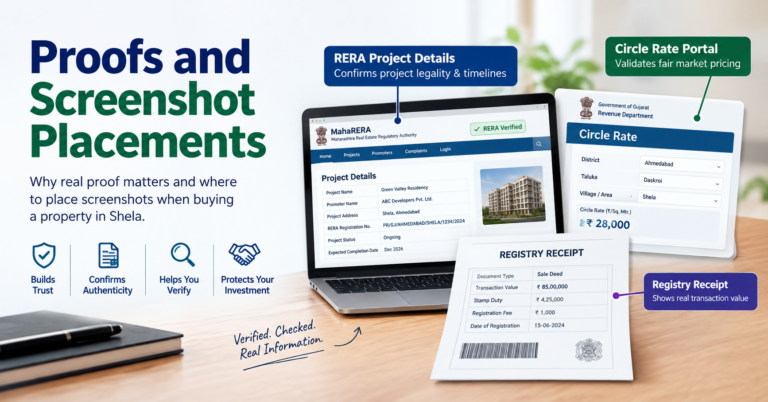
Proofs and Screenshot Placements
Who Should NOT Buy a 3 BHK in Shela?
This is important.
You probably should not buy a 3 BHK if:
- You are stretching your finances to the limit.
- The third bedroom has no practical purpose.
- Your emergency savings will disappear after the purchase.
- Your EMI would make your monthly budget uncomfortable.
- You expect to move cities within a few years.
- You are buying only because a salesperson says “future mein price badhega.”
- You are assuming guaranteed appreciation.
- You have not verified the project.
- You are ignoring a poor location because the apartment looks attractive.
- The 3 BHK is significantly overpriced compared with similar units.
A bigger home is not automatically a better financial decision.
Who Should Consider Renting Instead?
Renting can be the smarter decision when:
- Your job location may change.
- You are unsure whether you will stay in Ahmedabad.
- You are not financially ready for the down payment.
- The available properties are overpriced.
- You need time to understand Shela’s micro-markets.
- Your current rental is significantly cheaper than the ownership cost.
- You are buying primarily because you fear “prices will run away.”
There is nothing financially shameful about waiting.
The cost of a wrong property purchase can be much higher than the cost of renting for another year while you research properly.
Who Should Not Use This Guide?
This article is not designed for:
- short-term property flippers,
- speculative buyers looking for quick profits,
- people investing purely on rumours,
- buyers expecting guaranteed appreciation,
- investors looking for insider information,
- people making decisions only from WhatsApp property tips.
Real estate is slow-moving and expensive to enter and exit.
The right property can work very well.
The wrong property can lock your capital for years.
If I Were Buying This Property Today
This is where I would be opinionated.
If I were buying a home for my family in Shela today, I would not automatically choose the 3 BHK.
I would first shortlist both 2 BHK and 3 BHK properties and compare them using the same checklist.
If the family consisted of two adults and one child, and the 2 BHK had:
- good carpet efficiency,
- proper bedrooms,
- strong natural light,
- good ventilation,
- convenient location,
- reliable project management,
- manageable EMI,
I would have no problem choosing the 2 BHK.
But if I expected to stay for 8–10 years, had two children or needed a genuine home office, I would seriously consider the 3 BHK — provided the price premium was reasonable.
What would I negotiate hardest?
The total acquisition cost.
Not just the headline discount.
I would compare the complete cost against at least three similar properties.
One red flag I would not ignore
A salesperson who is unwilling to provide clear documentation or encourages me to pay first and verify later.
If basic information about the project, unit, payment schedule or documentation is difficult to obtain before booking, I would step back.
No apartment is so special that it justifies abandoning due diligence.
My Practical Rule: Buy the Smallest Home That Will Comfortably Work for Your Next 7–10 Years
This is perhaps the simplest way to think about the decision.
Do not buy the biggest property you can technically afford.
And do not buy the smallest property simply because the EMI is lower.
Buy the smallest home that comfortably fits your realistic future needs.
For one couple with one child:
Good 2 BHK > financially stressful 3 BHK
For a family with two children and long-term ownership plans:
Well-planned 3 BHK > cramped 2 BHK
For an investor:
Best risk-adjusted property > biggest property
That distinction matters.
Conclusion:
The right answer is not hidden in a property brochure.
It comes from matching four things:
Your family needs
- your actual budget
- the specific property
- your expected holding period
Current Shela market data shows meaningful variation in both sale prices and rental values, which is exactly why buyers should avoid relying on a single average number.
A 2 BHK can protect your cash flow.
A 3 BHK can provide long-term flexibility.
Neither is automatically the better investment.
Before you book, calculate the total acquisition cost, compare carpet area, inspect the actual property, verify RERA and legal documents, check the surrounding location and negotiate without artificial urgency.
And if the numbers do not work, walk away.
There will always be another property.
A good property decision should leave you feeling financially comfortable after registration — not financially relieved simply because the salesperson finally stopped calling.
If you are comparing two specific 2 BHK and 3 BHK options in Shela, use a simple side-by-side worksheet covering price, carpet area, EMI, maintenance, rent potential, location, possession and resale demand before making the final decision.
Frequently Asked Questions
Is a 3 BHK better than a 2 BHK for a family in Shela?
Is 2 BHK or 3 BHK better for investment in Shela?
Should I buy a 2 BHK and upgrade later?
Is Shela a good location for families?
Should I wait before buying property in Shela?
References
About the Author