
If you are searching for an affordable residential property in Shela, there is a good chance you have already experienced the same problem as many other buyers.
One website says you can get a 3 BHK for ₹65–70 lakh. A broker tells you, “Sir, this price is only for today.” Another project shows ₹75 lakh on the advertisement, but after you ask for the actual cost, the number suddenly moves closer to ₹85–90 lakh.
Then comes the familiar pressure:
“Only two units are left.”
“Price is increasing next week.”
“Book today and we will give you a special discount.”
This is exactly where buyers need to slow down.
In my experience advising property buyers and researching residential markets, the cheapest-looking 3 BHK is not necessarily the cheapest property to own.
The real question is not:
“Can I find a 3 BHK in Shela under ₹80 lakh?”
The better question is:
“Can I buy a legally clean, properly located, usable 3 BHK in Shela for a total cost that genuinely fits my budget?”
That distinction can save you several lakhs.
And the 2026 market makes this particularly important. Current listings show that Shela has 3 BHK options ranging from roughly the ₹60–80 lakh segment to ₹1 crore and substantially higher, depending on project, size, construction stage and positioning.
So yes, 3 BHK flats in Shela under ₹80 lakh do exist.
But you need to know which ₹80 lakh properties are actually good deals — and which ones only look affordable in an advertisement.
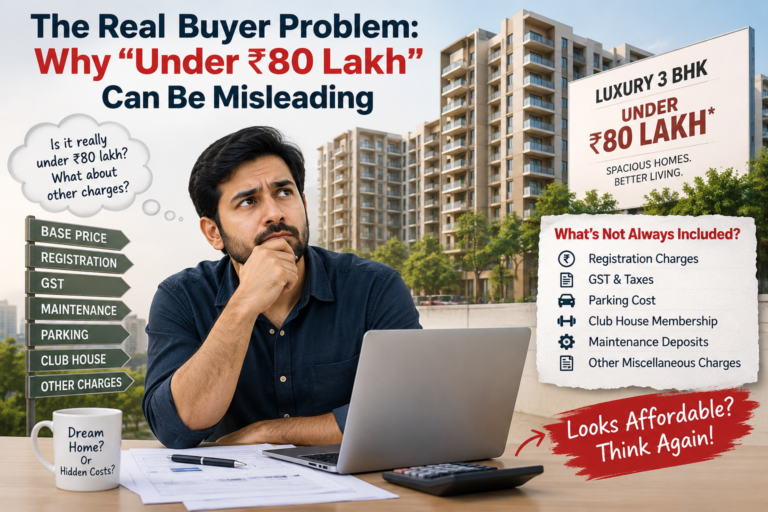
The Real Buyer Problem: Why “Under ₹80 Lakh” Can Be Misleading
Imagine a family with a total property budget of ₹80 lakh.
They want:
- 3 bedrooms
- parking
- good ventilation
- a reasonable society
- schools nearby
- decent connectivity
- future resale potential
- manageable EMI
They find a 3 BHK advertised at ₹72 lakh.
It looks perfect.
But then the actual calculation begins.
| Cost | Example |
|---|---|
| Advertised apartment price | ₹72 lakh |
| Floor/other applicable charges | ₹1–2 lakh |
| Parking/other charges | ₹1–3 lakh |
| Maintenance/deposits | ₹0.5–1.5 lakh |
| Stamp duty/registration and applicable taxes | Additional |
| Interiors/furniture | ₹3–8 lakh+ |
| Real cash requirement | Potentially much higher than ₹72 lakh |
The exact amount depends on the transaction, project and applicable government charges, so never use a headline property price as your final budget.
This is one of the biggest mistakes I see buyers make.
The ₹75 lakh question
When somebody tells you:
“3 BHK ₹75 lakh.”
Ask:
“Is ₹75 lakh the agreement value, all-inclusive price, or only the base price?”
That one question can completely change your comparison.
What Does the Shela Market Actually Look Like in 2026?
There is no single “Shela price.”
That is important.
Different projects can have dramatically different pricing because of:
- exact micro-location
- developer reputation
- age of the building
- carpet area
- super built-up area
- amenities
- possession status
- construction quality
- road access
- surrounding development
- resale liquidity
- floor/view
- parking
- project density
Current property portals show this spread clearly.
For example, current listings include 3 BHK options around ₹63 lakh, ₹69–74 lakh, ₹71 lakh, ₹73 lakh and ₹75 lakh, while several other projects are already around ₹80 lakh–₹1 crore or above.
Housing.com’s current Shela data also shows substantial variation in asking rates. Its locality data puts the average property rate around ₹6,070–₹6,268 per sq ft depending on the page/update, while another 2026 source from Magicbricks reports an average multistorey apartment rate of approximately ₹5,125 per sq ft. These differences are exactly why buyers should not treat one portal’s average as the “true market price.”
There is another important point.
Shela is not one homogeneous market.
A property close to established South Bopal infrastructure is not automatically equivalent to a project deeper into the developing side of the area.
Likewise, a ready-to-move resale apartment should not be directly compared with a newly launched project where possession is several years away.
Price per square foot without context is almost useless.
Step-by-Step Buyer Action Plan
Step 1: Choose the Location Before Choosing the Project
This sounds obvious, but buyers frequently do the opposite.
They see a beautiful brochure first.
Then they try to justify the location.
Don’t.
Start with your daily life.
What to check
If you are buying for your own family, check:
- commute to work
- school distance
- hospital access
- grocery stores
- public transport
- road condition
- traffic at peak hours
- drainage/waterlogging history
- street lighting
- surrounding construction
- access to major roads
- distance from your parents/family if relevant
Shela benefits from its position in western Ahmedabad and its connectivity with South Bopal, Shilaj and the wider western/peripheral corridor. The area also has substantial residential supply, giving buyers plenty of choice, including Budget-friendly 3 BHK options in Shela. However, that choice also means buyers need to compare projects carefully rather than assuming every new development offers the same value, location advantages or construction quality.
My practical rule
Visit the property three times:
- Weekday morning
- Weekday evening
- Weekend
A road that looks peaceful at 11 AM can feel very different at 7 PM.
Mistake to avoid
Do not buy a cheaper apartment because:
“It is only 10 minutes farther.”
Ten minutes on Google Maps and ten minutes during Ahmedabad peak traffic are not necessarily the same thing.
Pro tip
Drive the actual route from the property to your workplace at your normal commuting time.
That gives you more useful information than another hour looking at the brochure.
Step 2: Validate the Budget and Actual Property Price
If your maximum budget is ₹80 lakh, I would not search only for properties advertised at exactly ₹80 lakh.
I’d target a lower purchase price.
Why?
Because you need room for:
- registration/stamp-related costs
- applicable taxes
- brokerage, if any
- maintenance deposits
- interiors
- appliances
- furniture
- moving costs
- emergency buffer
My preferred approach
If ₹80 lakh is your total property budget, I would initially look around:
₹65–72 lakh advertised price
rather than starting at ₹80 lakh.
That gives you breathing room.
Compare carpet area, not just super built-up area
Two apartments can both be called “3 BHK” while offering very different usable space.
Ask for:
- carpet area
- built-up area
- super built-up area
Then compare.
A ₹72 lakh 3 BHK with substantially better usable space may be a better purchase than a ₹65 lakh apartment with a much smaller carpet area.
Mistake to avoid
Never compare:
Project A: ₹5,000/sq ft super built-up
with
Project B: ₹5,500/sq ft carpet
as if those numbers mean the same thing.
They don’t.
Step 3: Verify the Builder and RERA Information
A low price is not a bargain if the project creates legal or possession problems.
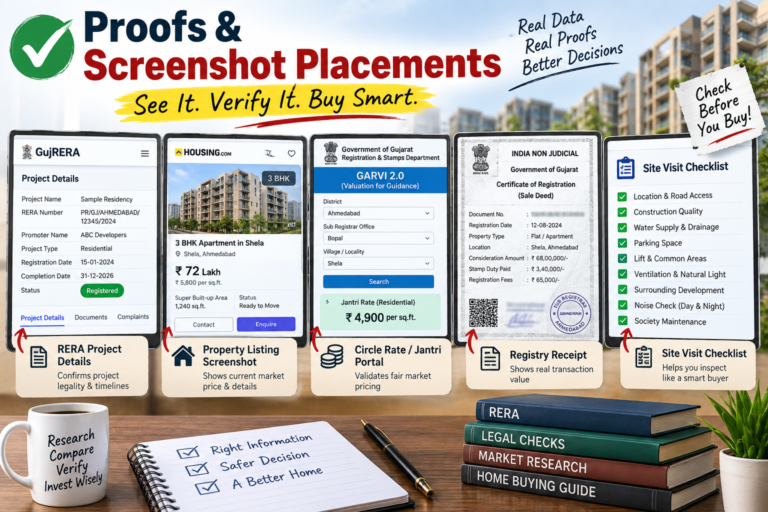
For an under-construction project, check the project on the GujRERA system.
Gujarat has its own Real Estate Regulatory Authority, and buyers can use the official RERA system to examine registered project information.
Check:
- RERA registration number
- promoter name
- project name
- registered address
- approved/project details available on the portal
- declared completion/possession timeline
- project extensions, if applicable
- complaints/orders where available
- phase details
- unit information
- promised amenities
Do not simply ask the sales person:
“Is this RERA approved?”
Ask:
“Give me the RERA number. I will verify it myself.”
That changes the conversation immediately.
Important warning
RERA registration does not mean:
“This project is guaranteed to be a perfect investment.”
It means you have a regulatory framework and project information to examine.
You still need legal and financial due diligence.
Step 4: Site Visit Like a Buyer, Not Like a Tourist
Most buyers walk into the sample flat and look at:
- false ceiling
- sofa
- kitchen
- lights
- wallpaper
That is the least important part.
The sample flat is designed to sell you a lifestyle.
Your job is to inspect the building.
Look at:
Construction
- cracks
- seepage
- plaster quality
- common-area finish
- lift condition
Water
- water pressure
- source
- backup
- drainage
Parking
- actual allotted parking
- parking dimensions
- visitor parking
- basement ventilation
Apartment
- natural light
- cross ventilation
- bedroom sizes
- kitchen usability
- balcony usability
- toilet ventilation
Society
- maintenance
- security
- lift-to-flat ratio
- open space
- density
- common areas
One of my favourite buyer tests
Stand silently in the bedroom for 2–3 minutes.
Listen.
Can you hear:
- highway traffic?
- construction?
- generators?
- clubhouse noise?
- nearby commercial activity?
You cannot negotiate away noise after purchasing.
Step 5: Legal and Registry Checks
This is the step where buyers should be willing to spend money on professional advice.
For a resale property, investigate:
- title documents
- previous sale deed
- chain of ownership
- society documentation
- outstanding dues
- mortgage/loan status
- property tax
- maintenance dues
- encumbrances where applicable
- sanctioned plan
- occupancy/completion documentation as applicable
- actual physical property versus documents
For a new project, the lawyer should review the relevant title and project documents rather than simply relying on the salesperson’s statement.
Why this matters
You are potentially committing tens of lakhs.
Spending a small amount on legal due diligence is cheap insurance compared with discovering a problem after registration.
Step 6: Negotiate Like a Buyer, Not Like Someone Asking for a Discount
One common mistake is saying:
“Sir, give me your best price.”
That gives the seller no reason to negotiate intelligently.
Instead, establish your numbers first.
Example
Suppose you find:
3 BHK asking price: ₹75 lakh
You determine that comparable properties suggest the realistic transaction value is closer to ₹70–72 lakh.
Now your conversation becomes:
“I am ready to proceed if the final all-in commercial works at ₹X, subject to document verification.”
That is much stronger.
Negotiate more than just the base price
Ask about:
- floor-rise charges
- parking
- maintenance deposits
- club charges
- documentation charges
- other applicable charges
- payment schedule
- possession-linked payments
- resale furniture/appliances
- repairs
- registration-related responsibilities
My strongest negotiation advice
Do not negotiate against yourself.
If the seller says:
“What is your final budget?”
Don’t immediately tell them your maximum number.
Read more:- Affordable 2 BHK Apartment In Shela Ahmedabad
What Are the Best Affordable 3 BHK Options in Shela Under ₹80 Lakh?
There are currently several examples in the market showing that the sub-₹80 lakh segment is real.
Current listings include:
- Pratham Realty — 3 BHK around ₹63.38 lakh
- Sun Skyview — roughly ₹68.92–74.46 lakh
- Ratna Turquoise Rosedale — roughly ₹72.97–73.76 lakh
- SP Epitome — around ₹71 lakh
- Sun Parkwest — roughly ₹60–68 lakh
- Green Garnet — roughly ₹70.13–75.05 lakh
- Rashmi Riesen — around ₹71.99 lakh
These are current asking/listing examples, not recommendations or confirmed transaction prices. Availability and prices can change, and buyers should independently verify the project, exact unit, carpet area, RERA information and total cost.
There are also resale opportunities. For example, current listings include a ready-to-move 3 BHK in South Bopal/Shela around ₹60 lakh and a 3 BHK resale in Vishwanath Sarathya West around ₹75 lakh.
Why I would not simply publish a “Top 10 projects” list
Because the best property depends on your situation.
A family needing immediate possession may prefer a 5–10-year-old resale apartment over a ₹75 lakh new booking with several years of construction remaining.
An investor may prefer a different product.
A first-time buyer may prioritise EMI and liquidity.
There is no universal “best 3 BHK in Shela.”
There is only the best fit for your use case.
Case Study
Case Study 1 — Family Buyer
Illustrative scenario, not a claimed client transaction
A family with two children has:
Total budget: ₹80 lakh
They initially wanted a new ₹78 lakh project.
But after calculating:
- registration-related expenses
- interiors
- appliances
- parking/other applicable charges
- moving expenses
their effective requirement was becoming uncomfortable.
Instead, they considered a ready-to-move resale apartment.
Purchase
Property: 3 BHK
Location: South Bopal/Shela belt
Purchase price: ₹68 lakh
Additional setup/legal/interior budget: approximately ₹8–10 lakh
Total planned outlay: approximately ₹76–78 lakh
The family sacrificed:
- newest amenities
- brand-new construction
But gained:
- immediate possession
- established neighbourhood
- ability to inspect the actual apartment
- no multi-year construction waiting period
Illustrative current-value scenario
If a comparable property later reaches around ₹75–80 lakh, that would represent moderate appreciation rather than a dramatic investment return.
And that is the point.
The family’s success was not dependent on a 20–30% annual price increase.
They bought something they could comfortably live in.
Lesson
For an end-user, avoiding a bad purchase is often more valuable than maximising appreciation.
Case Study 2 — Investor
Illustrative scenario, not a claimed client transaction
An investor buys a 3 BHK for:
Entry price: ₹72 lakh
Suppose the property generates:
Monthly rent: ₹22,000
Annual gross rent:
₹22,000 × 12 = ₹2.64 lakh
Gross rental yield:
₹2.64 lakh ÷ ₹72 lakh ≈ 3.67%
Before considering:
- vacancy
- maintenance
- property tax
- brokerage
- repairs
- financing costs
- taxes
That is a much more realistic way to evaluate the investment than simply saying:
“Shela prices will double.”
Some current market sources report rental yields in the broader Shela market around the 3–5% range depending on property type and methodology, but rental yield calculations should always be made for the specific unit rather than relying on locality averages.
Five-year illustrative outcome
Suppose the property appreciates from:
₹72 lakh → ₹95 lakh
That is meaningful appreciation, but not extraordinary.
If the investor also collected rent during the holding period, the total return could be stronger.
But the investor must still account for transaction costs and property-specific expenses.
What worked?
- reasonable entry price
- decent rental demand
- long holding period
- no dependence on immediate flipping
What didn’t?
The investor should not assume that every Shela apartment will appreciate at the same rate.
Real estate returns are highly dependent on entry price.
Buying an excellent property at an excessive price can still produce a poor investment.
“Testimonials” — Use Only Genuine Buyer Feedback
I would not publish invented testimonials under real-sounding names.
That is exactly the type of EEAT signal that can destroy trust if readers discover it is fabricated.
Instead, when you have genuine buyer feedback, use a format like this:
[Verified buyer testimonial — publish only after obtaining permission]
“I originally wanted a new project, but after comparing the total cost, we chose a resale 3 BHK in the South Bopal–Shela area. The biggest advantage was that we could inspect the actual flat before paying.”
Buyer type: IT professional
Property: 3 BHK, South Bopal/Shela
Outcome: End-use purchase
[Verified buyer testimonial — publish only after obtaining permission]
“The RERA and document verification took more time than I expected, but it gave me confidence before making the payment.”
Buyer type: PSU employee
Property: 3 BHK, Shela
Outcome: End-use purchase
[Verified buyer testimonial — publish only after obtaining permission]
“My biggest mistake would have been looking only at the advertised price. Once I calculated the complete cost, two projects I liked were no longer within my budget.”
Buyer type: NRI
Property: Shela residential property
Outcome: Purchase after financial and legal review
Do not label these as real testimonials until you have actual buyers, permission and verifiable details.
What the Current Market Data Tells Me
The 2026 data is actually more useful when you look at the disagreement between sources.
Housing.com currently reports a Shela average property rate around ₹6,070–₹6,268 per sq ft depending on its update/page, while Magicbricks reports approximately ₹5,125 per sq ft for multistorey apartments.
That does not mean one website is necessarily wrong.
It shows how much property pricing depends on:
- dataset
- property type
- asking price
- project mix
- methodology
- listing inventory
Another current listing snapshot shows a large number of 3 BHK options, including both affordable and premium projects.
This is good news for buyers.
Why?
Because you have choice.
You don’t need to buy the first property a broker shows you.
You can compare:
new vs resale
ready-to-move vs under-construction
larger old apartment vs smaller new apartment
Shela vs South Bopal vs Shilaj/Ghuma
That competition is useful.
But There Is a Hidden Risk: Too Much New Supply
This is something investors should pay attention to.
Ahmedabad’s western and western-peripheral corridors have been important areas for new residential launches. Recent market reporting based on Cushman & Wakefield data says almost 40% of Q2 2026 launches came from western and western-peripheral corridors, including Shela, South Bopal, Bopal and Hebatpur.
For an end-user, abundant supply can be good.
For an investor, it can create competition.
If ten similar projects are offering similar 3 BHK apartments, your property doesn’t automatically become scarce simply because you own one.
That affects resale.
A future buyer may have:
- your resale unit
- a new launch
- another resale
- a slightly cheaper project
- a project with better amenities
So if you are buying purely for investment, liquidity matters more than brochure beauty.
Proofs & Screenshot Placements
Who This Guide Is NOT For
This guide is not for someone who wants:
A quick flip
If your plan is:
Buy today → sell in 6 months → make ₹10 lakh
I would not buy based on that strategy.
Transaction costs alone make short-term residential flipping difficult.
A rumour-based investment
Don’t buy because someone says:
“This road is coming.”
“That company is coming.”
“Prices will double.”
Ask for the actual planning/infrastructure evidence.
Maximum leverage
If purchasing the property requires you to use almost every rupee of savings and stretch your EMI, wait.
Owning a 3 BHK while having no emergency fund is not financial security.
Buyers who need immediate certainty but are considering long-possession projects
If you need a home within 6–12 months, don’t buy a project promising possession several years away simply because the launch price looks attractive.
Who Should Consider Renting Instead?
I would seriously consider renting if:
- your job location may change
- you may leave Ahmedabad in 2–3 years
- your income is unstable
- you don’t have an emergency fund
- EMI would consume too much of your monthly income
- you are buying mainly because “property prices always go up”
- you haven’t identified the exact locality where you want to live
There is nothing wrong with renting.
Renting for another 12–24 months while building a stronger down payment can be a better financial decision than buying the wrong ₹75 lakh apartment today.
If I Were Buying This Property Today
I would not rush into a new launch simply because it is advertised at ₹70–80 lakh.
My first choice would be:
A ready-to-move or near-ready 3 BHK
preferably in an established residential pocket with:
- usable carpet area
- good road access
- reliable water
- reasonable society maintenance
- established occupancy
- parking
- good ventilation
- clean documentation
I would rather buy a well-maintained resale at ₹68–75 lakh than pay a similar amount for a project where I have to wait years and hope the promised development happens.
Current listings demonstrate that both sub-₹80 lakh new-project options and resale opportunities exist, so buyers should compare them rather than assuming new construction is automatically better.
What would I negotiate hardest?
The total acquisition cost.
Not just the headline price.
I would ask for a complete written cost sheet and negotiate the overall deal.
What configuration would I choose?
A practical 3 BHK with good usable carpet area.
I would not pay a large premium simply for:
- oversized clubhouse
- flashy entrance
- decorative landscaping
- marketing claims
One red flag I would not ignore
A seller/builder who avoids giving clear documentation.
If I repeatedly hear:
“Don’t worry, sir.”
instead of:
“Here is the document.”
I would stop.
My Bottom Line on Affordable Residential Property in Shela
Shela remains an interesting residential market for buyers because there is a broad range of housing and considerable choice.
But that choice creates another problem:
There are too many properties to buy blindly.
The 2026 market clearly contains 3 BHK opportunities below ₹80 lakh, but the quality, size, location, possession timeline and total acquisition cost vary dramatically.
So don’t ask:
“Which is the cheapest 3 BHK in Shela?”
Ask:
“Which 3 BHK gives me the best combination of location, usable space, legal safety, possession certainty, total cost and resale liquidity?”
That is the question that protects your money.
And if the answer is:
“None of the properties I have seen meet those conditions.”
Then don’t buy.
There will always be another apartment.
There will not always be another opportunity to undo a bad property decision cheaply.
Free Buyer Checklist
Before paying a token amount for an affordable 3 BHK in Shela, ask:
Property
- Carpet area confirmed?
- Super built-up area confirmed?
- Parking documented?
- Actual unit inspected?
- Water supply checked?
- Drainage/waterlogging checked?
- Noise checked at peak hours?
Price
- Base price confirmed?
- Complete cost sheet received?
- Registration/stamp-related costs understood?
- Maintenance/deposit charges understood?
- Interior budget included?
- Comparable properties checked?
Builder
- RERA number verified?
- Promoter details checked?
- Possession timeline checked?
- Project complaints/orders reviewed where available?
- Previous projects examined?
Legal
- Title documents reviewed?
- Sale deed/ownership chain checked?
- Encumbrance/loan status checked?
- Property tax/maintenance dues checked?
- Approved plans/documents reviewed?
Decision
- EMI comfortably affordable?
- Emergency fund remains after purchase?
- Suitable for your actual lifestyle?
- Resale demand considered?
- You’re buying because the property is good — not because someone created urgency?
FAQ: Real Buyer Questions
Is ₹80 lakh enough to buy a 3 BHK home in Shela in 2026?
What is the price of 3 BHK homes in Shela under 80 lakhs?
Can I get a good 3 BHK in Shela for ₹70 lakh?
Is resale 3 BHK property in Shela worth considering?
Should I wait for 3 BHK prices in Shela to fall?
References
About the Author