
Infrastructure is one of the biggest factors that can change the long-term real estate potential of a location. When a major road, railway line, airport or industrial corridor becomes operational, buyers naturally start asking whether nearby residential markets will also benefit.
The Ahmedabad–Dholera Expressway is one such infrastructure development that is attracting attention in Gujarat’s real estate market.
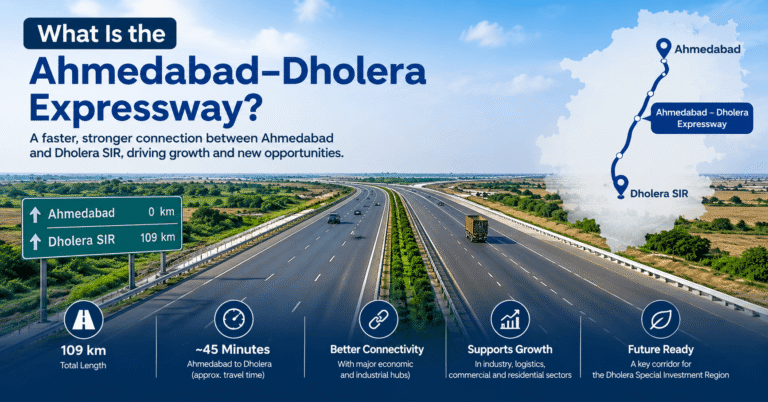
The expressway has already changed the travel equation between Ahmedabad and Dholera. The approximately 109-km Ahmedabad–Dholera Greenfield Expressway was inaugurated in March 2026, and current government and infrastructure reports indicate that Ahmedabad–Dholera travel time has been reduced to roughly 45 minutes.
At the same time, another important development has emerged in September 2026. NHAI has invited bids for a proposed ₹124.40 crore interchange connecting the Ahmedabad–Dholera Expressway with the Sardar Patel Ring Road. This could further integrate the expressway with Ahmedabad’s wider road network.
This naturally raises an important question for property buyers:
Will the Dholera Expressway increase property demand in Shela?
The short answer is:
It could support Shela’s long-term property demand, but buyers should not assume that the expressway alone will automatically increase property prices.
The potential benefit comes from a combination of factors — Ahmedabad’s western connectivity, access towards the Dholera economic corridor, employment growth, infrastructure development, residential convenience and future buyer demand.
In this article, we will examine how the Dholera Expressway could affect Shela, what the actual connectivity advantage may be, what risks buyers should consider, and whether the infrastructure story is strong enough to influence a Shela property-buying decision.
What Is the Ahmedabad–Dholera Expressway?
The Ahmedabad–Dholera Expressway is a major access-controlled road corridor connecting Ahmedabad with the Dholera Special Investment Region and onward towards the Bhavnagar side.
The expressway is approximately 109 km long and begins around the Sardar Patel Ring Road/Sarkhej side of Ahmedabad before moving towards Dholera. It was inaugurated in March 2026 and has significantly reduced travel time between Ahmedabad and Dholera.
This is important because Dholera is not simply another residential suburb.
Dholera SIR is being developed as an industrial and economic region, which means its long-term success depends heavily on connectivity for workers, businesses, logistics and investment.
The expressway therefore has implications beyond transportation.
It can potentially influence:
- business movement
- employee commuting
- industrial investment
- logistics
- commercial development
- land demand
- residential demand
- regional property sentiment
But there is a major point that Shela property buyers should understand.
Dholera Expressway does not mean that every residential location in Ahmedabad will automatically benefit equally.
The actual impact will depend on connectivity from the residential location to the expressway and on whether people working in the Dholera corridor actually choose that residential market.
How Is the Dholera Expressway Connected to Ahmedabad?
The northern end of the expressway is around the Sarkhej/Sardar Patel Ring Road side of Ahmedabad.
This is particularly relevant when discussing Shela because Shela is located in Ahmedabad’s western residential growth corridor.
However, buyers should avoid describing Shela as being “directly connected” to the Dholera Expressway.
That would be misleading.
The potential relationship is more accurately understood as:
Shela → Ahmedabad western road network → Sarkhej/SP Ring Road → Ahmedabad–Dholera Expressway → Dholera SIR
This distinction matters.
A property can be relatively close to a major highway on a map but still have an inconvenient real-world route to the nearest entry point.
For an access-controlled expressway, the location of the interchange matters more than simply measuring distance from the road.
This is why buyers should calculate the actual driving route rather than relying on statements such as “Dholera Expressway is nearby.”
Why Is the New Sardar Patel Ring Road Interchange Important for Shela?
One of the most interesting current developments is the proposed interchange between the Ahmedabad–Dholera Expressway and Sardar Patel Ring Road.
In September 2026, NHAI invited bids for a ₹124.40 crore interchange project at the junction of the two corridors. The project is intended to improve connectivity between Ahmedabad, Dholera and the surrounding road network.
This is important because real estate does not benefit simply from infrastructure existing somewhere in the region.
It benefits when people can use that infrastructure conveniently.
A stronger connection between the Dholera Expressway and Sardar Patel Ring Road could make the wider corridor more accessible from different parts of Ahmedabad.
For Shela buyers, this could potentially improve the strategic value of western Ahmedabad’s road connectivity.
However, there is an important caution.
A proposed interchange should not be treated as an immediate property-price guarantee.
The actual effect needs to be evaluated after:
- construction
- opening
- traffic movement
- travel-time savings
- commuter adoption
Only then can buyers properly judge the real residential impact.
Could Better Dholera Connectivity Increase Demand for Homes in Shela?
Potentially, yes.
But the relationship is indirect.
Imagine a person working for a company connected with the Dholera industrial corridor.
That person has several choices.
They could:
- live closer to Dholera
- rent accommodation near their workplace
- purchase a home in Ahmedabad
- live in another western Ahmedabad locality
- choose a location based on family requirements
If the person prefers Ahmedabad because of schools, hospitals, shopping, established communities and lifestyle facilities, then better road connectivity to Dholera could make certain Ahmedabad locations more attractive.
Shela could potentially participate in this demand.
But that does not mean every Dholera employee will choose Shela.
This is why the correct real-estate argument is:
The Dholera Expressway may expand the economic and commuting catchment of Ahmedabad, which could indirectly support residential demand in well-connected areas such as Shela.
That is much more realistic than saying:
“Dholera Expressway will definitely increase Shela property prices.”
1. Employment Growth Could Be the Biggest Long-Term Factor
Road infrastructure itself does not create sustained housing demand.
Employment does.
If Dholera develops into a major employment centre, the number of people travelling between Ahmedabad and Dholera could increase.
That could create demand for:
- rental homes
- apartments
- family housing
- temporary accommodation
- employee housing
- supporting commercial development
The Dholera Expressway makes this movement easier.
But the real question for Shela is:
How much of this future employment-driven housing demand will actually come to Ahmedabad?
And among Ahmedabad locations, how much will come to Shela?
There is currently no credible basis for assigning a specific percentage.
Therefore, this should be treated as a long-term potential demand driver, not a guaranteed short-term price trigger.
2. Shela's Existing Residential Ecosystem Could Be an Advantage
One reason Shela could benefit from regional infrastructure is that it is already a residential market rather than a completely new development zone.
Homebuyers generally consider more than workplace distance.
A family may also evaluate:
- schools
- hospitals
- grocery stores
- restaurants
- entertainment
- public transport
- existing residential societies
- road connectivity
- children’s education
- family convenience
This gives established residential areas an advantage when new employment centres emerge.
A buyer may be willing to travel somewhat farther to work if the family gets a better overall residential environment.
This is where Shela could potentially benefit.
3. The Expressway Could Improve Ahmedabad's Regional Connectivity
The biggest benefit may not be Shela-to-Dholera travel alone.
Instead, it could be the creation of a stronger regional road network.
The expressway connects into Ahmedabad’s broader road system, while the proposed Sardar Patel Ring Road interchange is intended to further improve integration between the two corridors.
For property buyers, connectivity should be viewed as a network rather than a single road.
A useful way to think about it is:
Local road → Ring Road → Expressway → Dholera SIR
The better these connections work together, the more valuable the regional accessibility can become.
4. Dholera Development Is Bigger Than the Expressway
Another reason buyers are watching the Dholera corridor is that road infrastructure is only one part of the development story.
The region is also receiving attention through other transport and economic infrastructure.
In September 2026, reports said the Sarkhej–Dholera semi-high-speed rail project had moved forward with EPC bidding. The proposed railway corridor is targeted for operations around 2030 and is intended to strengthen connectivity between Ahmedabad and Dholera.
This matters because multiple modes of connectivity can have a stronger long-term economic effect than one road alone.
The broader development story includes:
- expressway connectivity
- proposed rail connectivity
- Dholera SIR
- industrial development
- airport-related infrastructure
- logistics
- commercial activity
The more successfully these components develop together, the stronger the case for regional economic growth becomes.
5. Could Dholera Development Create Rental Demand in Shela?
This is a question investors should pay attention to.
Suppose employment growth in the Dholera region increases.
Some workers may prefer renting in Ahmedabad rather than purchasing immediately.
That could create rental demand in locations that offer:
- reasonable commute
- quality apartments
- social infrastructure
- good roads
- schools and healthcare
- established neighbourhoods
Shela could potentially benefit from such demand.
But again, this depends on actual commuting behaviour.
Investors should therefore avoid purchasing a property based only on an assumption of future rental demand.
Instead, check current:
- rental listings
- achieved rents where available
- vacancy levels
- tenant profile
- nearby competing projects
- maintenance costs
- apartment supply
A high advertised rent is not necessarily the same as a rent that tenants are actually paying.
6. Will the Expressway Increase Shela Property Prices?
This is probably the question most investors really want answered.
The honest answer is:
Possibly, but not automatically and not immediately.
Property prices generally depend on several factors working together.
A simplified property-demand equation is:
Connectivity + Employment + Infrastructure + Livability + Buyer Demand + Supply
The Dholera Expressway mainly strengthens the connectivity component.
If Dholera employment grows, infrastructure improves and more people need housing in Ahmedabad, then the demand side could strengthen.
But if Shela receives a very large amount of new housing supply at the same time, price growth could remain moderate.
Therefore:
More connectivity does not automatically equal higher property prices.
7. New Housing Supply Could Limit Price Growth
This is an important point that property marketing often ignores.
Suppose demand increases by 10%.
If available housing supply increases by 20%, developers may still need to compete for buyers.
This can limit price appreciation.
For this reason, anyone considering Shela as an investment should study both:
Demand and supply.
Do not only ask:
“What infrastructure is coming?”
Also ask:
“How many competing projects are being launched?”
“How much unsold inventory exists?”
“Are buyers actually purchasing?”
“How long are properties staying on the market?”
These questions provide a much better indication of real market strength.
8. Why Buyers Should Not Overpay Because of the Dholera Story
Infrastructure stories can create excitement.
That excitement can sometimes become a pricing problem.
A developer or broker may say:
“Dholera is growing, so Shela prices will increase.”
That statement may sound logical, but it does not tell you whether today’s asking price is reasonable.
Suppose two similar apartments are available.
One costs ₹75 lakh.
Another costs ₹85 lakh because the seller claims that future infrastructure will increase prices.
The buyer should not automatically pay ₹10 lakh extra for a future expectation.
Instead, compare:
- carpet area
- construction quality
- project age
- builder reputation
- possession
- amenities
- maintenance
- parking
- location
- resale demand
- nearby competing projects
Infrastructure should support your property decision, not replace your property analysis.
9. Does Shela Have a Direct Advantage Over Other Ahmedabad Locations?
Not necessarily.
This is another important point.
If Dholera-related employment grows, several Ahmedabad locations may compete for residential demand.
Potentially competing areas could include parts of:
- South-West Ahmedabad
- Bopal
- South Bopal
- Shela
- Sarkhej-side locations
- other areas with convenient access to major roads
Therefore, Shela’s future performance should be compared with competing locations rather than analysed in isolation.
A buyer should ask:
“Why should I buy in Shela instead of another location with similar access to the Dholera corridor?”
The answer should come from the property’s:
- price
- location
- livability
- connectivity
- project quality
- future supply
- resale potential
10. What About Shela's Existing Connectivity?
Shela’s potential benefit from Dholera should be considered alongside its existing connectivity.
The locality already sits within Ahmedabad’s western residential growth area and has connections towards important parts of the city. Real-estate locality information also highlights access through roads including Sardar Patel Ring Road and Sanand-Sarkhej Road.
This existing road network is important.
Why?
Because future infrastructure is most useful when it connects efficiently with infrastructure that already exists.
A new expressway cannot help much if the first and last parts of the journey are extremely inconvenient.
Therefore, Shela buyers should examine the entire route:
Home → local road → major connecting road → expressway access → Dholera
The weakest part of that chain can determine the actual commuting experience.
11. What Could Reduce the Positive Impact on Shela?
A balanced property article should also discuss the downside.
Several factors could limit the impact.
Dholera employment may take time
Infrastructure can be completed faster than employment ecosystems develop.
A road can be operational today, while large-scale job creation may take years.
Other locations may capture the demand
Shela will compete with other Ahmedabad residential markets.
Property supply could increase
If many developers launch projects, increased supply can reduce pricing pressure.
Travel time may vary
A headline such as “45-minute Ahmedabad–Dholera travel” does not mean every Shela resident will complete the full journey in 45 minutes.
The journey begins at the buyer’s home, not at the expressway entrance.
Prices may already reflect expectations
Some sellers may already incorporate future infrastructure expectations into asking prices.
This can reduce the investment advantage for buyers entering at inflated valuations.
12. How Should a Buyer Calculate the Real Connectivity Benefit?
Instead of asking:
“How close is this project to the Dholera Expressway?”
ask these five questions.
Question 1: Where is the nearest practical entry point?
Identify the actual interchange you would use.
Question 2: How long does it take from the property to that interchange?
Measure this during peak traffic.
Question 3: How reliable is the route?
A route that takes 25 minutes one day and 60 minutes another day may not provide the expected commuting advantage.
Question 4: What happens after leaving the expressway?
The final part of the journey matters too.
Question 5: Does the connectivity benefit justify the property's price?
This is the most important question.
A good road cannot automatically turn an overpriced property into a good investment.
13. What Should Shela Property Buyers Check Before Purchasing?
If you are considering a Shela property partly because of the Dholera growth story, use this checklist.
Check 1: RERA Registration
For an under-construction project, verify the project’s Gujarat RERA information.
Check:
- registration number
- promoter details
- project status
- approved plans
- possession timeline
- project-related disclosures
Do not rely only on the developer’s brochure.
Check 2: Actual Carpet Area
Compare properties using carpet area rather than simply super built-up area.
A larger advertised area does not necessarily mean more usable living space.
Check 3: Complete Purchase Cost
Calculate:
- base price
- GST where applicable
- parking
- floor-rise charges
- maintenance deposit
- club charges
- legal/documentation charges
- stamp duty
- registration
- other builder charges
Your decision should be based on the total acquisition cost, not the headline price.
Check 4: Approach Road
Visit the property yourself.
Look at the road during busy hours.
A future expressway cannot solve a poor local approach road.
Check 5: Drainage and Waterlogging
This is especially important for properties in developing peripheral areas.
Visit during or immediately after heavy rainfall if possible.
Check 6: Nearby Infrastructure
Check the actual distance to:
- schools
- hospitals
- supermarkets
- public transport
- major roads
- workplaces
Check 7: Competing Projects
Compare at least three similar properties before making a purchase.
14. Shela vs Dholera: Which Is Better for a Homebuyer?
There is no universal answer.
It depends on what you need.
Factor | Shela | Dholera |
Established residential environment | Advantage | Developing |
Existing family amenities | Advantage | Developing |
Ahmedabad lifestyle access | Advantage | Lower |
Proximity to Dholera SIR | Lower | Advantage |
Dholera employment access | Improving | Advantage |
Existing residential ecosystem | Stronger | Developing |
Long-term infrastructure story | Positive | Very strong |
Immediate end-user convenience | Generally stronger | Depends on location |
Investment risk | Depends on property | Potentially higher for speculative buyers |
For a family that already works and lives in Ahmedabad, Shela may offer greater everyday convenience.
For someone whose primary objective is proximity to Dholera’s industrial development, Dholera itself may be more relevant.
This is why buyers should not treat every infrastructure story as an investment recommendation.
15. What Could Happen to Shela Property Demand From 2026 to 2030?
The next several years could be particularly important.
2026
The Ahmedabad–Dholera Expressway is operational, reducing the travel-time barrier between Ahmedabad and Dholera.
2026–2027
The proposed Sardar Patel Ring Road interchange could become an important connectivity development if executed as planned.
2027–2028
The market should become clearer about whether Dholera-related economic activity is translating into actual employment and commuting demand.
2028–2030
If industrial development, employment and transport infrastructure progress together, the broader Ahmedabad–Dholera corridor could become increasingly important for real estate.
2030 onward
The actual residential winners should become easier to identify because there will be more evidence from:
- employment
- rents
- transactions
- occupancy
- commuting
- infrastructure usage
This is why a long-term investor should focus on evidence rather than predictions.
16. How Can You Tell Whether Shela Is Actually Benefiting?
Do not wait for property brokers to tell you.
Track real indicators.
Indicator 1: Rental Demand
Are more people looking for rentals in Shela?
Indicator 2: Occupancy
Are new residential projects getting occupied?
Indicator 3: Resale Activity
Are owners actually finding buyers?
Indicator 4: Transaction Prices
Are completed transactions increasing, rather than merely asking prices?
Indicator 5: Commercial Development
Are shops, offices, services and other businesses expanding?
Indicator 6: Road Usage
Is the improved infrastructure actually being used by commuters?
Indicator 7: Employment
Are new jobs being generated in the Ahmedabad–Dholera corridor?
These indicators are much stronger than simply reading a developer’s advertisement.
17. Should Investors Buy Shela Property Before Dholera Fully Develops?
This depends on the purchase price and investment horizon.
An investor who believes Dholera will develop rapidly may see Shela as an established residential market that could benefit from wider regional economic growth.
But there is also a risk.
The market may take longer to develop than expected.
If your investment depends entirely on Dholera creating large employment numbers within the next one or two years, the risk is higher.
A more conservative buyer should ask:
“Would I still be comfortable owning this Shela property if Dholera’s growth takes five to ten years longer than expected?”
If the answer is yes because the property already has strong local demand, the investment case is stronger.
If the answer is no, the purchase may be relying too heavily on a future prediction.
18. The Biggest Mistake Buyers Can Make
The biggest mistake is confusing infrastructure potential with guaranteed appreciation.
A road can improve connectivity.
A railway can reduce travel time.
An airport can improve accessibility.
An industrial corridor can create jobs.
But none of these guarantees that a particular apartment will appreciate at a particular rate.
Property appreciation ultimately depends on:
Real demand + suitable supply + reasonable entry price + location quality + economic growth.
That is the framework buyers should use.
19. So, Will Dholera Expressway Increase Shela Property Demand?
The most realistic answer is:
Yes, it has the potential to support demand — but indirectly and over time.
The expressway strengthens the Ahmedabad–Dholera connection and has already reduced travel time significantly. The new proposed Sardar Patel Ring Road interchange could further improve integration with Ahmedabad’s road network.
If Dholera develops into a significant employment and industrial centre, Ahmedabad’s established residential areas could potentially benefit from additional housing demand.
Shela is one location that could participate in this growth because of its position in western Ahmedabad and its existing residential ecosystem.
But there is no sound basis for saying:
“Dholera Expressway guarantees higher Shela property prices.”
Instead, buyers should treat the expressway as one potential long-term demand driver among several.
Conclusion
Will Dholera Expressway increase Shela property demand?
Potentially yes — but the effect is more likely to be gradual, indirect and dependent on actual economic growth.
The Ahmedabad–Dholera Expressway has already improved regional connectivity, cutting the Ahmedabad–Dholera journey to around 45 minutes according to current reports.
The proposed Sardar Patel Ring Road interchange is another development worth monitoring because better integration between the expressway and Ahmedabad’s road network could improve practical accessibility.
However, a smart Shela property buyer should not purchase simply because “Dholera is developing.”
Instead, evaluate:
- the property’s actual location
- access to major roads
- commute time
- local infrastructure
- project quality
- RERA details
- carpet area
- total purchase cost
- rental demand
- resale potential
- competing supply
- realistic future demand
If these fundamentals are strong, then Dholera connectivity can be considered an additional positive factor.
The right strategy is not to buy Shela property because of one infrastructure project. The right strategy is to buy a fundamentally good property that could also benefit if the Ahmedabad–Dholera corridor continues to grow.