
A 5 BHK apartment can look luxurious in a brochure and still feel surprisingly ordinary after you move in.
I have seen the same mistake repeatedly in premium-home buying: a buyer walks into a large apartment, notices the marble, lobby, clubhouse and impressive entrance, and assumes the property is premium. Then the practical questions come later.
Where does the morning light actually enter?
Is the living room properly proportioned?
Can guests use the home without disturbing the family?
Are the bedrooms genuinely private?
How much usable space is left after furniture is placed?
Are the views likely to remain open?
What happens to maintenance costs five years from now?
And, most importantly, is the premium being paid for genuine quality or simply for branding?
That distinction matters because a 5 BHK is a major financial commitment.
A premium apartment should not merely look expensive. It should provide better spaciousness, privacy, comfort, functionality, craftsmanship, architecture, materials, livability and long-term value.
This guide explains how to tell the difference.
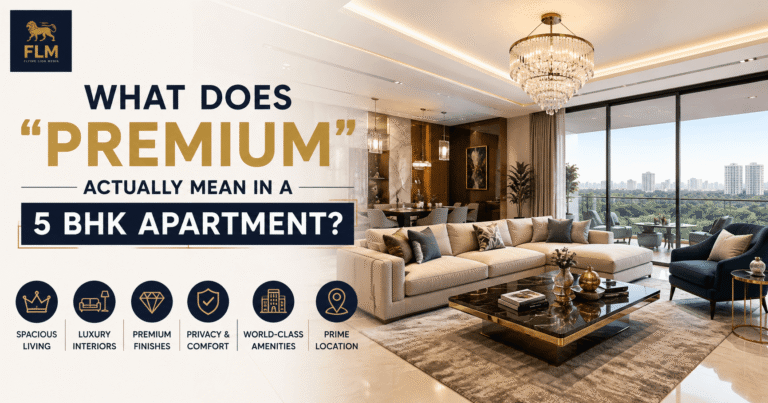
What Does “Premium” Actually Mean in a 5 BHK Apartment?
The word premium is often used too casually in real estate.
A higher price does not automatically mean higher quality.
An apartment becomes genuinely premium when several elements work together:
- Excellent location
- Thoughtful architecture
- Efficient layout
- Genuine spaciousness
- Privacy
- Natural daylight
- Ventilation
- High-quality materials
- Superior finishes
- Strong craftsmanship
- Useful amenities
- Reliable security
- Good accessibility
- Convenient parking
- Strong maintenance standards
- Long-term livability
- Reasonable resale potential
The important point is integration.
A home with expensive Italian flooring but poor ventilation is not necessarily premium.
A home with five bedrooms but narrow passages and badly positioned doors is not necessarily premium.
A property with a spectacular clubhouse but weak construction quality is not premium.
A ₹5 crore apartment that forces you to compromise on privacy every day may be a worse purchase than a ₹3.5 crore apartment with better architecture and functionality.
That is why buyers should evaluate what they are actually receiving for the premium.
1. Location Is the First Layer of Luxury
Before discussing interiors, examine the location.
This is particularly important in Ahmedabad, where different residential pockets can offer very different combinations of connectivity, neighborhood quality, infrastructure and future development.
A premium apartment should ideally provide convenient access to the places that matter to your household:
- Workplace
- Schools
- Hospitals
- Shopping
- Restaurants
- Airport
- Major roads
- Public transport
- Business districts
- Social and recreational destinations
But accessibility alone is not enough.
The neighborhood matters too.
A luxury tower surrounded by poor access roads, traffic bottlenecks, construction activity or incompatible land use may lose some of its practical value.
This is why I would never evaluate a premium apartment only from inside the sales office.
Visit the surrounding area at:
- Morning peak hours
- Evening peak hours
- Weekends
- Late evening
You may discover something the brochure does not show.
What to check
Ask:
“If I lived here for ten years, what would become better, worse or remain unchanged?”
Look at:
- Road width
- Traffic patterns
- Nearby development
- Open land
- Commercial activity
- Drainage
- Street lighting
- Access roads
- Noise
- Future construction
- Neighborhood quality
A premium address should support long-term convenience, not just current prestige.
2. Spaciousness Is More Than Carpet Area
One of the biggest mistakes in luxury-home buying is assuming that a larger number automatically means a better home.
It doesn’t.
Two 5 BHK apartments can have similar headline areas but feel completely different.
Why?
Because proportion and layout determine how the space is experienced.
A genuinely premium apartment should have:
- Generous living areas
- Comfortable bedrooms
- Proper dining space
- Useful circulation
- Adequate storage
- Functional bathrooms
- Well-sized balconies
- Practical utility areas
- Minimal wasted passage space
Ask for the exact area breakup
Do not stop at:
“This apartment is 4,000 sq. ft.”
Ask:
- What is the carpet area?
- What is the built-up area?
- What is the super built-up area?
- What is included in the quoted price?
- Which areas are common?
- Are balconies included?
- Are terraces included?
- Is parking separately charged?
The difference can be substantial.
For a premium purchase, usable space matters more than impressive numbers.
3. Architecture Should Improve Daily Living
Premium architecture isn’t about making a building look dramatic from the outside.
Its real purpose is to make the interior work better.
Look at the apartment’s:
- Orientation
- Proportion
- Room placement
- Window positioning
- Ceiling heights
- Circulation
- Privacy zones
- Service areas
- Balcony design
- Natural light
- Ventilation
A well-designed 5 BHK should ideally separate different activities.
For example:
Public zone
- Entrance
- Formal living
- Dining
- Guest seating
Private zone
- Family lounge
- Bedrooms
- Master suite
Service zone
- Kitchen
- Utility
- Staff/service access
This separation improves privacy and functionality.
Imagine having guests in the living room while a family member is working, another is sleeping and someone else is using the kitchen.
Good architecture allows these activities to coexist without the entire home feeling connected to one noisy central space.
That is a premium feature.
4. Privacy Is One of the Most Undervalued Luxury Features
Buyers often focus heavily on views and finishes when comparing 5 BHK apartments for sale in Ahmedabad, but I would put privacy much higher on the list.
A truly premium 5 BHK should answer:
-
Can neighbors see directly into bedrooms?
-
Does the main door open toward another apartment’s entrance?
-
Can visitors reach private areas without crossing family spaces?
-
Are bedrooms sufficiently separated?
-
Does the lift lobby create unnecessary exposure?
-
Can household staff move through the home without disrupting family areas?
Privacy becomes especially important in a five-bedroom home because the household may include:
-
Parents
-
Children
-
Guests
-
Elderly family members
-
Domestic staff
-
Frequent visitors
A Useful Test
During your site visit, stand at the apartment entrance and imagine:
“Ten guests have arrived. Where do they go?”
Then imagine:
“One family member wants to sleep while everyone else is entertaining.”
If the layout handles both situations comfortably, that is a sign of thoughtful design. For buyers comparing 5 BHK apartments for sale in Ahmedabad, this simple privacy test can reveal whether the property is genuinely designed for comfortable family living or simply offers a large bedroom count on paper.
5. The Master Suite Should Feel Like a Separate Experience
In a premium 5 BHK, the master bedroom should not simply be the largest bedroom.
It should function as a private retreat.
Look for:
- Proper bedroom proportions
- Natural daylight
- Good ventilation
- Comfortable bed placement
- Dressing area
- Walk-in wardrobe where appropriate
- Spacious bathroom
- Privacy from living areas
- Quality bathroom finishes
- Useful storage
The master bathroom deserves particular attention.
Check:
- Ventilation
- Natural light
- Water pressure
- Drainage
- Fixture quality
- Shower area
- Storage
- Waterproofing
- Accessibility
A beautiful bathroom that develops leakage problems later is not luxury.
Reliability is part of premium quality.
6. Materials and Finishes Must Be Evaluated Beyond Appearance
Luxury brochures often highlight:
- Marble
- Wood
- Stone
- Glass
- Metal
- Imported fittings
But the material name alone doesn’t tell you whether the product is good.
You need to examine:
- Grade
- Thickness
- Installation quality
- Warranty
- Maintenance requirements
- Replacement availability
- Durability
For example, expensive-looking flooring can still be poorly installed.
Cabinetry can appear sophisticated while using mediocre hardware.
Bathroom fittings can carry a premium brand name but still be inappropriate for the property’s water conditions.
This is where craftsmanship becomes important.
Look closely at:
- Tile alignment
- Joint consistency
- Door finishing
- Cabinet edges
- Hardware
- Stone seams
- Window installation
- Paint quality
- False-ceiling detailing
The small details often reveal more than the entrance lobby.
7. Natural Daylight and Ventilation Are Real Luxury
This is one of the areas where buyers should be less impressed by decoration.
Natural daylight costs nothing to use, yet it dramatically affects the experience of a home.
Check:
- Which rooms receive morning light?
- Which rooms receive afternoon light?
- Are bedrooms naturally lit?
- Does the kitchen have ventilation?
- Are bathrooms ventilated?
- Does the living area receive enough daylight?
- Are balconies actually usable?
Then check ventilation.
Open windows where possible.
Notice:
- Air movement
- Heat
- Humidity
- Odor
- Noise
A premium apartment should not depend entirely on artificial lighting and air-conditioning to feel comfortable.
Daylight, ventilation and orientation are part of the architecture.
Read More:- Where Can I Buy a Premium 5 BHK in Ahmedabad?
8. Views Are Valuable — But Don't Pay Blindly for Them
A panoramic view can significantly improve a home’s ambience.
But ask one uncomfortable question:
Will the view still exist five years from now?
If your apartment overlooks:
- Vacant land
- Low-rise buildings
- A road
- A proposed development area
- Another tower under construction
you need to investigate what can legally be developed there.
Do not rely solely on statements such as:
“Nothing will come up here.”
Ask for evidence.
Check relevant planning and development information where available.
The Ahmedabad Municipal Corporation publishes development-permission and building-regulation information, and its building approval documentation highlights the importance of development permission and applicable regulations.
A view is premium only when its underlying assumption is reasonably defensible.
9. Technology Should Solve Problems, Not Impress Buyers
Smart-home technology sounds impressive.
But not every automated feature adds meaningful value.
Look for technology that improves:
- Security
- Energy efficiency
- Convenience
- Access control
- Lighting
- Climate management
- Monitoring
Useful systems may include:
- Video door phones
- Smart access
- Security cameras
- Automated lighting
- Home-control systems
- Energy monitoring
- Digital locks
But ask:
“What happens when the technology stops working?”
Can the system be repaired locally?
Is the equipment proprietary?
Are replacement parts available?
Does the apartment remain fully functional without the automation?
Technology should improve reliability and convenience, not create another maintenance headache.
10. Amenities Should Match Your Lifestyle
A premium project may advertise:
- Clubhouse
- Swimming pool
- Gym
- Lounge
- Gardens
- Children’s areas
- Sports facilities
- Party spaces
- Wellness facilities
But amenities should be judged by actual usefulness.
If your family rarely uses the clubhouse, paying a substantial premium for an enormous amenity package may not make financial sense.
Ask:
- Who will use these facilities?
- How frequently?
- What are the maintenance charges?
- Are facilities operational?
- Are they shared with too many residents?
- Are they genuinely exclusive?
A smaller, well-maintained amenity package can be more valuable than an enormous brochure list.
11. Parking Is a Premium Feature When It Is Actually Convenient
For a five-bedroom household, parking requirements can be significant.
Don’t simply ask:
“How many parking spaces are included?”
Inspect them.
Check:
- Size
- Width
- Column positioning
- Turning radius
- Access
- Distance from lift
- Visitor parking
- EV charging availability
- Security
- Ease of entry and exit
Try parking an actual vehicle there.
A theoretically allocated parking space that is difficult to use every day isn’t premium.
12. Security and Accessibility Matter More as the Home Gets Larger
A premium residential environment should provide sensible security without making daily life inconvenient.
Check:
- Entry control
- Visitor management
- CCTV coverage
- Lift access
- Fire safety systems
- Emergency exits
- Security staffing
- Service access
- Delivery management
Also think about elderly family members.
Ask:
- Is the lift easily accessible?
- Are there unnecessary steps?
- Are corridors safe?
- Is emergency access practical?
- Is the apartment future-friendly?
A luxury home should remain comfortable as the household changes.
13. Sustainability Is Becoming Part of Premium Living
Premium does not have to mean wasteful.
Look for features that improve long-term efficiency:
- Natural ventilation
- Daylight
- Energy-efficient lighting
- Water-saving fixtures
- Rainwater management
- Landscaping
- Waste management
- Solar integration where applicable
- Efficient building systems
These features can improve both environmental performance and operating costs.
The important question is not:
“Does the brochure say sustainable?”
Instead ask:
“What measurable feature actually reduces resource consumption or improves efficiency?”
That is the difference between sustainability as marketing language and sustainability as functionality.
14. Maintenance Can Destroy the Meaning of “Premium”
This is an issue buyers often underestimate.
A luxury apartment can become expensive to own if maintenance is poorly controlled.
Before buying, ask for:
- Maintenance estimate
- Common-area charges
- Clubhouse charges
- Parking-related charges
- Utility costs
- Major equipment maintenance
- Sinking/reserve fund information where applicable
Then ask:
“What will this apartment cost me every month after possession?”
Do not calculate affordability using only EMI.
Your real housing cost can include:
EMI + maintenance + property tax + utilities + insurance + parking/amenity costs + interior upkeep
A home that stretches your finances too far is not financially premium.
15. Builder Reputation Matters More Than the Lobby
A sophisticated entrance cannot compensate for poor execution.
Research:
- Previous projects
- Delivery history
- Construction quality
- Complaint patterns
- Possession experience
- Maintenance after handover
- Documentation
- Financial credibility
- Reputation among existing residents
Speak to owners in completed projects.
Ask them questions the sales team cannot answer:
“Did the builder deliver what was promised?”
“How were the finishing issues handled?”
“What happened after possession?”
“How is maintenance?”
“Would you buy from the same developer again?”
Those conversations can be more useful than another showroom presentation.
Step-by-Step Buyer Action Plan
Step 1: Location Selection
Start with the neighborhood, not the apartment.
What to do
Shortlist three locations before comparing projects.
Why it matters
You can change interiors.
You cannot easily change the location.
Mistake to avoid
Choosing a property because the apartment is spectacular while ignoring a poor commute or weak neighborhood.
Pro tip
Drive the route to your workplace during peak traffic before paying a booking amount.
Step 2: Budget and Price Validation
Calculate your total acquisition cost, not just the advertised price.
Consider:
- Base price
- Floor premium
- Location premium
- Parking
- Club charges
- Amenities
- Registration
- Stamp duty
- Taxes where applicable
- Interior costs
- Maintenance deposits
- Other documented charges
Then compare the effective price per usable area across competing properties.
The key question
“What am I paying extra for?”
If Property A costs ₹50 lakh more than Property B, identify exactly what creates that difference.
Is it:
- Better location?
- Better view?
- Larger usable area?
- Better architecture?
- Better construction?
- Better privacy?
- Better amenities?
- Better developer?
- Better resale prospects?
If you cannot explain the premium, don’t automatically pay it.
Step 3: Builder and RERA Verification
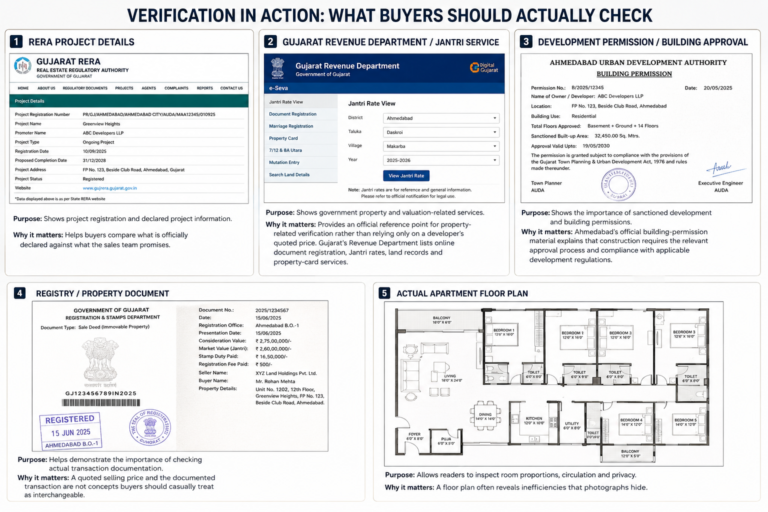
For an under-construction project, verify the project through the relevant regulatory records rather than relying solely on the sales team.
Check:
- Project registration
- Promoter details
- Declared completion timeline
- Approved information
- Project status
- Relevant disclosures
For Gujarat buyers, the state regulatory framework and government property/document services should be part of the verification process.
Also cross-check land and registration-related information through Gujarat government’s Revenue Department services, which include document registration, Jantri rates, land records and property-card services.
Mistake to avoid
Never assume:
“The project is by a famous developer, so everything must be fine.”
Reputation reduces risk.
It does not eliminate the need for verification.
Step 4: Site Visit Checklist
Do not conduct one ten-minute showroom visit.
Visit at different times.
Check:
- Noise
- Daylight
- Ventilation
- Views
- Traffic
- Parking
- Construction quality
- Lift waiting time
- Water pressure
- Mobile connectivity
- Surrounding development
- Privacy
If possible, speak with residents of an already occupied building by the same developer.
Pro tip
Take photographs and notes during every visit.
Otherwise, after seeing five properties, every apartment starts blending together.
Step 5: Legal and Registry Checks
Before making a significant financial commitment, have the documents independently reviewed by a qualified property lawyer.
Depending on the transaction, checks may include:
- Title
- Ownership
- Encumbrances
- Approvals
- Development permissions
- Building permissions
- Agreement terms
- Carpet-area declaration
- Possession commitments
- Parking rights
- Common-area rights
For Ahmedabad, municipal development-permission documentation and Gujarat government land/document services are useful official reference points.
The mistake to avoid
Do not treat a builder’s legal team as your independent legal advisor.
Their job is to represent the transaction.
Your lawyer’s job is to protect your interests.
Step 6: Negotiation Strategy
Do not negotiate emotionally.
Negotiate based on evidence.
Instead of saying:
“Can you give me a discount?”
ask:
“What is the all-inclusive price?”
Then compare it with alternatives.
Negotiate:
- Base price
- Floor premium
- Parking
- Club charges
- Payment schedule
- Waivers
- Interior packages
- Other documented charges
One important rule
Never let a “today only” discount force you into a multi-crore decision.
A genuine premium property should survive a 48-hour verification process.
If the deal disappears because you asked for time to check documents, that itself is useful information.
What Makes a 5 BHK Feel Premium in Everyday Life?
Here is the practical test I would use.
Feature | Premium experience | Warning sign |
Layout | Natural movement between spaces | Long wasted corridors |
Bedrooms | Private and well-proportioned | Small rooms added to reach “5 BHK” |
Living room | Spacious and flexible | Large on paper, awkward in reality |
Kitchen | Functional and ventilated | Decorative but impractical |
Bathrooms | Good ventilation and fittings | Dark or poorly ventilated |
Balcony | Usable outdoor space | Narrow decorative balcony |
Windows | Good daylight and views | Small openings |
Privacy | Separate public/private zones | Bedrooms exposed to guests |
Parking | Easy access | Tight or awkward spaces |
Amenities | Useful and well maintained | Large brochure list |
Technology | Practical and reliable | Complicated proprietary systems |
Materials | Durable and well installed | Expensive-looking but poor workmanship |
Maintenance | Predictable | High and unclear |
Location | Convenient and established | Dependent on speculative promises |
Two Realistic Buyer Case Studies
Case Study 1: The Family Buyer
Situation
A family was considering a 5 BHK apartment priced at approximately ₹3.4 crore.
They initially preferred the more expensive property because it had:
- Larger clubhouse
- Grand entrance
- Higher-floor apartment
- Attractive views
An alternative property was available at around ₹3.05 crore.
The second property had:
- Slightly less impressive common areas
- Better internal layout
- Better bedroom proportions
- More practical parking
- Stronger privacy between guest and family areas
Decision
The family chose the ₹3.05 crore property after comparing the actual usable space and total ownership cost.
Lesson
They did not save money by buying the cheaper apartment.
They made a better decision by understanding what the additional ₹35 lakh was actually buying.
That is the right way to evaluate premium housing.
Case Study 2: The Investor
Suppose an investor buys a premium 5 BHK for approximately ₹3 crore.
After interiors and transaction-related expenses, the total investment could approach ₹3.3 crore, depending on the project and transaction structure.
If the property generates approximately ₹1 lakh per month in rent:
Annual gross rent = ₹12 lakh
Gross rental yield on ₹3.3 crore:
₹12 lakh ÷ ₹3.3 crore ≈ 3.6%
That may sound reasonable, but it is not exceptional for the risk involved.
Then consider:
- Vacancy
- Maintenance
- Property tax
- Repairs
- Brokerage
- Interior depreciation
- Resale liquidity
The investor therefore should not buy solely because:
“Luxury property always appreciates.”
It doesn’t.
A premium property needs sufficient demand from future buyers or tenants.
What worked
- Strong location
- Limited competing inventory
- Good developer
- Large usable layout
- Strong end-user demand
What didn’t work
If the investor had chosen the property solely because it was the most expensive apartment in the area, resale could become difficult.
Luxury does not automatically equal liquidity.
Realistic Buyer Testimonials
Rahul Mehta — IT Professional
“I initially focused on the highest floor and the view. After comparing layouts, I realised privacy and usable space mattered more for my family. We chose the apartment that worked better day to day.”
Amit Patel — PSU Employee
“The builder was offering a discount if we booked immediately. We didn’t. We checked the documents and compared the final cost with two other projects. The pressure disappeared once we had the numbers.”
Nisha Shah — NRI Buyer
“Because I was buying remotely, I was more concerned about documentation and resale than the interiors. I hired an independent lawyer and asked someone locally to inspect the property several times.”
Verified Data and Market Context
Premium housing has become an important part of India’s residential market. ANAROCK’s H1 2025 homebuyer survey reported stronger preference for premium and luxury housing, while larger homes continued to attract buyers in major cities including Ahmedabad.
ANAROCK’s Ahmedabad residential market research has also classified Ahmedabad’s residential segments into affordable, mid-end, high-end, luxury and ultra-luxury categories, with luxury defined in that report as approximately ₹1.5 crore–₹2.5 crore and ultra-luxury above ₹2.5 crore. These are market-report classifications, not universal definitions of what constitutes a premium home.
That distinction is important.
A ₹2.5 crore apartment is not automatically premium simply because it crosses a particular price threshold.
Likewise, a ₹1.8 crore apartment can potentially offer a better premium living experience than a ₹3 crore apartment if its location, architecture, privacy, quality and functionality are superior.
Interest rates also influence affordability. The RBI’s published data in late July 2026 showed a policy repo rate of 5.25%. Homebuyers should therefore assess their financing costs based on the actual loan offer available to them rather than assuming that today’s borrowing conditions will remain unchanged throughout a long ownership period.
The broader lesson is simple:
Premium housing is market-dependent, and affordability is personal.
Proofs and Screenshot
If I Were Buying This Property Today
If I were buying a 5 BHK apartment today, I would not start with the brochure, clubhouse or sample apartment.
I would start with three things:
1. Location
I would choose the location where I could comfortably see my family living for at least the next 7–10 years.
2. Layout
I would prioritize:
- Privacy
- Natural light
- Ventilation
- Bedroom proportions
- Living-room functionality
- Kitchen usability
- Storage
- Parking
I would happily sacrifice some flashy amenities for a better floor plan.
3. Price
I would calculate the all-in acquisition cost and compare it against at least two or three competing properties.
I would want a clear answer to:
“Why is this apartment worth this much more than the next-best alternative?”
If nobody can answer that convincingly, I would negotiate harder—or walk away.
What would I negotiate hardest?
I would focus on the total acquisition cost, not just the headline discount.
I would negotiate:
- Base price
- Floor premium
- Parking
- Additional charges
- Payment schedule
- Other documented costs
A ₹10 lakh discount sounds attractive.
But if another property is fundamentally better priced by ₹20–30 lakh after all costs, the discount means very little.
The red flag I would not ignore
Unexplained price premium.
If a property is substantially more expensive because the salesperson says:
“This is premium.”
I would ask:
“Show me exactly what makes it premium.”
If the answer consists mostly of branding, lobby design and promises about future appreciation, I would be extremely cautious.
Conclusion
A truly premium 5 BHK apartment should make your life easier.
It should give you:
- Spaciousness without wasted space
- Privacy without isolation
- Luxury without unnecessary extravagance
- Elegance without sacrificing functionality
- Better architecture
- Better materials
- Better craftsmanship
- Natural daylight
- Good ventilation
- Useful amenities
- Reliable security
- Convenient parking
- Strong accessibility
- A good neighborhood
- Sustainable and efficient features
- Predictable maintenance
- Long-term livability
Most importantly, it should justify its price.
Do not ask only, “How luxurious does this apartment look?”
Ask:
“What am I getting for the premium I am paying?”
That question can prevent a very expensive mistake.
If you are comparing two 5 BHK apartments, create a simple scorecard covering location, usable space, privacy, architecture, materials, views, amenities, parking, maintenance, builder reputation, legal documentation and total price.
The property that wins on the spreadsheet may not always be the one with the prettiest brochure—but it is far more likely to be the one you will be happy to own years later.